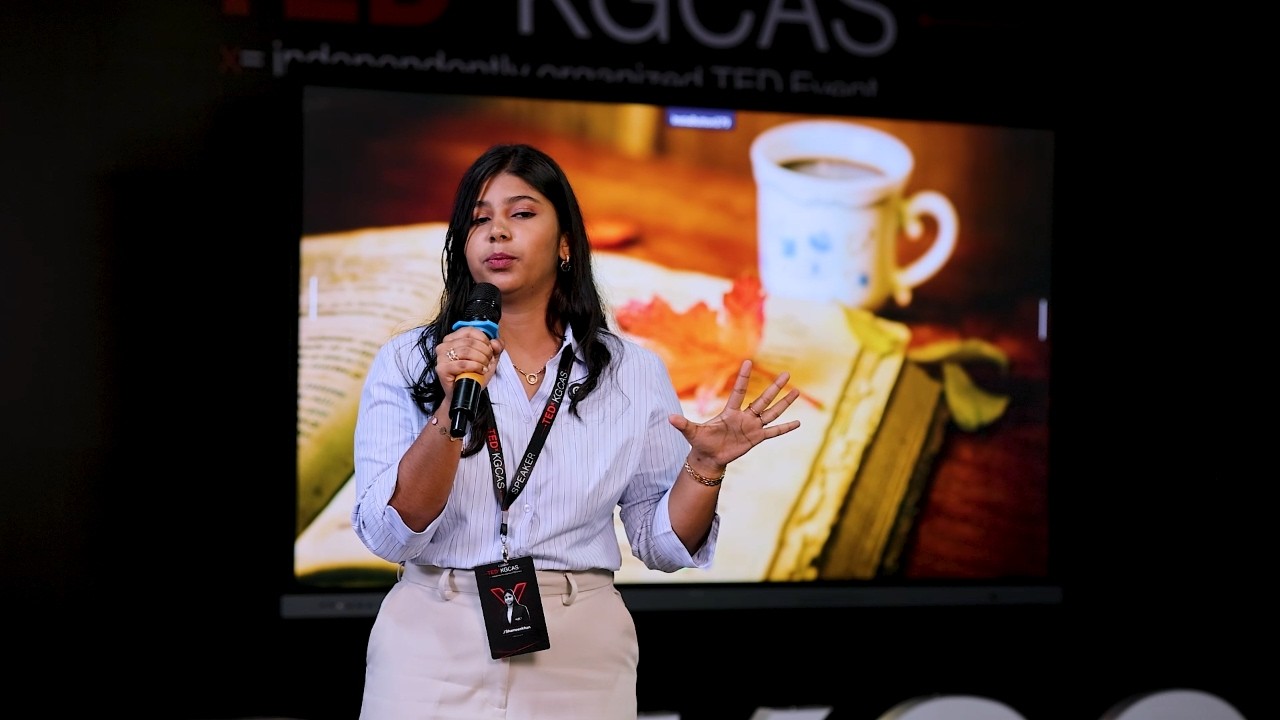
Why I left my book untitled | J Shameenkhan | TEDxKGCAS
Keywords
Summary
153 words
Critical Evaluation
Value of the Information & Strength of the Argument
The talk offers a thoughtful and accessible philosophical perspective on creativity and the value of leaving works open to interpretation. The argument is built on relatable personal anecdotes and references to established concepts like Eco’s ‘open work’ and Calder’s mobiles, which strengthens its persuasive appeal. However, the reasoning is primarily anecdotal and lacks rigorous philosophical or scientific depth. The speaker does not engage with counterarguments or provide empirical evidence, making the argument more inspirational than analytical. The connection between the farewell chart, the untitled book, and scientific progress is compelling but remains at a surface level.
Scientific Rigor, Source Quality, Title Accuracy
The talk references Umberto Eco’s ‘open work’ and Alexander Calder’s mobiles, but provides no specific citations or sources. The only link in the description is to the general TEDx page, which does not offer direct references. The title accurately reflects the content, which focuses on the decision to leave a book untitled as a metaphor for openness in creativity. The talk is a personal opinion piece rather than a scientific review, so the lack of rigorous sourcing is expected, but it limits its reliability as a factual reference.
199 words
Title / Content Match
The title accurately reflects the core narrative and central theme of the talk, which revolves around the decision to leave a book untitled as a philosophical choice.
Quality & Reliability
6/10
The talk is a personal reflection and philosophical argument, not a scientific study. It references Umberto Eco's 'open work' and Alexander Calder's mobiles, but provides no citations or sources. The reasoning is coherent and grounded in personal experience, but the lack of verifiable references and the anecdotal nature limit its scientific reliability.
Key Moments
Markers derived by PSI from the transcript: the creator did not define chapters.
- Introduction: the question of what we have truly finished, leading to the farewell chart anecdote.
- The farewell chart plan and its chaotic execution, illustrating the beauty of uncontrolled collaboration.
- Introduction of Umberto Eco's 'open work' concept and Alexander Calder's mobiles as examples.
- Personal story of writing a poetry book and the decision to leave it untitled, with a QR code for reader input.
- Discussion on the difference between naming and understanding, referencing Newton and Einstein.
- Conclusion: creativity as leaving space for others, and the idea that meaningful things are never truly finished.
Cited Sources
- TEDx Program — General TEDx page mentioned in the video description, providing context for the talk format.
Concurring Sources
- Umberto Eco's 'The Open Work' — The concept of open work is central to the talk, and this source provides a detailed explanation.
- Alexander Calder's mobiles — Calder's mobiles are cited as an example of open art, and this source offers background on his work.
Contribution & Novelties
The talk offers a personal and accessible perspective on the concept of the ‘open work’, applying it to modern contexts like reader participation via QR codes. It connects philosophical ideas to everyday experiences, making them relatable. However, the core concepts are not new; they are drawn from Eco and Calder. The speaker’s unique contribution is the application to his own creative process and the emphasis on collaboration and openness in creativity.
Pour aller plus loin :
- Umberto Eco’s ‘The Open Work’ — The foundational text on the concept of open works, directly relevant to the talk’s central idea.
- Alexander Calder — Overview of the artist and his mobiles, which serve as a key example in the talk.
- Reader-response criticism — A literary theory that emphasizes the reader’s role in creating meaning, aligning with the talk’s argument about untitled books.
139 words
Radar Profile
The radar profile shows moderate scores across all dimensions, with a slightly higher emphasis on information quality and reliability, reflecting the talk's philosophical nature. The low technical level indicates that the content is accessible to a general audience, while the moderate quantity of information suggests a focused but not exhaustive exploration of the topic.