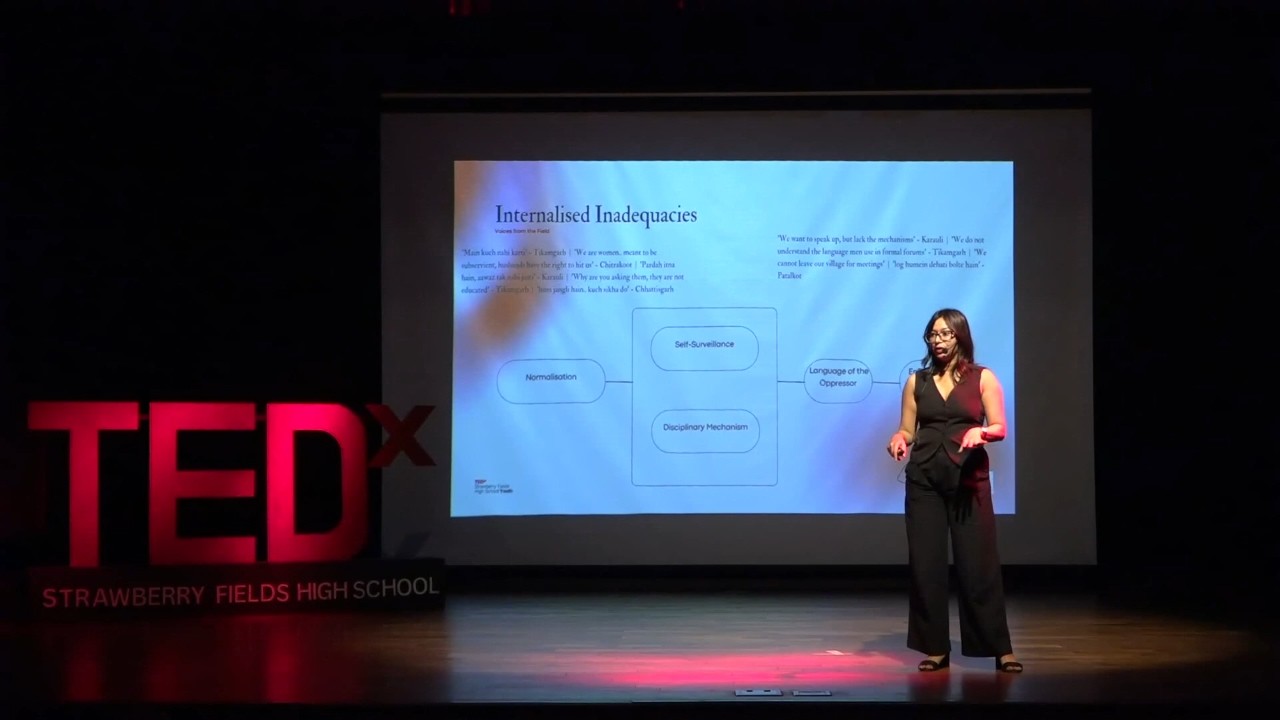
Shaping Dominant Narratives | Prarthana Lumba | TEDxStrawberry Fields High School
Keywords
Summary
148 words
Critical Evaluation
Value of the Information & Strength of the Argument
The talk provides valuable insights into the mechanisms of narrative control and silencing, supported by concrete field examples that illustrate theoretical concepts. The argumentation is coherent, moving from theory (Spivak, Panopticon) to practice (field anecdotes) and then to a proposed methodology (FPAR). The speaker’s personal experience adds authenticity, though the argument could be strengthened by more systematic evidence or references to broader research.
Scientific Rigor, Source Quality, Title Accuracy
The talk references Gayatri Spivak’s ‘Can the Subaltern Speak?’ and the Panopticon concept, but does not provide specific citations or URLs. The description includes only a link to TEDx general page. The title accurately reflects the content, and the talk is well-structured. No comments were provided for analysis.
126 words
Title / Content Match
The title accurately reflects the content, which focuses on how dominant narratives are shaped and whose voices are marginalized.
Quality & Reliability
7/10
The talk is grounded in established postcolonial theory (Spivak) and the speaker's own field research, but it is an opinion/expert talk without peer-reviewed citations or systematic methodology presentation.
Key Moments
Markers derived by PSI from the transcript: the creator did not define chapters.
- Introduction to themes: gender binaries, power dynamics, singular reality.
- Example of research grant on climate change and reproductive health in Chhindwara.
- Introduction of epistemic violence and Spivak's 'Can the Subaltern Speak?'.
- Explanation of the Panopticon metaphor and internalized surveillance.
- Field anecdote: woman in Tikamgarh devalues her work as 'time pass'.
- Field anecdote: women excluded from water governance meetings in Pimpri Gawda.
- Field anecdote: woman in Chhattisgarh hesitant to attend Gram Sabha due to male dominance.
- Discussion of positionality and the importance of reflexivity in research.
- Introduction of Feminist Participatory Action Research (FPAR) and call for bottom-up knowledge production.
Cited Sources
- TEDx Talks — General TEDx page, mentioned in description.
Concurring Sources
- TEDx Talks — General TEDx page, mentioned in description.
Contribution & Novelties
The talk offers a personal, field-based perspective on how epistemic violence operates in rural India, making theoretical concepts tangible. It emphasizes the need for participatory research methods and positionality, which is a valuable contribution to discussions on decolonizing knowledge production.
Pour aller plus loin :
- Gayatri Spivak - Can the Subaltern Speak? — Foundational essay on epistemic violence.
- Panopticon - Wikipedia — Michel Foucault’s concept of surveillance and self-discipline.
- Feminist Participatory Action Research — Overview of participatory research approaches.
79 words
Radar Profile
The radar profile shows high scores in information quantity and quality, moderate technical level, and high reliability, reflecting a well-argued expert talk with practical examples but limited technical depth.