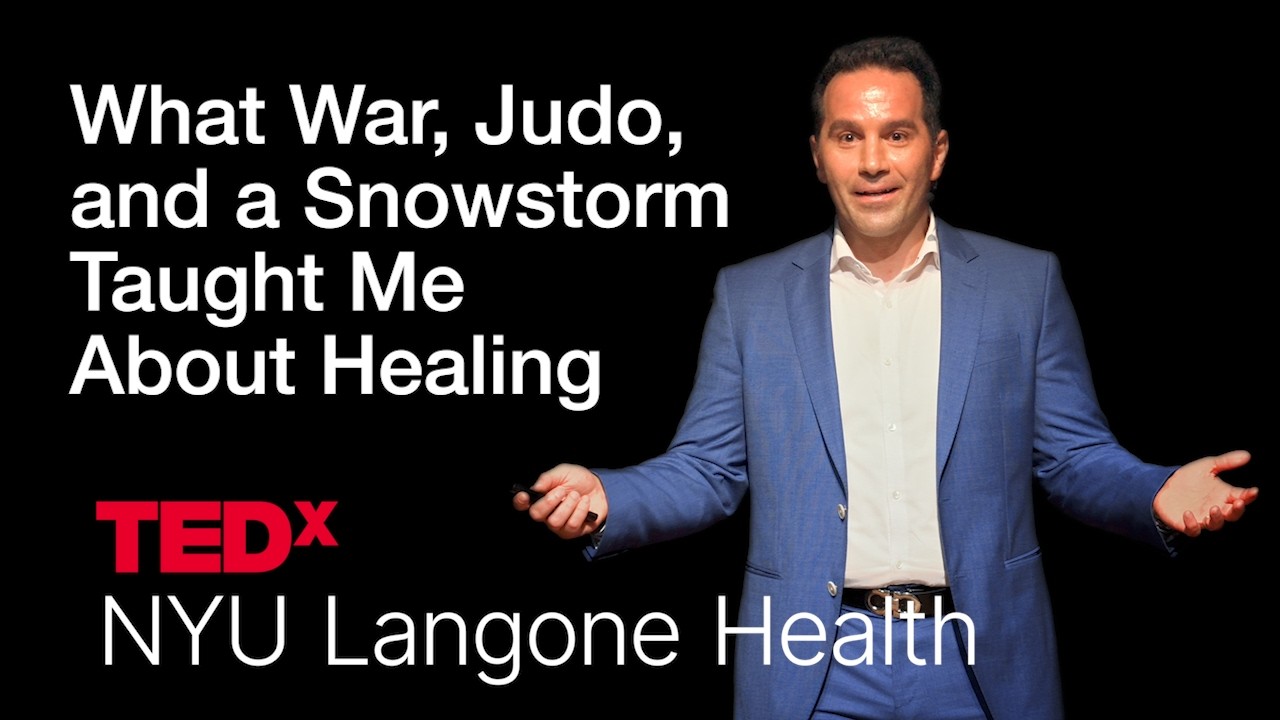
Beirut to Brooklyn: From war to healing | Oscar Lahoud, MD | TEDxNYU Langone Health
Keywords
Summary
206 words
Critical Evaluation
Dr. Lahoud’s talk is a compelling personal narrative that weaves together themes of resilience, leadership, and the serendipitous nature of career paths. As a physician and CMO, his credibility is high, and his anecdotes from clinical practice lend authenticity to his message. The talk is not a scientific presentation but rather an inspirational and reflective piece, grounded in his professional experience. He references the ‘planned happenstance learning theory’ and a 2013 Spanish study on piano learning and cognitive improvements, but he does not provide specific citations or details, which limits the verifiability of these claims. The judo principles (sutemi, kumikata, kuzushi) are used as metaphors for leadership and resilience, which is effective but not scientifically rigorous. The case of the leukemia patient is powerful and illustrates the importance of healthcare access, but it is presented as an anecdote rather than a systematic study. The talk’s strength lies in its emotional resonance and practical wisdom, but it lacks the depth of a scientific review or data-driven analysis. The adéquation between title and content is strong, as the title encapsulates the personal journey and the healing theme. Overall, the talk offers valuable insights into leadership and personal growth, but it should be viewed as an expert opinion rather than evidence-based medicine. The speaker’s background and role lend weight to his perspectives, but the lack of detailed sources and the reliance on personal stories limit its scientific rigor. Nonetheless, the message is uplifting and thought-provoking, encouraging viewers to embrace unexpected opportunities and turn adversity into strength.
253 words
Title / Content Match
The title accurately reflects the speaker's journey from Beirut to Brooklyn and the theme of healing, both personal and professional.
Quality & Reliability
7/10
The talk is a personal narrative by a medical professional, grounded in his experience as a physician and CMO. It references a specific study on piano learning and cognitive functions, but lacks detailed citations. The content is credible but primarily anecdotal.
Key Moments
Markers derived by PSI from the transcript: the creator did not define chapters.
- Introduction: Dr. Lahoud introduces himself and the theme of unexpected opportunities.
- Story of his name 'Oscar' and his family's escape from Beirut.
- Reflection on his mother's scar and the value of opportunities.
- His path to medicine and specialization in hematology.
- Initiative to bring stem cell access to regional patients.
- Case of the young Hispanic woman with leukemia.
- Introduction of judo principles: sutemi, kumikata, kuzushi.
- Piano learning and cognitive benefits, referencing a 2013 study.
- Snowstorm hitchhiking story and concluding message.
Cited Sources
- TEDx Talks — The talk was given at a TEDx event, and this link provides general information about TEDx.
Concurring Sources
- Planned Happenstance Learning Theory — The theory is mentioned in the talk and supports the idea that unexpected events can shape careers.
- Music training and cognitive abilities — This study aligns with the speaker's reference to a 2013 study on piano learning and cognitive improvements.
Dissenting Sources
- No discordant sources found — The talk does not present controversial claims that contradict established scientific consensus.
Contribution & Novelties
The talk offers a unique perspective on how personal experiences, including war, judo, and music, can shape a physician’s approach to leadership and patient care. It emphasizes the importance of bringing specialized medical expertise to underserved communities, illustrated by a concrete initiative. The integration of judo principles into medical leadership is a novel framework.
Pour aller plus loin :
- Planned Happenstance Learning Theory — This theory, developed by John Krumboltz, is directly referenced in the talk and provides a framework for career development.
- Cognitive benefits of music training — This article discusses the effects of music training on cognitive functions, supporting the speaker’s claim about piano learning.
- Healthcare access and disparities — The World Health Organization’s page on health equity provides context on the importance of equitable access to healthcare, a key theme in the talk.
136 words
Radar Profile
The radar profile shows moderate scores across all dimensions, with slightly higher quality and reliability scores reflecting the speaker's expertise, but lower technical depth due to the anecdotal nature of the talk.