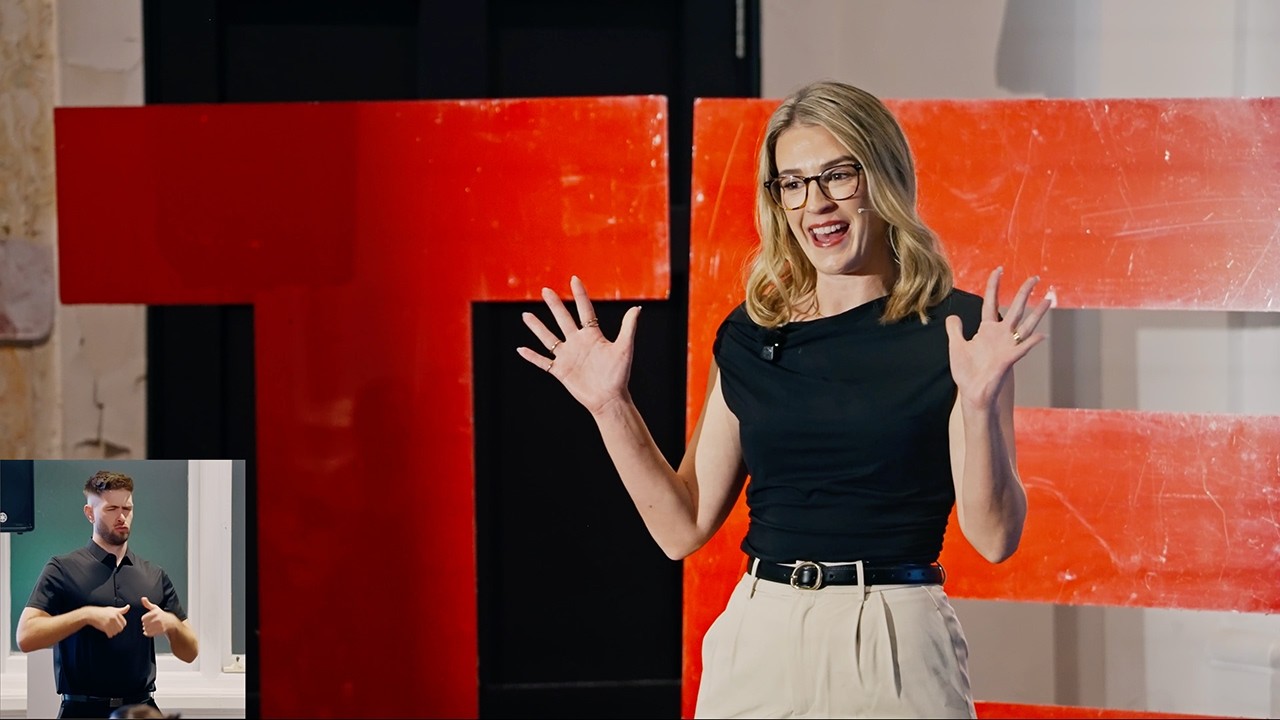
CODA: Between two worlds | Tara Kozuh | TEDxPerth Salon
Keywords
Summary
154 words
Critical Evaluation
The talk is a compelling personal narrative that provides valuable insights into the CODA experience and the importance of sign language. Tara Kozuh’s firsthand account is authentic and emotionally resonant, effectively conveying the challenges and rewards of living between two cultures. The anecdotes about the remote and yelling through walls are memorable and illustrate the visual nature of Auslan in a relatable way. The talk’s strength lies in its personal testimony, which humanizes the issues faced by deaf individuals and their families. However, from a scientific perspective, the talk lacks empirical data and references to research on deafness, language acquisition, or the psychological impacts of being a CODA. The statistics mentioned (90% of deaf adults have hearing children, 90% of deaf children are born to hearing parents) are presented without sources, and while they are commonly cited, their accuracy is not verified. The argument for the social responsibility of learning sign language is persuasive but relies on emotional appeal rather than systematic evidence. The talk does not engage with potential counterarguments, such as the debate over cochlear implants versus sign language, though it briefly acknowledges a place for both. The quality of information is moderate, with a strong emphasis on personal experience over rigorous analysis. The sources cited are limited to the TEDx program, and no academic or institutional references are provided. The talk is well-structured and engaging, with a clear narrative arc from personal struggle to advocacy. The title accurately reflects the content, and the talk successfully raises awareness about the CODA experience and the value of Auslan. Overall, it is a valuable contribution to public discourse on disability and inclusion, but it would benefit from more robust evidence and engagement with broader research.
285 words
Title / Content Match
The title accurately reflects the content, focusing on the CODA experience of navigating two worlds.
Quality & Reliability
7/10
Personal testimony with lived experience, but limited verifiable data and no cited research.
Key Moments
Markers derived by PSI from the transcript: the creator did not define chapters.
- Introduction: Tara introduces herself as a CODA and explains the term.
- Tara describes her family and the minority status of hearing members.
- Anecdote about the remote and the visual nature of Auslan.
- Tara discusses her role as an informal interpreter and the resentment it caused.
- Tara shares her identity struggles and journey of self-discovery.
- The birth of Tiny Hands Signs and its mission.
- Call to action: learning three signs and the importance of Auslan.
Cited Sources
- TEDx Program — Mentioned as the organizing body for the TEDx event.
Concurring Sources
- CODA (Child of Deaf Adults) — Provides background on the CODA experience, aligning with Tara's narrative.
- Auslan (Australian Sign Language) — Confirms the existence and characteristics of Auslan as described.
Contribution & Novelties
The talk provides a personal perspective on the CODA experience, highlighting the dual identity and the importance of sign language for family communication. It introduces the concept of Tiny Hands Signs, a business that promotes Auslan in early childhood education. The talk emphasizes the social responsibility of hearing individuals to learn sign language, shifting the burden from deaf individuals to society.
Pour aller plus loin :
- CODA (Child of Deaf Adults) — Overview of the CODA identity and experiences.
- Auslan (Australian Sign Language) — Information on the language and its usage.
- Deaf culture — Exploration of the cultural aspects of the Deaf community.
103 words
Radar Profile
The radar profile shows moderate scores across all dimensions, with a slight peak in quality of information due to the authentic personal testimony. The low technical level reflects the accessible nature of the talk, while the moderate quantity of information and reliability are consistent with a personal narrative lacking external references.