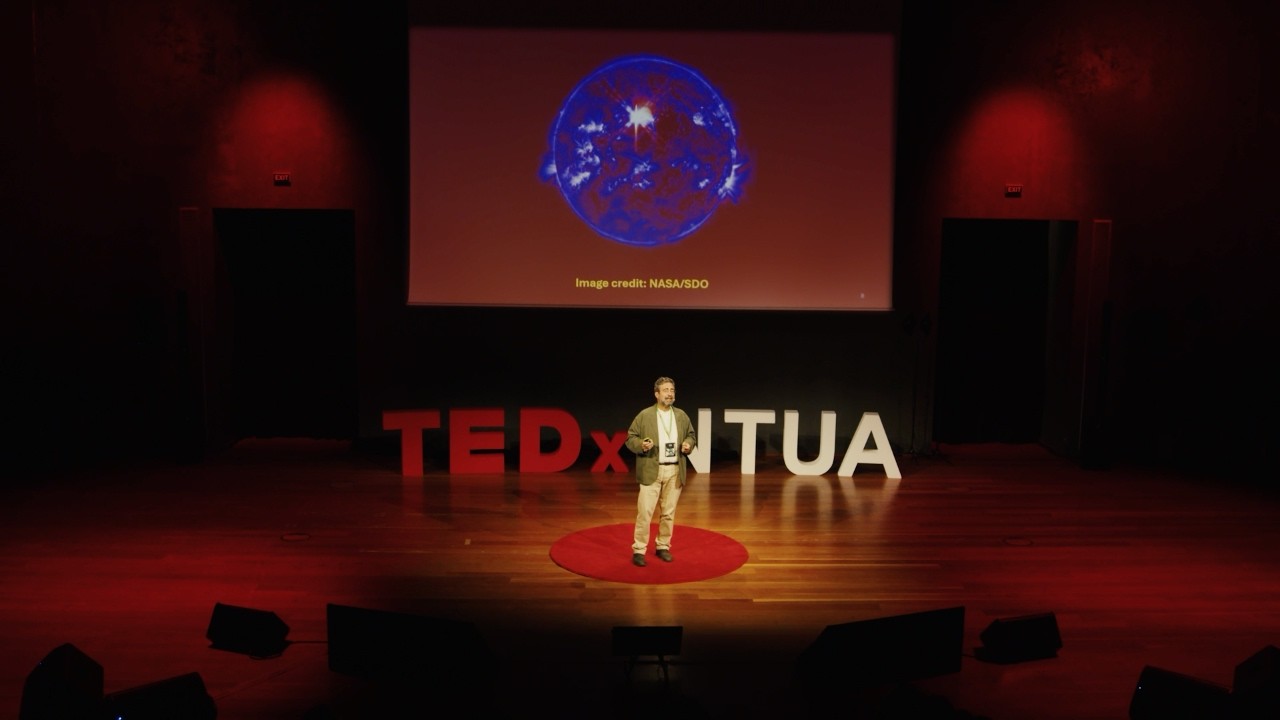
The cycles of our Sun | Yannis Daglis | TEDxNTUA
The cycles of our Sun | Yannis Daglis | TEDxNTUA
Keywords
Summary
188 words
Critical Evaluation
Value of the Information & Strength of the Argument
The talk provides a clear and engaging explanation of solar physics, connecting complex concepts to everyday life. The argumentation is logical, starting from the Sun’s role as a life-giver and moving to its hidden magnetic activity and potential threats. The speaker effectively uses analogies (e.g., the sea becoming rough) and visual aids to make the content accessible. The value lies in raising awareness about space weather and its societal implications, though the depth is limited by the format.
Scientific Rigor, Source Quality, Title Accuracy
The scientific content is accurate and aligns with current understanding of solar physics. The speaker’s credentials lend credibility, but no specific sources are cited in the talk. The title accurately reflects the content, focusing on the Sun’s cycles. The description mentions the speaker’s expertise and affiliations, which supports reliability. No comments were provided for analysis.
148 words
Title / Content Match
The title accurately reflects the content, which focuses on the Sun's 11-year magnetic cycle and its effects on Earth.
Quality & Reliability
8/10
The speaker is a professor of space physics with extensive expertise, and the content is consistent with established solar physics. The talk is a general overview without citations to specific studies, but the scientific accuracy is high.
Key Moments
Markers derived by PSI from the transcript: the creator did not define chapters.
- Introduction: life linked to stellar sacrifice, heavy elements from dead stars.
- The Sun as life-giver: fusion of hydrogen into helium, light for photosynthesis.
- Introduction of the invisible Sun: magnetic field and 11-year cycle.
- Sunspots: formation, size, and relation to solar activity.
- Solar flares: mechanism of X-ray and UV emission.
- Coronal mass ejections: plasma clouds, travel time to Earth.
- Earth's magnetic protection and geomagnetic storms.
- Auroras: cause and beauty, visible at high latitudes.
- Negative impacts: induced currents, power grid damage, 1989 Quebec blackout.
- Conclusion: understanding the Sun's cycle to protect civilization.
Cited Sources
- TEDx Talks — The talk was given at a TEDx event, and the description links to the TEDx program.
Concurring Sources
- Solar cycle — The talk's description of the 11-year cycle aligns with established knowledge.
- Coronal mass ejection — The talk's explanation of CMEs matches scientific understanding.
Contribution & Novelties
The talk offers a compelling synthesis of solar physics, emphasizing the dual nature of the Sun as both life-giver and potential threat. It highlights the importance of space weather monitoring for modern society. The speaker’s personal expertise adds authority, but the content is largely a review of established knowledge.
Pour aller plus loin :
- Solar cycle — Overview of the 11-year cycle and its historical observations.
- Coronal mass ejection — Detailed explanation of CMEs and their effects.
- Geomagnetic storm — Description of storms and their impact on technology.
- Aurora — Physical mechanism and visibility.
- Space weather — Broader context of solar activity effects on Earth.
105 words
Radar Profile
The radar profile shows high scores in information quality and reliability, with moderate scores in quantity and technical level. This indicates a well-communicated, scientifically accurate talk that is accessible to a general audience, though not extremely detailed.