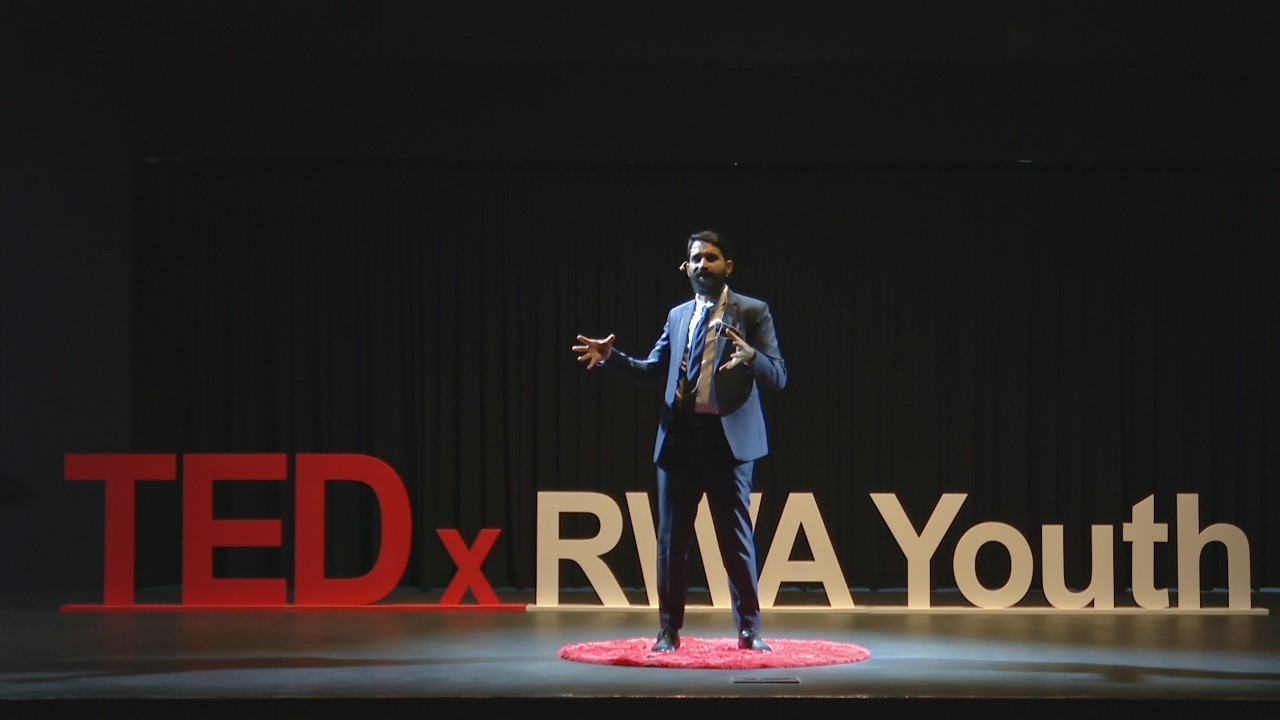
Gravity: A perspective on love and connection | Atish Andrade | TEDxRWA Youth
Keywords
Summary
142 words
Critical Evaluation
Value of the Information & Strength of the Argument
The talk’s value lies in its accessible and engaging narrative, using a fable to explain complex evolutionary concepts. However, the scientific argumentation is weak: it relies on oversimplified and partly inaccurate claims about neurotransmitters (e.g., oxytocin as a ’lynch pin’, dopamine as ‘motivation’). The causal link between social media use and neurotransmitter release is presented without nuance or evidence. The proposed solution (breathing and self-affirmation) is presented as a definitive cure without any scientific backing. The argumentation is more inspirational than scientific, lacking rigor and depth.
Scientific Rigor, Source Quality, Title Accuracy
The talk provides no citations or references to scientific literature. The only source mentioned is the TEDx program itself. The speaker’s authority is based on his personal and professional background, not on scientific expertise in neuroscience. The title ‘Gravity’ is a poetic metaphor that is not scientifically explored. The content is largely anecdotal and lacks the rigor expected of a scientific presentation. The talk’s adequacy to the title is partial, as it focuses more on love and connection than on gravity as a physical force.
186 words
Title / Content Match
The title 'Gravity' is a poetic metaphor for love's pull, which is central to the talk, but the content is more about love and neuroscience than gravity itself.
Quality & Reliability
4/10
The talk presents a highly metaphorical and anecdotal narrative, with limited scientific depth. Neurotransmitters (oxytocin, dopamine, serotonin) are mentioned but oversimplified, and the evolutionary story is presented as a fable. No empirical data or citations are provided, and the proposed self-love exercise lacks scientific validation. The speaker's background is in applied geology and education, not neuroscience, which further limits the scientific authority.
Key Moments
Markers derived by PSI from the transcript: the creator did not define chapters.
- Introduction: The talk begins with a quote about love and fortune, setting the theme.
- Story of Gregory and Mara: A metaphorical tale of two single-celled organisms forming a symbiotic relationship, representing the first 'love story'.
- Evolution to Homo sapiens: The story transitions to human evolution, emphasizing the role of love and cooperation.
- Neurochemistry of love: The speaker explains the roles of oxytocin, dopamine, and serotonin in the experience of love.
- Critique of digital distractions: The talk highlights how short reels and social media hijack reward systems, harming attention and connection.
- Proposed solution: The speaker introduces a self-love exercise involving breathing and affirmations.
- Guided exercise: The audience is led through the breathing and affirmation practice.
- Conclusion: The speaker summarizes the message about managing chemical reactions for happiness.
Cited Sources
- TEDx Program — The talk was given at a TEDx event, and the description links to the general TEDx page.
Concurring Sources
- Oxytocin and social bonding — General scientific consensus that oxytocin is involved in social bonding, supporting the talk's basic premise.
Dissenting Sources
- Dopamine and motivation — The talk simplifies dopamine as a 'motivation' chemical, but its role is more complex, involving reward prediction and learning.
Contribution & Novelties
The talk offers a creative and engaging metaphor for love as a driving evolutionary force, which may resonate with a general audience. However, it does not present novel scientific insights. The proposed self-love exercise is a practical, albeit unvalidated, technique.
Pour aller plus loin :
- Oxytocin — Provides a scientific overview of oxytocin’s role in social bonding.
- Dopamine — Explains dopamine’s functions in reward and motivation.
- Serotonin — Details serotonin’s role in mood and well-being.
- Digital media use and mental health — Discusses research on the effects of digital media on mental health and attention.
95 words
Radar Profile
The radar profile shows low scores across all dimensions, with a slight relative strength in 'fiabilite_globale' compared to 'niveau_technique'. This indicates a talk that is accessible but lacks scientific depth and rigor, consistent with an inspirational rather than educational content.
💬 No comments were provided for analysis.