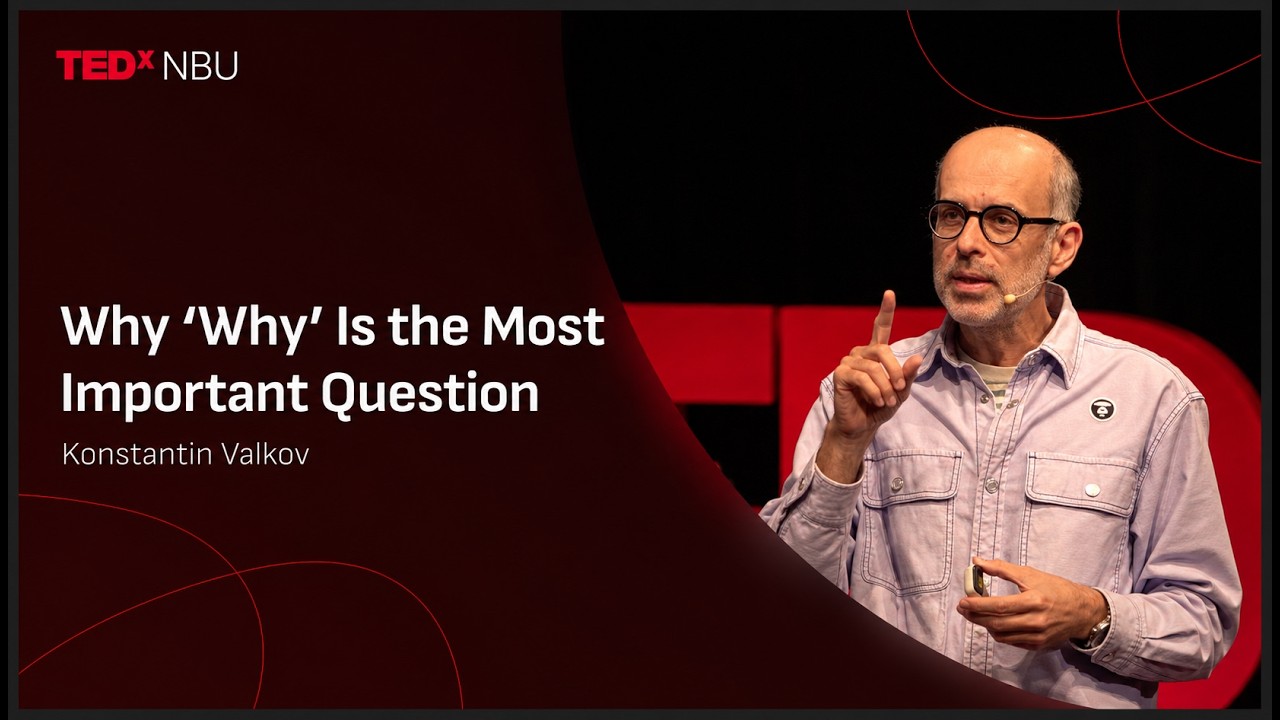
Why ‘Why’ Is the Most Important Question | Konstantin Valkov | TEDxNBU
Keywords
Summary
176 words
Critical Evaluation
Value of the Information & Strength of the Argument
The talk provides a compelling and original perspective on disinformation, focusing on omission rather than outright falsehood. The historical case of the Bosozoku is used effectively to illustrate the argument, showing how a group of traumatized veterans was transformed into a caricature by media narratives. The argumentation is coherent and persuasive, building from the specific example to a broader principle about the importance of asking ‘why’. The speaker’s background as a journalist adds practical credibility. However, the argument could be strengthened by more explicit connections to contemporary examples of disinformation by omission, and by acknowledging potential counterarguments or complexities in the historical narrative.
Scientific Rigor, Source Quality, Title Accuracy
The talk is an expert opinion rather than a rigorously sourced academic presentation. The speaker does not cite specific studies, articles, or books, relying instead on his own knowledge and the historical narrative. The description provides only a link to TEDx generally, not to specific sources. The title accurately reflects the content, and the talk is well-structured. The lack of explicit sources limits the ability to verify the historical claims, though the narrative is plausible and aligns with known historical events. The talk would benefit from referencing academic works on media framing, subculture studies, or the specific history of the Bosozoku.
219 words
Title / Content Match
The title accurately reflects the core message: the importance of asking 'why' to combat disinformation. The content consistently supports this thesis through the Bosozoku example.
Quality & Reliability
7/10
The talk is a well-structured expert opinion that uses a historical case study (the Bosozoku subculture) to illustrate the concept of disinformation by omission. The speaker is a journalist and media expert, lending credibility. However, the talk lacks explicit citations or references to academic sources, and the historical narrative, while plausible, is presented without detailed sourcing.
Key Moments
Markers derived by PSI from the transcript: the creator did not define chapters.
- Introduction: disinformation as omission, not just lies.
- Setting the scene: 1945 Japan, kamikaze pilots returning alive.
- Media portrayal of Bosozoku as 'bandits' and 'terrorists'.
- The real story: kamikaze pilots' trauma and survivor's guilt.
- Evolution into organized gangs, media's role in naming 'Bosozoku'.
- Four steps of erasure: labeling, simplifying, visualizing, burying memory.
- Conclusion: asking 'why' as the antidote to disinformation.
Cited Sources
- TEDx Program — The talk was given at a TEDx event, and this link is provided in the description for general information about the TEDx format.
Concurring Sources
- Bosozoku - Wikipedia — Provides historical context on the Bosozoku subculture, supporting the speaker's narrative.
Dissenting Sources
- No direct discordant sources found — The talk does not cite specific sources, and no contradictory sources were identified in the provided data.
Contribution & Novelties
The talk offers a fresh angle on disinformation by focusing on omission rather than falsehood, using the Bosozoku case as a vivid illustration. It provides a framework (four steps of erasure) that can be applied to other historical or contemporary examples. The emphasis on asking ‘why’ as a critical thinking tool is a practical takeaway for media literacy.
Pour aller plus loin :
- Disinformation — Provides a general overview of disinformation types, including by omission.
- Bosozoku — Detailed background on the subculture, its history, and media portrayal.
- Survivor guilt — Psychological concept relevant to the kamikaze pilots’ experience.
- Media framing — Academic concept explaining how media shapes perception.
108 words
Radar Profile
The radar profile shows moderate scores across the board, with the highest in quality of information and reliability, reflecting the speaker's expertise and coherent argument. The lower score in technical level indicates the talk is accessible to a general audience, focusing on conceptual rather than technical depth.
💬 No comments were provided for analysis.