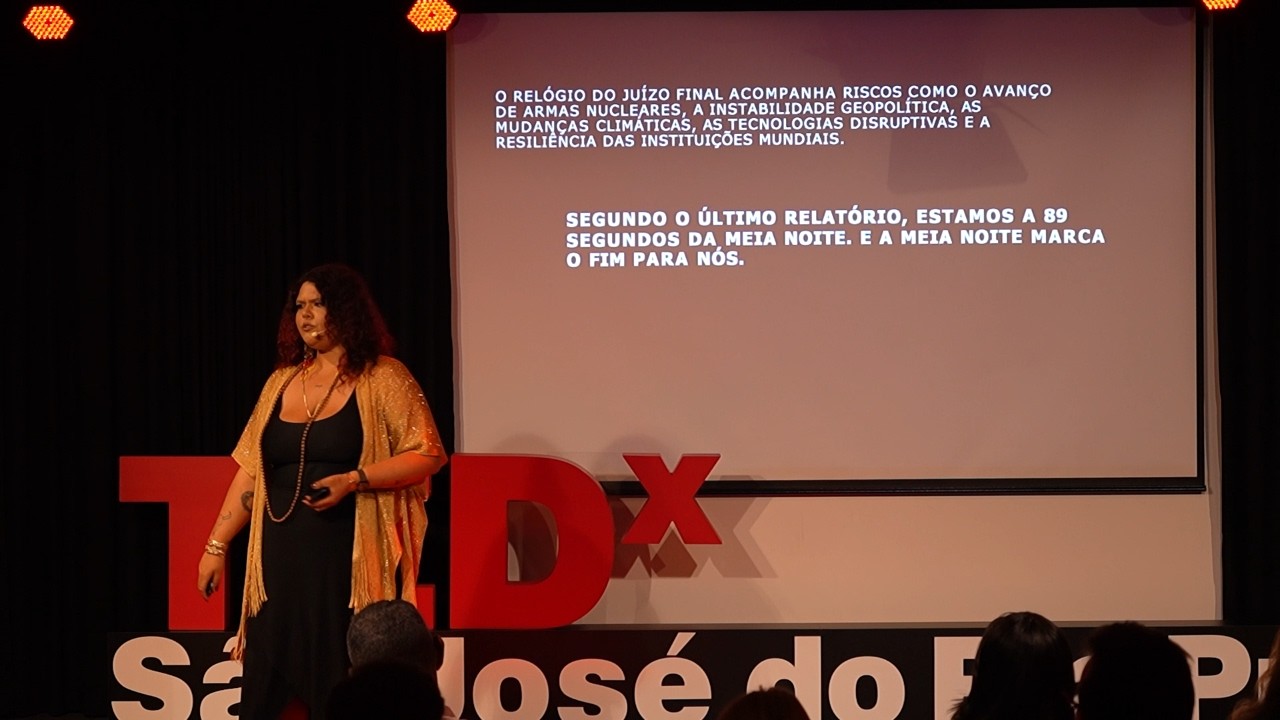
Sonhe, antes que o mundo acabe | Milena Munhoz | TEDxSão José do Rio Preto Women
Keywords
Summary
154 words
Critical Evaluation
Value of the Information & Strength of the Argument
The talk’s value lies in its emotional appeal and its framing of imagination as a necessary precursor to social change. Munhoz effectively uses personal stories to illustrate systemic issues, making abstract concepts like inequality and climate crisis tangible. However, the argumentation is largely anecdotal and lacks rigorous evidence. She mentions the Doomsday Clock and UNHCR data, but does not provide sources or delve into the complexities of these issues. The call to ‘dream collectively’ is inspiring but remains vague, without concrete strategies or policy proposals. The strength of the argument is in its moral clarity, but it falls short of a substantive analysis.
Scientific Rigor, Source Quality, Title Accuracy
The talk is a personal narrative rather than a scientific presentation. Munhoz references the Doomsday Clock and UNHCR statistics, but provides no citations or detailed context. The title accurately reflects the content’s focus on dreaming as a response to global crises. The talk is well-structured and the speaker’s passion is evident, but the lack of verifiable sources and the reliance on emotional storytelling limit its scientific rigor. The description mentions the TEDx format, which is a platform for sharing ideas, not necessarily peer-reviewed research.
202 words
Title / Content Match
The title 'Dream before the world ends' accurately reflects the talk's central theme of using imagination and collective dreaming as a tool for social change, though it is more metaphorical than literal.
Quality & Reliability
5/10
The talk is a personal narrative and advocacy piece, with limited scientific depth. It references the Doomsday Clock and UNHCR data, but lacks detailed citations or rigorous analysis. The speaker's background as a psychologist and activist lends credibility to the experiential aspects, but the scientific claims are presented without supporting evidence.
Key Moments
Markers derived by PSI from the transcript: the creator did not define chapters.
- Introduction: childhood curiosity and observing sugarcane plantations.
- Discovery of indigenous history and the impact of learning.
- Work as a psychologist in the sertão, encountering people's dreams for dignity.
- Reflection on collective future and the Doomsday Clock.
- Statistics on displacement and poverty, and the paradox of decreasing extreme poverty but increasing inequality.
- Anecdote about her sister and the metaphor of losing the way home.
- Critique of consumer dreams and the unsustainability of the current system.
- Call to action: examine personal dreams and their collective impact.
- Conclusion: dreams as seeds and the power of collective dreaming.
Cited Sources
- TEDx Program — Mentioned in the description as the organizing body for the event.
Concurring Sources
- Doomsday Clock — The speaker references the Doomsday Clock's 89 seconds to midnight, which aligns with the current scientific consensus on global risks.
Contribution & Novelties
The talk offers a personal and emotional perspective on the role of imagination in social change, connecting psychological practice with activism. It emphasizes the need to collectively reimagine futures beyond consumerism. While not scientifically novel, it contributes to the discourse on hope and agency in times of crisis.
Pour aller plus loin :
- Doomsday Clock — Background on the symbolic clock and its current setting.
- UNHCR Global Trends Report — Data on forced displacement, relevant to the statistics mentioned.
- World Bank Poverty Data — Information on global poverty and inequality trends.
- Paulo Freire’s Pedagogy of the Oppressed — Concept of critical consciousness, related to the talk’s call for collective awareness.
110 words
Radar Profile
The radar profile shows low scores in technical level and information quantity, reflecting the talk's focus on personal narrative and advocacy rather than in-depth analysis. The moderate scores in information quality and reliability indicate that while the speaker is credible and the message is coherent, the lack of citations and scientific depth limits its overall robustness.