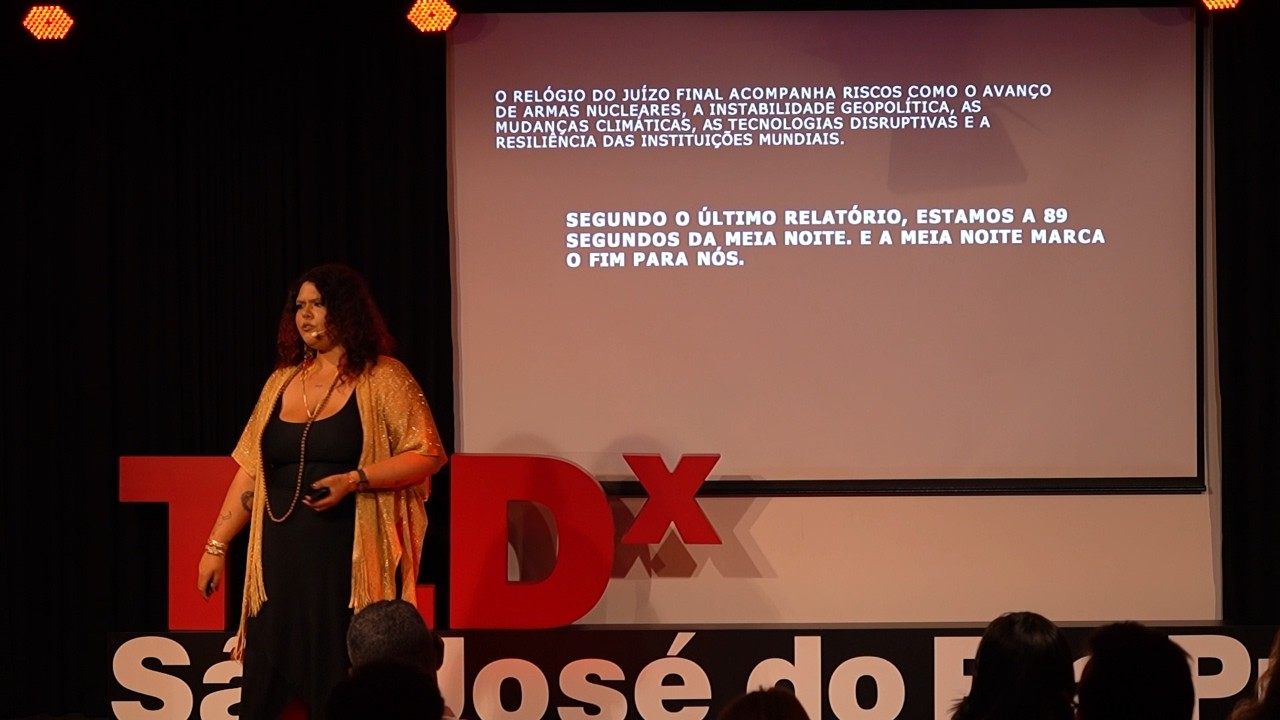
Sonhe, antes que o mundo acabe | Milena Munhoz | TEDxSão José do Rio Preto Women
Keywords
Summary
148 words
Critical Evaluation
Milena Munhoz delivers a passionate and heartfelt talk that effectively combines personal narrative with broader social critique. Her background as a social psychologist lends credibility to her observations about human suffering and resilience. The talk is well-structured, moving from personal anecdotes to global statistics, and finally to a call to action. However, the scientific rigor is limited: while she mentions the Doomsday Clock and UNHCR data, she does not provide detailed sources or engage with the underlying research. The argumentation is more emotional than analytical, which may appeal to a general audience but lacks the depth expected from a scientific presentation. The talk’s strength lies in its ability to humanize complex issues and inspire reflection, but it falls short in offering concrete solutions or evidence-based strategies. The title accurately reflects the content, and the talk successfully conveys the urgency of reimagining our future. Overall, it is a compelling and thought-provoking presentation, though it would benefit from more robust scientific grounding.
160 words
Title / Content Match
The title accurately reflects the talk's central theme of dreaming as a necessary act before the world ends, and the content aligns well with this message.
Quality & Reliability
6/10
The talk is a personal and professional reflection by a psychologist, blending anecdotal evidence with references to the Doomsday Clock and UNHCR data. While the speaker is qualified, the content is largely opinion-based and lacks rigorous scientific citations. The references are accurate but not deeply explored.
Key Moments
Markers derived by PSI from the transcript: the creator did not define chapters.
- Introduction: Milena shares her childhood curiosity and the influence of her elders.
- She describes the landscape of sugarcane plantations and the historical displacement of indigenous peoples.
- She talks about her work as a psychologist in the sertão and the stories of people striving for dignity.
- She introduces the Doomsday Clock and its current setting at 89 seconds to midnight.
- She cites statistics on displacement and poverty, and reflects on inequality.
- She shares a personal story about her sister and the metaphor of finding the way home.
- She critiques consumerist dreams and calls for collective dreaming.
- She invites the audience to examine their own dreams and concludes with a call to action.
Cited Sources
- TEDx Program — Mentioned in the description as the organizing body for TEDx events.
Concurring Sources
- The Doomsday Clock — Supports the claim about the clock's setting.
- UNHCR Global Trends — Provides data on displacement figures.
Contribution & Novelties
The talk offers a unique perspective by linking personal psychological practice with global systemic issues, emphasizing the role of imagination in social change. It bridges individual and collective dreams, proposing that dreaming is a political act.
Pour aller plus loin :
- The Doomsday Clock — Official page of the Bulletin of the Atomic Scientists, providing current time and rationale.
- UNHCR Global Trends Report — Data on forced displacement, relevant to the statistics mentioned.
- World Bank Poverty Data — Information on global poverty statistics.
- Paulo Freire’s Pedagogy of the Oppressed — Concept of critical consciousness, related to the talk’s themes of empowerment and social change.
104 words
Radar Profile
The radar profile shows moderate scores across all dimensions, with slightly higher scores in information quantity and quality, reflecting the talk's balance of personal narrative and factual references. The lower technical level indicates a general audience focus.