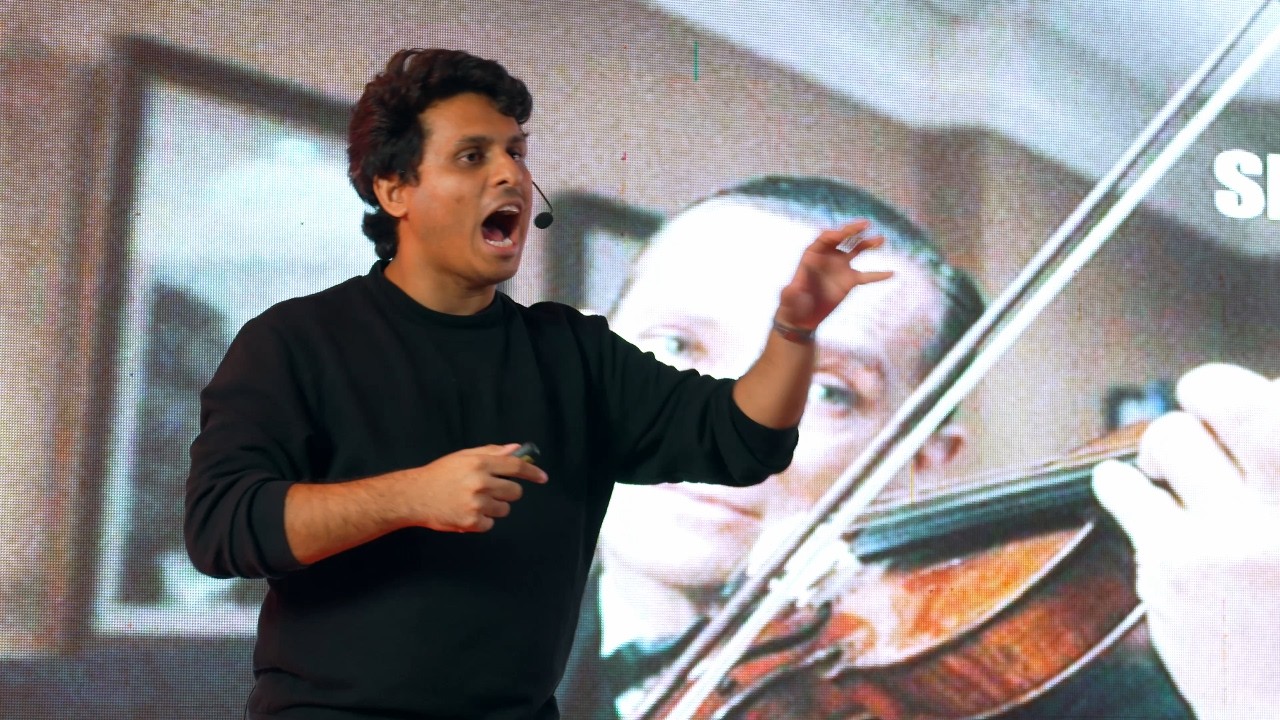
The Stories We Become | Abhilash Sudheesh | TEDxChinmaya Vidyalaya Attukal Youth
Keywords
Summary
204 words
Critical Evaluation
Value of the Information & Strength of the Argument
The talk offers a valuable perspective on identity, moving beyond conventional career-based definitions to a more nuanced understanding based on recurring behavioral patterns. The argument is built through a series of historical and literary examples, which are engaging and relatable. However, the reasoning is largely anecdotal and lacks empirical support. The speaker’s personal journey adds authenticity, but the argument would be stronger with more concrete evidence or psychological research. The progression from personal confusion to a general principle is clear, but the leap from specific examples to a universal claim about identity is not fully justified. The talk is more inspirational than rigorously analytical.
Scientific Rigor, Source Quality, Title Accuracy
The talk does not cite any formal sources or studies; it relies on well-known historical figures and literary characters as illustrative examples. The references to Michelangelo, Gandhi, Leonardo da Vinci, Benjamin Franklin, and Sherlock Holmes are accurate in their general portrayal, but they are used selectively to support the speaker’s thesis. The title ‘The Stories We Become’ is somewhat misleading, as the talk focuses more on patterns of behavior than on narratives or stories. The description mentions the influence of stories on identity, but the talk itself does not delve deeply into that concept. The lack of citations and the subjective nature of the argument limit its scientific rigor.
228 words
Title / Content Match
The title 'The Stories We Become' is somewhat abstract but aligns with the talk's theme of identity formation through narratives, though the talk focuses more on patterns of behavior than on stories per se.
Quality & Reliability
5/10
The talk is a personal reflection and philosophical argument based on anecdotal evidence and historical examples. It lacks empirical data, citations, or scientific rigor, and the reasoning is largely illustrative rather than evidence-based.
Key Moments
Markers derived by PSI from the transcript: the creator did not define chapters.
- Introduction: The speaker's hesitation when asked what he does, and his multiple roles.
- The theory of subtraction: Michelangelo and Gandhi as examples of stripping away to find essence.
- Leonardo da Vinci as a polymath, challenging the subtraction theory.
- Sherlock Holmes as an example of diverse skills serving a single obsession (observation).
- The shift from asking 'what do you do' to 'what pattern repeats' in your life.
- Examples of patterns in ordinary people: accountant as bringing order, homemaker as nurturing.
- Conclusion: Encouragement to discover your pattern and define identity by it.
Cited Sources
- TEDx Program — The talk was given at a TEDx event, and this link provides information about the TEDx format.
Concurring Sources
- Narrative Identity — Supports the idea that identity is constructed through stories and patterns.
Dissenting Sources
- The End of Identity — Some psychological perspectives argue that identity is more fluid and less stable than the talk suggests, emphasizing situational influences over consistent patterns.
Contribution & Novelties
The talk offers a fresh perspective on identity by shifting focus from professional roles to underlying behavioral patterns. It synthesizes examples from history and literature to illustrate this concept, making it accessible and thought-provoking. The idea of ‘patterns’ as the core of identity is not entirely new but is presented in a compelling and personal way.
Pour aller plus loin :
- Ikigai: A Japanese Concept for Finding Purpose — Related concept of finding purpose at the intersection of passion, mission, profession, and vocation.
- Polymath — Historical and contemporary examples of individuals with expertise in multiple fields.
- Narrative Identity — Psychological concept that individuals form identity by integrating life experiences into an internalized, evolving story.
114 words
Radar Profile
The radar profile shows moderate scores across information quantity, quality, and reliability, with a low technical level. This indicates a talk that is engaging and accessible but lacks depth in terms of evidence and technical detail.
💬 Sur les 0 commentaires analysés, aucune tendance n'a pu être dégagée.