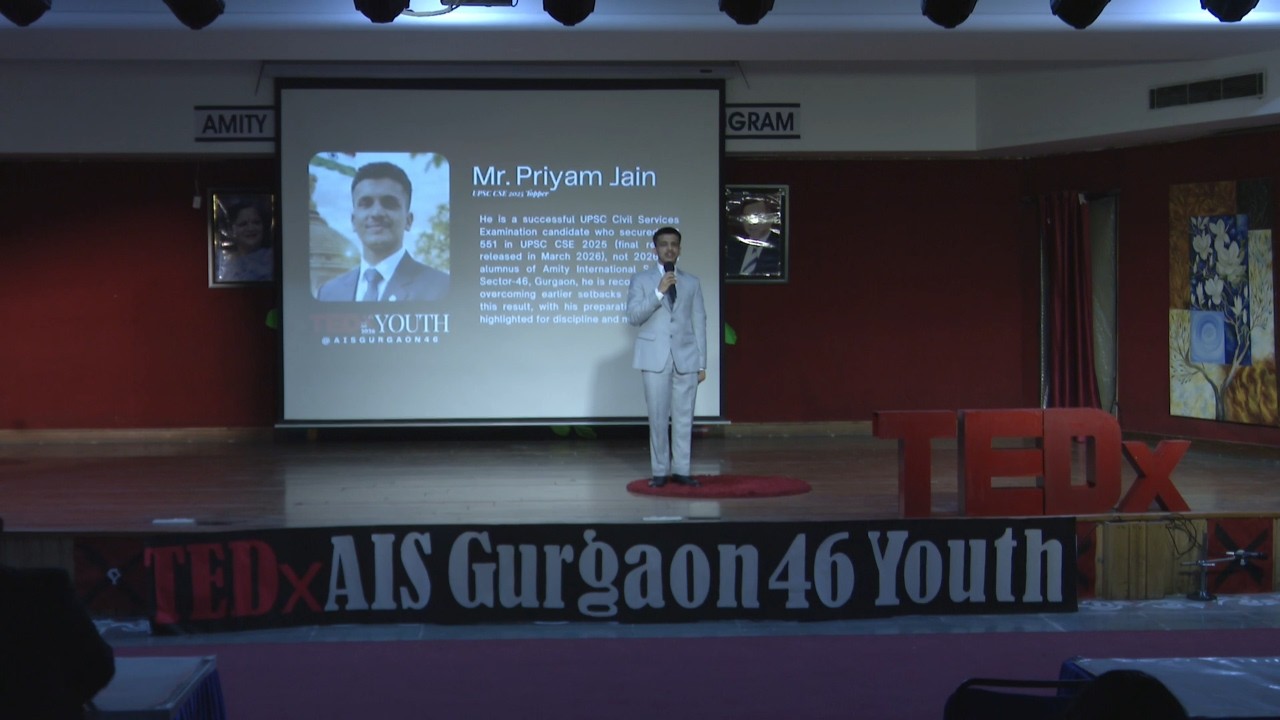
Nurturing Nature | Priyam Jain | TEDxAIS Gurgaon 46 Youth
Keywords
Summary
158 words
Critical Evaluation
Value of the Information & Strength of the Argument
The talk’s value lies in its accessible framing of sustainability as a civic duty and its integration of personal responsibility with broader systemic critiques. The argumentation is primarily persuasive and anecdotal, relying on examples like the COVID-19 lockdown and the Iran-Israel conflict to illustrate points. However, the reasoning is often superficial and lacks empirical support. For instance, the claim that glass paneling is a ‘Britishers concept’ that contributes to heat stress is an oversimplification without architectural or scientific backing. The speaker’s call for a shift in mindset is compelling but the argumentation would benefit from concrete data and case studies to strengthen its credibility.
Scientific Rigor, Source Quality, Title Accuracy
The talk demonstrates low scientific rigor. It references the SDGs and mentions concepts like EPR and fast breeder reactors, but provides no specific sources, data, or citations. The speaker’s authority is based on his civil services exam rank, not on environmental expertise. The title accurately reflects the content, but the content itself is a general advocacy piece rather than a rigorous analysis. The lack of verifiable sources significantly undermines the talk’s scientific credibility.
192 words
Title / Content Match
The title 'Nurturing Nature' accurately reflects the talk's central theme of environmental conservation and sustainability.
Quality & Reliability
4/10
The talk is an opinion-based advocacy piece with anecdotal evidence and general references to SDGs, but lacks rigorous scientific citations or data. The speaker's credentials (UPSC rank) lend some authority, but the content is largely rhetorical and lacks verifiable sources.
Key Moments
Markers derived by PSI from the transcript: the creator did not define chapters.
- Introduction: Importance of nurturing nature for India's Amritkal and Viksit Bharat 2047.
- Reference to SDGs 7, 11, and 13 as directly related to nature conservation.
- Discussion on human responsibility for environmental damage, citing COVID-19 as a period of nature's healing.
- Critique of capitalist and consumer-oriented mindset leading to excessive consumption and waste.
- Example of heat stress in urban areas and the role of glass paneling in increasing heat index.
- Geopolitical example: Iran-Israel war and its impact on oil prices, highlighting dependence on non-renewable energy.
- Introduction of the '5 Rs' principle and the need for extended producer responsibility (EPR).
- Call for integrating sustainability into every profession and action, with a focus on civic sense.
Cited Sources
- TEDx Program — The talk was given at a TEDx event, and the description links to the TEDx program page.
Concurring Sources
- Sustainable Development Goals — The talk references SDGs 7, 11, and 13, which are directly related to energy, cities, and climate action.
Contribution & Novelties
The talk’s original contribution is its framing of environmental conservation as a civic and professional imperative, particularly for the younger generation in India. It connects individual consumer habits to broader systemic issues like geopolitical instability and urban heat islands. However, the ideas presented are not novel and are common in sustainability discourse.
Pour aller plus loin :
- Sustainable Development Goals — Official UN page detailing the 17 SDGs, including goals 7, 11, and 13.
- Extended Producer Responsibility — OECD page explaining EPR as a policy approach.
- Fast Breeder Reactor — Wikipedia article on fast breeder reactors, relevant to the speaker’s mention of nuclear energy.
104 words
Radar Profile
The radar profile shows low scores across all dimensions, indicating a talk that is light on information, technical depth, and reliability. The strongest aspect is the quality of information, which is still only moderate, reflecting the speaker's clear but unsubstantiated arguments.
💬 No comments were provided for analysis.