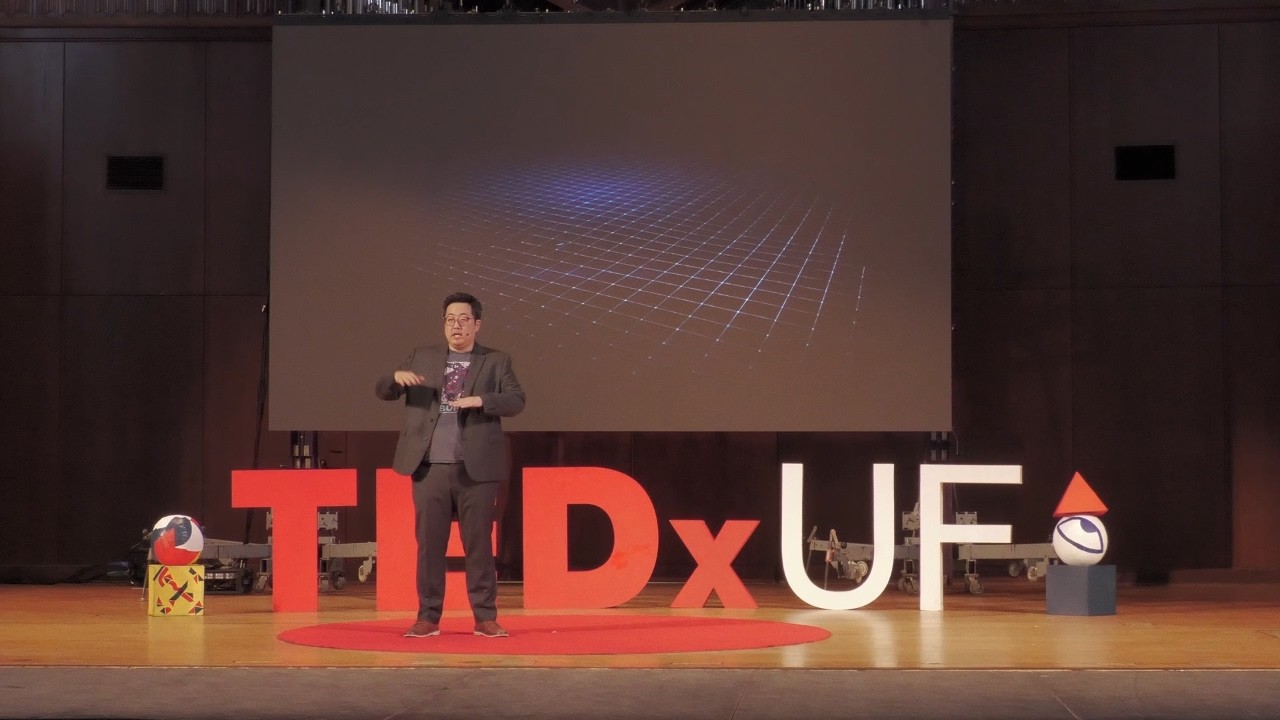
The ultimate dream machine | Philip Chang | TEDxUF
Keywords
Summary
173 words
Critical Evaluation
Value of the Information & Strength of the Argument
The talk provides valuable insights into the collaborative nature of modern particle physics and the scientific rationale for a muon collider. The argumentation is coherent, moving from personal anecdote to the physics of the Higgs field and the need for future colliders. The speaker effectively communicates complex ideas with accessible analogies, such as the ‘floating rock’ to describe the Higgs field’s non-zero value. However, the talk is more inspirational than technical, and some claims (e.g., the muon collider’s capabilities) are presented without detailed evidence or comparison with alternative proposals.
Scientific Rigor, Source Quality, Title Accuracy
The scientific content is generally accurate, reflecting established knowledge about the LHC and the Higgs mechanism. The speaker’s credentials as a CERN collaborator lend credibility. However, the talk does not cite specific sources or provide references for its claims, which limits its scientific rigor. The title is appropriate and engaging, though it does not explicitly mention the muon collider. The description provides a link to TEDx, which is a general resource rather than a direct source for the talk’s content.
184 words
Title / Content Match
The title 'The ultimate dream machine' is evocative and aligns with the talk's focus on the proposed muon collider as a visionary tool for particle physics.
Quality & Reliability
7/10
Talk by a physicist involved in the Higgs boson discovery, presenting established physics (LHC, Higgs mechanism) accurately. However, the talk is a motivational narrative rather than a detailed scientific exposition, and some simplifications (e.g., 'strange floating rock') may obscure nuances.
Key Moments
Markers derived by PSI from the transcript: the creator did not define chapters.
- Introduction: personal photo of Ursa Major and initial questions about the universe.
- Explanation of the Large Hadron Collider (LHC) and proton collisions.
- Discovery of the Higgs boson and its significance for mass.
- Discussion of the Higgs field's non-zero value and the 'floating rock' analogy.
- Introduction of the muon collider as the next step.
- Challenges of building a muon collider and the need for global collaboration.
- Conclusion: call to dream and collaborate for future discoveries.
Cited Sources
- TEDx — General information about TEDx events, mentioned in the video description.
Concurring Sources
- CERN - The Higgs boson — Official CERN page explaining the Higgs boson, consistent with the talk's description.
- Muon Collider Collaboration — Official collaboration site for the muon collider, supporting the talk's proposal.
Contribution & Novelties
The talk offers a personal perspective on the discovery of the Higgs boson and advocates for the muon collider as a future project. It emphasizes the collaborative aspect of modern science, which is often underappreciated. The ‘moonshot’ analogy for the muon collider is a compelling framing.
Pour aller plus loin :
- Muon collider — Overview of the proposed muon collider concept and its potential.
- Higgs boson — Detailed explanation of the Higgs boson and its role in the Standard Model.
- Large Hadron Collider — Information about the LHC and its experiments.
- Breakthrough Prize — Details about the prize awarded to the ATLAS and CMS collaborations.
105 words
Radar Profile
The radar profile shows balanced scores across information quantity, quality, technical level, and reliability, with a slight emphasis on quality and reliability. This reflects a talk that is scientifically sound but not highly technical, and more inspirational than data-driven.
💬 No comments were provided for analysis.