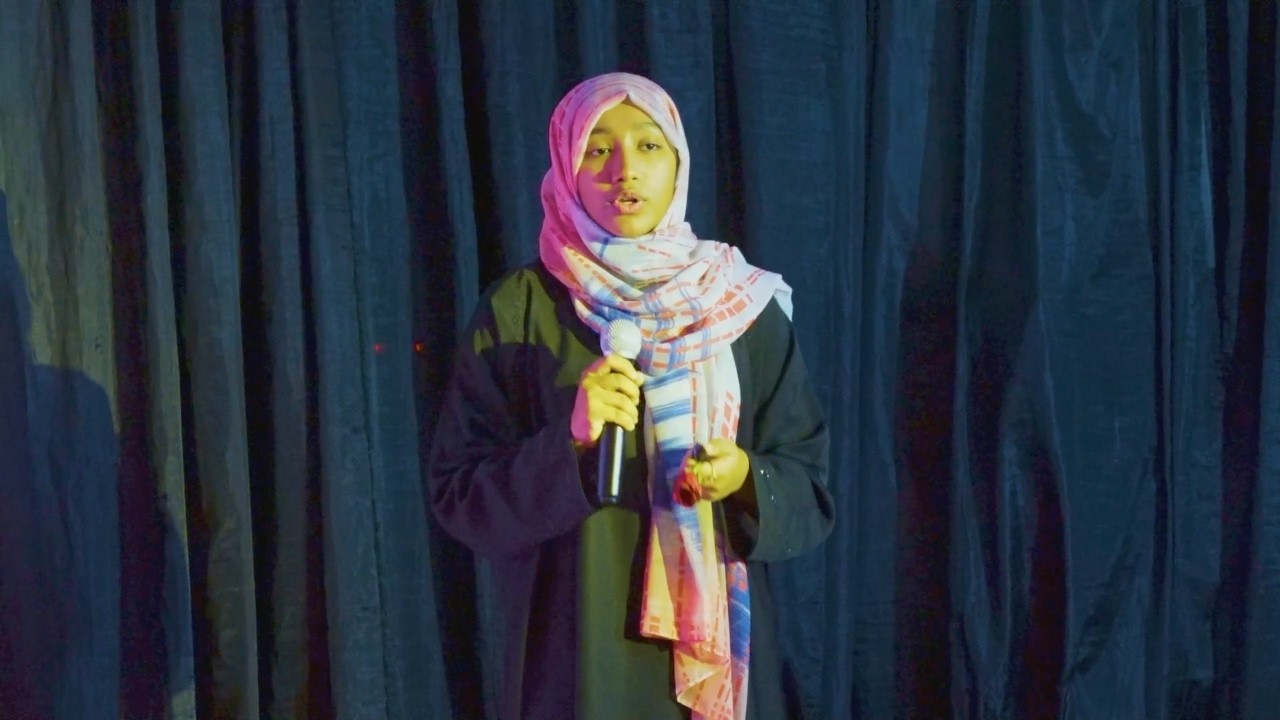
The Culture of Time | Anaya Rashid | TEDxAlmuntazir School Youth
Keywords
Summary
194 words
Critical Evaluation
The talk offers a thoughtful and poetic reflection on the relationship between time and culture. Rashid effectively uses personal anecdotes and cultural examples to illustrate her points, making the content accessible and relatable. The argument that culture gives meaning to time is well-supported by the examples of Eid mornings, weddings, and chai rituals, which resonate with many audiences. The reference to psychology, specifically the idea that memory is an editor that prioritizes emotional events, adds a layer of scientific credibility, though it is not backed by specific studies or citations. The talk is more of a personal essay than a rigorous scientific analysis, but it is coherent and persuasive. The introduction of Urdu terms ‘kashmakash’ and ‘malal’ enriches the discussion, providing nuanced vocabulary for common human experiences. The structure is clear, moving from the metaphor of the rose to cultural examples, psychological insights, and a call to action. However, the talk lacks empirical evidence and does not engage with potential counterarguments or alternative perspectives. The sources cited are minimal, with only a general reference to TEDx. The title accurately reflects the content, and the talk stays on topic throughout. Overall, it is a valuable contribution to discussions on time perception and cultural meaning, but it would benefit from more rigorous sourcing and engagement with academic literature.
216 words
Title / Content Match
The title accurately reflects the content, which explores how culture shapes our experience of time.
Quality & Reliability
6/10
The talk is a personal and cultural reflection on time perception, supported by references to psychology (memory as an editor) and examples from Swahili time and South Asian traditions. It lacks rigorous scientific citations and empirical evidence, but it is coherent and well-structured.
Key Moments
Markers derived by PSI from the transcript: the creator did not define chapters.
- Introduction with the metaphor of the rose in Beauty and the Beast, representing time running out.
- Poses the question: if we could see time slipping away, would we still postpone important things?
- Introduces the idea that culture transforms time into meaning, and that time itself is empty.
- Example of Eid morning: how culture makes an ordinary morning feel special.
- Mentions Swahili time in Tanzania, where 7:00 is called 'samaja', the first hour after sunrise.
- References psychology: memory is an editor, not a recording device; we remember meaning, not time.
- Discusses how culture provides signposts that make moments memorable, and how adulthood feels faster due to fewer memorable moments.
- Explores the significance of chai in South Asian homes as a symbol of connection and shared time.
- Introduces Urdu concepts 'kashmakash' (inner struggle) and 'malal' (gentle regret).
- Concludes that meaningful moments are often disguised as ordinary days, and that scarcity creates significance.
Cited Sources
- TEDx Talks — The talk was given at a TEDx event, and the description links to the TEDx program.
Concurring Sources
- TEDx Talks — The talk is part of the TEDx series, which is known for sharing ideas worth spreading.
Contribution & Novelties
The talk offers a personal and cultural perspective on time perception, emphasizing the role of culture in creating meaning. It introduces the Swahili time system and Urdu concepts like ‘kashmakash’ and ‘malal’ to illustrate cultural variations in experiencing time. The psychological insight that memory is an editor adds a scientific dimension, though it is not deeply explored.
Pour aller plus loin :
- Time perception — Overview of how humans perceive time, including cultural and psychological factors.
- Cultural psychology — Study of how culture influences mental processes and behavior.
- Memory and emotion — Research on how emotional events are better remembered.
100 words
Radar Profile
The radar profile shows moderate scores across all dimensions, with the highest in quality of information and the lowest in technical level. This reflects a talk that is well-articulated and meaningful but lacks deep scientific rigor and technical depth.
💬 No comments were provided for analysis.