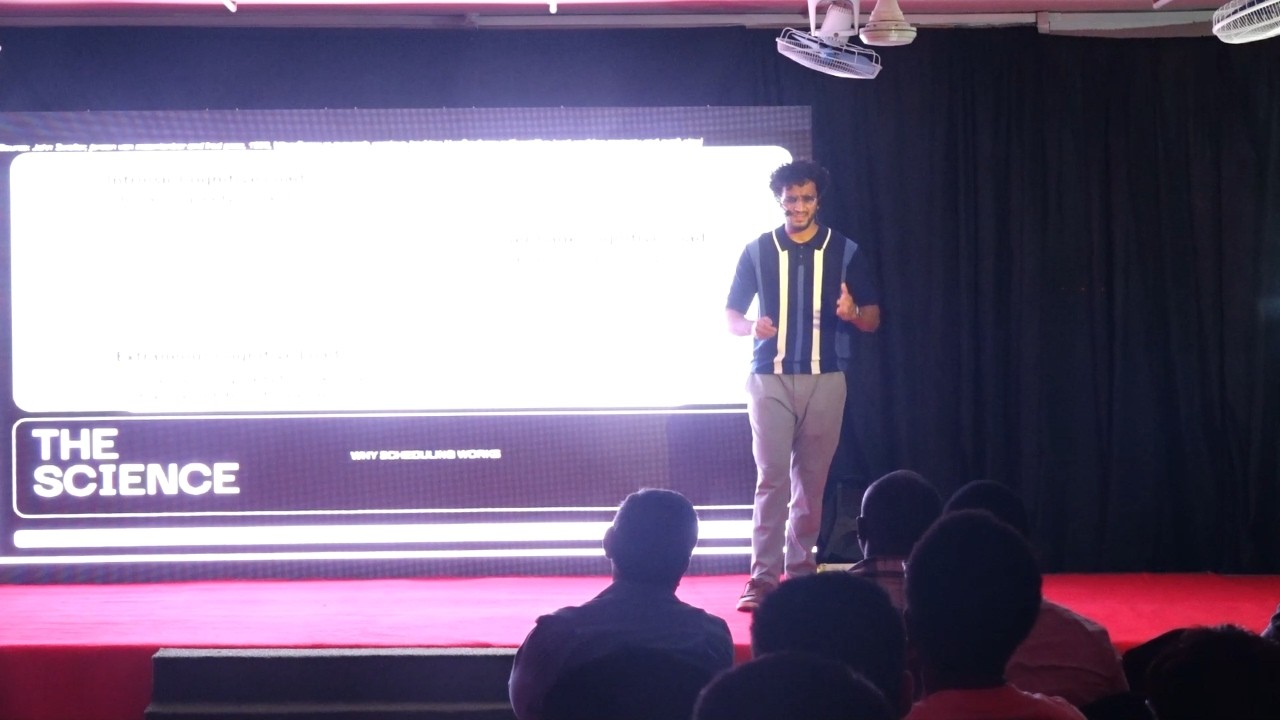
The Art of Scheduling | Yunus Osman | TEDxAlmuntazir School Youth
Keywords
Summary
158 words
Critical Evaluation
The talk offers a compelling personal narrative that resonates with common experiences of feeling overwhelmed and disconnected. The speaker’s anecdote about writing a simple to-do list is relatable and effectively illustrates the power of externalizing tasks. The scientific framework, while simplified, is accurate in its basic description of working memory and cognitive load theory. The distinction between intrinsic, extraneous, and germane load is a well-established concept in educational psychology, and the speaker correctly identifies that reducing extraneous load can enhance learning and focus. However, the talk lacks specific citations or references to studies, which weakens its scientific rigor. The speaker is a medical student, not a psychologist, and his interpretation is based on personal experience and general knowledge. The argumentation is coherent and persuasive, but it relies heavily on anecdotal evidence. The talk also touches on broader themes of intentionality and values, which are more philosophical than scientific. The title accurately reflects the content, and the talk is well-structured, moving from personal story to scientific explanation to practical advice. The speaker’s delivery is engaging and authentic, which enhances the message. Overall, the talk provides valuable insights into time management and personal growth, but it would benefit from more rigorous scientific backing. The absence of a detailed reference list is a notable weakness. The talk does not present original research but rather synthesizes existing concepts in an accessible way. The speaker’s emphasis on aligning schedule with values is a valuable takeaway. The talk is suitable for a general audience and offers practical advice that can be implemented immediately. The scientific explanation, while simplified, is not misleading and provides a useful framework for understanding why scheduling works. The talk’s strength lies in its motivational and practical aspects rather than its scientific depth. The speaker’s personal testimony adds credibility, but the lack of external validation limits its overall reliability. The talk could be improved by citing specific studies on cognitive load and time management. Despite these limitations, the talk is informative and inspiring, and it successfully communicates the importance of intentional time use.
340 words
Title / Content Match
The title accurately reflects the content, which focuses on the art of scheduling as a tool for intentional living.
Quality & Reliability
6/10
The talk is a personal testimony supported by references to cognitive psychology concepts (working memory, cognitive load) but lacks detailed scientific citations. The speaker is a medical student, not an expert in psychology, and the scientific explanations are simplified. The content is coherent and aligns with established theories, but the lack of precise sources reduces its reliability.
Key Moments
Markers derived by PSI from the transcript: the creator did not define chapters.
- Introduction: Speaker introduces himself as a medical student and shares his love for spontaneous activities.
- Speaker describes feeling lost and disconnected from life despite appearing fine.
- The turning point: Writing a simple to-do list and its immediate impact.
- Introduction of cognitive load theory and its three types: intrinsic, extraneous, and germane.
- Explanation of how scheduling reduces extraneous load and creates clarity.
- The four pillars: purpose, people, body, and values; emphasis on scheduling people.
- Conclusion: Borrowed time metaphor and the importance of intentional scheduling.
Cited Sources
- TEDx Program — The talk was given at a TEDx event, and the description links to the TEDx program page.
Concurring Sources
- Cognitive load theory — The talk's explanation of cognitive load aligns with established psychological theories.
- Working memory — The talk's reference to working memory as a 'mental desk' is consistent with scientific understanding.
Contribution & Novelties
The talk provides a personal and accessible perspective on scheduling, linking it to cognitive load theory. It emphasizes the importance of aligning schedules with values and relationships, which is a refreshing take beyond typical productivity advice.
Pour aller plus loin :
- Cognitive load theory — Provides a comprehensive overview of the theory, including its three types and applications in education.
- Working memory — Explains the concept of working memory and its limitations, which is central to the talk’s argument.
- Time management — Offers a broader context on time management techniques and their effectiveness.
93 words
Radar Profile
The radar profile shows moderate scores across all dimensions, indicating a balanced but not exceptional talk. The highest score is in quality of information, reflecting the accurate but simplified scientific content, while the lower scores in quantity and technical level suggest a lack of depth and detail.