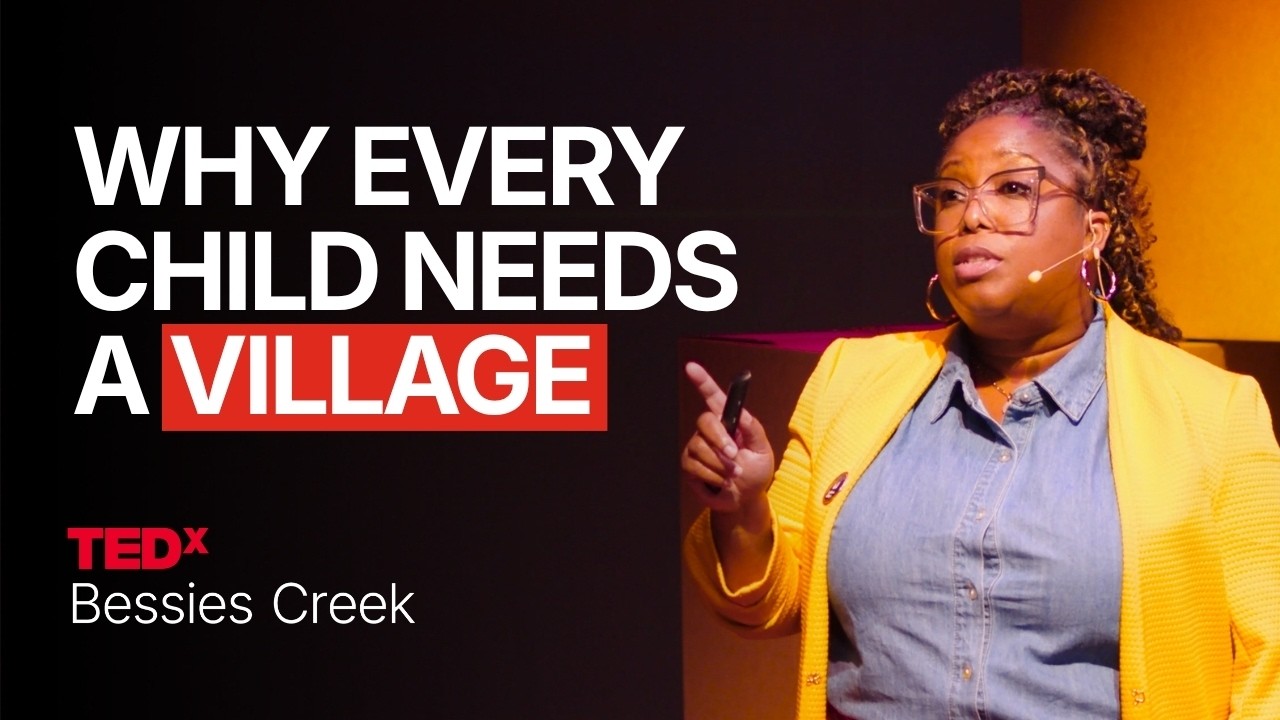
More than resilience: Why every child needs a village | Dr. Christina Pipkin | TEDxBessies Creek
Keywords
Summary
148 words
Critical Evaluation
The talk is a compelling personal narrative that effectively argues for the importance of community support over individual resilience. Dr. Pipkin’s credibility is established through her personal experience and professional background as an educator and school founder. The argument is logically structured: she presents a problem (children with incarcerated parents face significant challenges), illustrates it with a poignant anecdote, and proposes a solution (schools as villages of support). The scientific rigor is moderate; while she references ’educational research’ and ‘statistics,’ she does not provide specific citations or data, which limits the verifiability of her claims. The talk aligns with established concepts in education and psychology, such as trauma-informed teaching and the school-to-prison pipeline, but does not delve into the nuances or potential criticisms of these ideas. The adéquation between title and content is strong, as the talk consistently emphasizes the need for a village. The presentation is engaging and emotionally resonant, which may appeal to a broad audience, but it lacks the depth of a formal academic lecture. Overall, the talk provides valuable insights and a compelling call to action, but its reliance on anecdotal evidence and lack of explicit sources prevent it from being considered a rigorous scientific contribution.
200 words
Title / Content Match
The title accurately reflects the content, emphasizing the importance of community support over individual resilience.
Quality & Reliability
7/10
The talk is based on personal experience and professional expertise, but lacks specific citations or references to research. The arguments are coherent and align with known concepts in education and psychology, but the lack of verifiable sources limits the scientific rigor.
Key Moments
Markers derived by PSI from the transcript: the creator did not define chapters.
- Introduction: Dr. Pipkin shares her father's arrest and her personal background.
- She emphasizes that her success was due to her village, not just resilience.
- She discusses the school-to-prison pipeline and the invisibility of children with incarcerated parents.
- She introduces the story of Johnny and the significance of his hoodie.
- She critiques the celebration of resilience and calls for adults to take responsibility.
- She outlines what a school as a village looks like, including proactive counseling and involving incarcerated parents.
- Conclusion: She urges everyone to become part of a child's village.
Cited Sources
- TEDx Talks — The talk was given at a TEDx event, and the description links to the TEDx program.
Concurring Sources
- TEDx Talks — The talk is part of the TEDx series, which often features personal stories and expert opinions.
Contribution & Novelties
The talk offers a personal and professional perspective on the importance of community support for children with incarcerated parents, challenging the common emphasis on individual resilience. It provides a practical framework for schools to become ‘villages’ of support, including proactive counseling and involving incarcerated parents. The anecdote of Johnny’s hoodie powerfully illustrates how behavior can be a form of communication.
Pour aller plus loin :
- School-to-prison pipeline — This concept is central to the talk’s argument about the criminalization of children of color.
- Trauma-informed care — The talk advocates for proactive counseling and understanding trauma, which aligns with trauma-informed approaches.
- Resilience in children — The talk critiques the overemphasis on resilience, and this article provides background on the concept.
119 words
Radar Profile
The radar profile shows moderate scores across all dimensions, with slightly higher scores in information quantity and quality, reflecting the talk's balance of personal narrative and educational insight. The lower technical level and reliability scores indicate that while the talk is informative, it lacks rigorous scientific depth.
💬 No comments were provided for analysis.