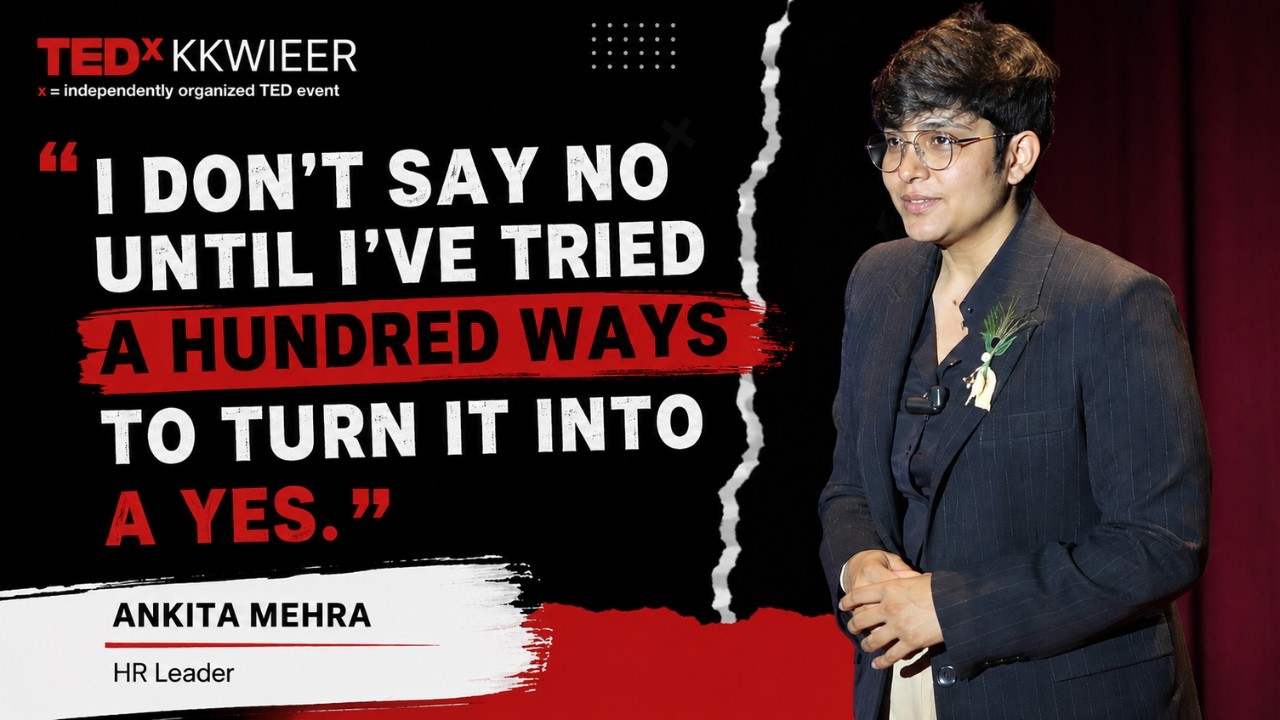
I Don’t Say No Until I’ve Tried a Hundred Ways to Turn It Into a Yes | Ankita Mehra | TEDxKKWIEER
Keywords
Summary
128 words
Critical Evaluation
Value of the Information & Strength of the Argument
The talk’s value lies in its authentic personal narrative, which illustrates resilience and emotional intelligence in real-life contexts. The argumentation is based on anecdotal evidence and personal reflection rather than scientific research, making it persuasive on an emotional level but limited in generalizability. The speaker effectively uses storytelling to convey her message, but the lack of concrete data or references weakens the scientific rigor.
Scientific Rigor, Source Quality, Title Accuracy
The talk is a personal testimony with no external sources cited. The only reference is the TEDx platform itself. The title accurately represents the content, focusing on the speaker’s mantra of persistence. The absence of citations and reliance on personal experience limit the scientific credibility, but the narrative is coherent and well-structured.
131 words
Title / Content Match
The title accurately reflects the core message of the talk, which is about persistence and resilience in the face of adversity.
Quality & Reliability
6/10
Personal testimony with emotional depth, but lacks verifiable data, citations, or external evidence. The narrative is compelling but subjective, and the scientific basis for resilience claims is not explicitly referenced.
Key Moments
Markers derived by PSI from the transcript: the creator did not define chapters.
- Speaker describes her father's suicide attempt and hospitalization, a pivotal childhood trauma.
- She recounts facing bullying and rumors at school, and the impact on her confidence.
- She makes the decision to leave a top college to be closer to her father, prioritizing family over ambition.
- She explains choosing a call center job over a reality TV show, emphasizing learning emotional intelligence.
- She discusses her career progression, leadership roles, and the importance of skill development over money.
- She reflects on being laid off and the realization that her job had become her identity, leading to a transformative period of self-work and therapy.
Cited Sources
- TEDx Program — Mentioned as the platform for the talk, providing context for the TEDx event format.
Concurring Sources
- Resilience (psychology) — Supports the speaker's emphasis on resilience as a key factor in overcoming adversity.
- Emotional intelligence — Aligns with the speaker's focus on emotional intelligence as a learned skill.
Dissenting Sources
- No direct discordant sources — No external sources were cited in the talk to contradict.
Contribution & Novelties
The talk offers a personal perspective on resilience, emphasizing the importance of persistence and self-reflection. It contributes to the discourse on overcoming adversity by sharing a specific, relatable story. However, it does not introduce new scientific concepts or data.
Pour aller plus loin :
- Resilience (psychology) — Provides a scientific overview of resilience, its components, and research.
- Emotional intelligence — Explores the concept of emotional intelligence, its measurement, and relevance in personal and professional life.
- Post-traumatic growth — Discusses the positive psychological change that can occur after adversity, relevant to the speaker’s journey.
93 words
Radar Profile
The radar profile shows moderate scores across all dimensions, with the highest in quality of information and fiabilite, reflecting the personal nature of the talk. The low technical level and quantity of information indicate a focus on narrative rather than data-driven content.
💬 No comments were provided for analysis.