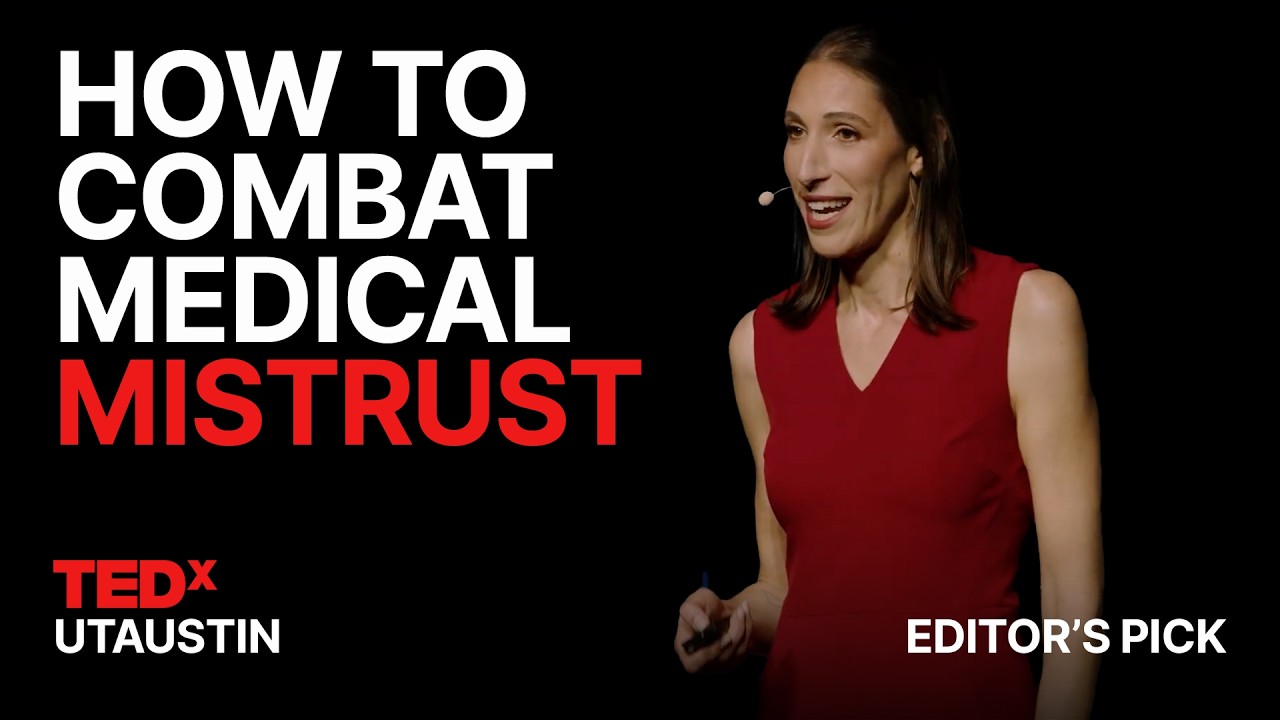
What to do when people stop trusting doctors | Aliza Norwood | TEDxUTAustin
Keywords
Summary
167 words
Critical Evaluation
Value of the Information & Strength of the Argument
The talk provides valuable insights into the importance of the doctor-patient relationship in building trust, supported by compelling patient stories. The argumentation is coherent and persuasive, emphasizing that mistrust is a relational issue rather than merely a knowledge deficit. However, the evidence is largely anecdotal, and the speaker does not provide specific data or references to support her claims beyond a general survey mention. The reasoning is sound but could be strengthened with more empirical evidence.
Scientific Rigor, Source Quality, Title Accuracy
The talk demonstrates scientific rigor in its use of patient narratives and reference to historical events like the Tuskegee study, but it lacks detailed citations and specific data. The title accurately reflects the content, and the talk is well-structured. The speaker’s expertise lends credibility, but the lack of concrete sources limits the overall scientific quality.
146 words
Title / Content Match
The title accurately reflects the content, which addresses the causes of medical mistrust and proposes rebuilding trust through patient-doctor relationships.
Quality & Reliability
7/10
The talk is based on the speaker's clinical experience and references a national survey and the Tuskegee study, but lacks specific citations and detailed data. The arguments are plausible and align with known issues in healthcare, but the evidence is anecdotal and not systematically presented.
Key Moments
Markers derived by PSI from the transcript: the creator did not define chapters.
Cited Sources
- TEDx Talks — The talk was given at a TEDx event, and this link is provided in the description.
Concurring Sources
- TEDx Talks — The talk is part of the TEDx series, which is known for sharing expert opinions.
Contribution & Novelties
The talk offers a fresh perspective on medical mistrust by framing it as a relationship issue rather than a knowledge or information problem. It emphasizes the importance of primary care relationships and suggests that rebuilding trust requires systemic changes to prioritize these relationships. The speaker’s patient stories provide concrete examples of how trust can be rebuilt through empathy and listening.
Pour aller plus loin :
- Tuskegee Syphilis Study — Historical context of medical mistrust.
- Patient-centered care — Approach that emphasizes the patient’s perspective.
- Primary care — The role of primary care in healthcare systems.
94 words
Radar Profile
The radar profile shows moderate scores across all dimensions, with slightly higher scores in information quantity and quality, reflecting the talk's balance of personal stories and general observations. The lower technical level indicates the content is accessible to a general audience.
💬 No comments were provided for analysis.