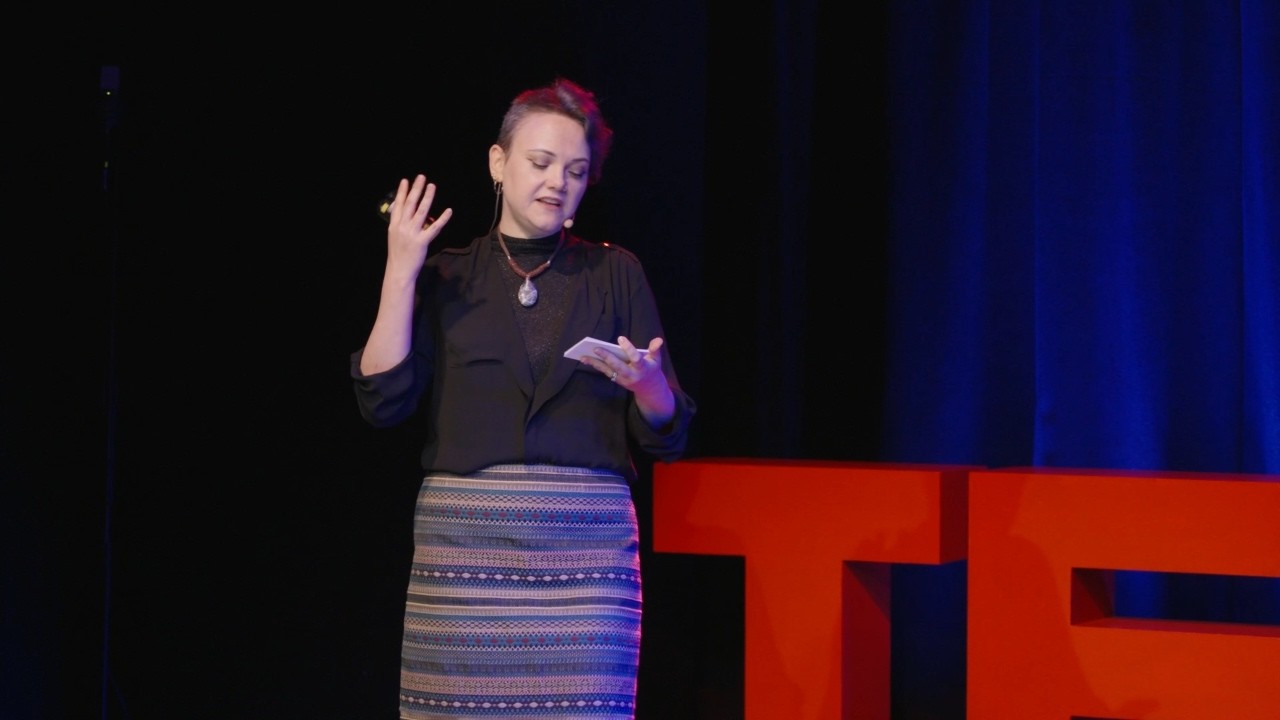
My Voice Is My Own | Jen Langton-Sneyd | TEDxUoChester
Keywords
Summary
166 words
Critical Evaluation
The talk presents a passionate and engaging overview of the human voice, blending personal experience with scientific references. However, the scientific rigor is inconsistent. The speaker makes several claims without providing specific citations, and TED has flagged the talk for lacking sufficient scientific support and potentially stigmatizing viewers. For instance, the claim that nasal breathing can cut exertion by 50% is presented without a direct source, and the assertion that conscious breathing techniques are more effective than mindfulness and meditation is based on a single 2023 study that is not named. The talk also touches on complex topics like the default mode network and mirror neurons, but simplifies them to a level that may mislead. The argumentation is largely anecdotal and relies on the speaker’s authority as a vocal coach rather than on robust evidence. The structure is clear, with three main ideas, but the transitions between topics are sometimes abrupt. The title ‘My Voice Is My Own’ is somewhat misleading as the talk covers more than just personal agency; it also includes anatomy, physiology, and neuroscience. The speaker’s enthusiasm is contagious, and the practical breathing exercise is a nice interactive element. However, for a scientifically rigorous audience, the lack of precise references and the overgeneralization of findings are significant weaknesses. The talk would benefit from citing specific studies and acknowledging the limitations of the evidence. Overall, it serves as an inspiring introduction to the voice but should be viewed with caution regarding its scientific claims.
246 words
Title / Content Match
The title 'My Voice Is My Own' aligns with the core message of personal agency and uniqueness of voice, though the talk covers broader topics.
Quality & Reliability
5/10
The talk presents personal views and some scientific references, but TED has flagged it for lacking sufficient scientific support and potential stigmatization. Several claims are oversimplified or lack citations.
Key Moments
Markers derived by PSI from the transcript: the creator did not define chapters.
- Introduction: obsession with voice and three core ideas.
- Discussion on the uniqueness of human voice and coevolution of music.
- Explanation of the power-source-filter model and larynx anatomy.
- Breathing: semi-autonomic function, nasal vs oral breathing, and box breath.
- Benefits of breath work: heart rate variability and resonant frequency breathing.
- Brain involvement: multimodal activation, mirror neurons, vagus nerve, default mode network.
- Benefits of singing: neuroplasticity, stress response, prosocial benefits, and agency.
- Conclusion: make your voice musical and use it as a tool for self-awareness.
Cited Sources
- TEDx Content Guidelines — Referenced in the description as the guidelines for TEDx organizers, indicating the talk may not fully comply.
- TEDx Program — Mentioned in the description as the umbrella organization for TEDx events.
Concurring Sources
- TEDx Content Guidelines — The talk's disclaimer aligns with the guidelines' emphasis on scientific accuracy.
Dissenting Sources
- TEDx Content Guidelines — The talk has been flagged for not meeting the guidelines due to insufficient scientific support.
Contribution & Novelties
The talk offers a personal and interdisciplinary perspective on the voice, integrating anatomy, physiology, neuroscience, and practical advice. It emphasizes the uniqueness of each individual’s voice and the importance of conscious breathing and musicality. The speaker’s enthusiasm and interactive breathing exercise provide a memorable experience.
Pour aller plus loin :
- Power-source-filter model — A foundational model in voice science.
- Vagus nerve — Key nerve involved in voice and parasympathetic regulation.
- Default mode network — Brain network engaged during rest and introspection, also activated by singing.
- Mirror neurons — Neurons that respond to actions and emotions of others, relevant to emotional communication.
- Pranayama — Ancient breathing practices mentioned in the talk.
110 words
Radar Profile
The radar profile shows moderate scores across all dimensions, with a slight peak in quantity of information and a dip in reliability. This indicates a talk that is informative and engaging but lacks rigorous scientific backing.
💬 No comments were provided for analysis.