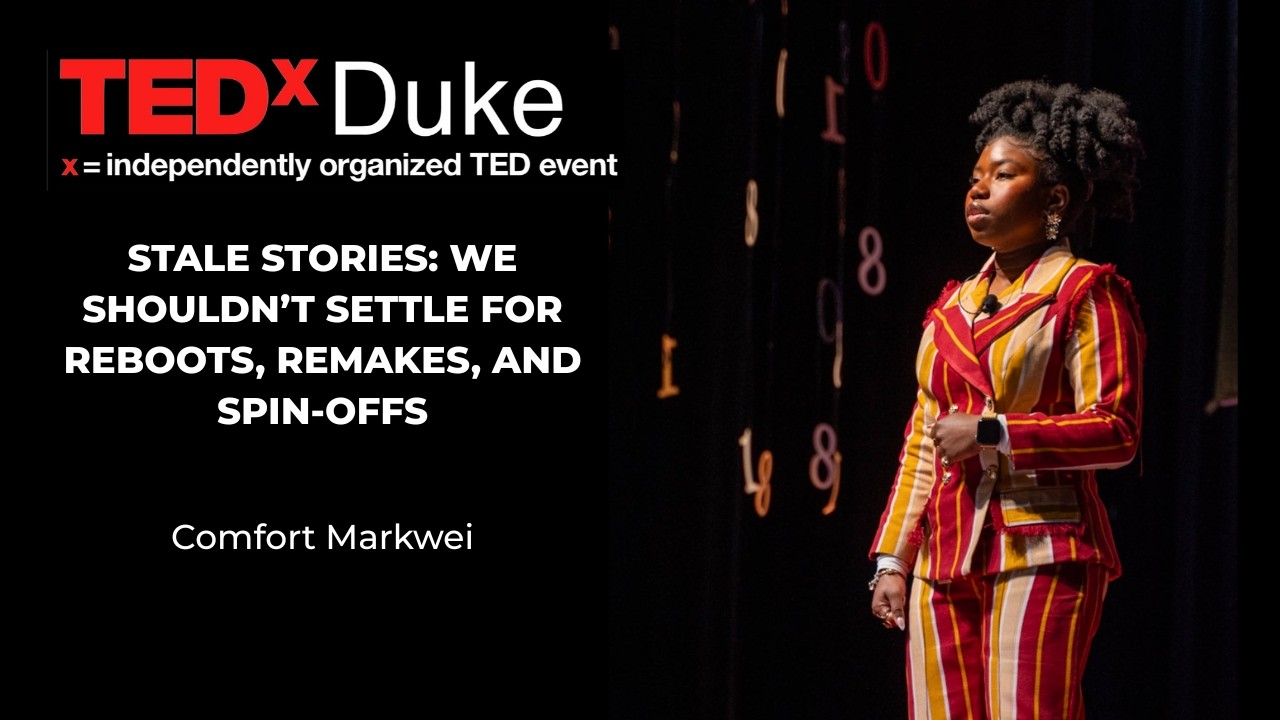
We shouldn't settle for the single story of Africa | Comfort Markwei | TEDxDuke
Keywords
Summary
155 words
Critical Evaluation
Comfort Markwei’s TEDx talk offers a compelling personal perspective on the importance of diverse African representation in media. The strength of the talk lies in its authentic storytelling, which effectively illustrates the emotional impact of the ‘single story’ on identity formation. Her anecdotes about her cousins and Adwoa ground the argument in lived experience, making it relatable and persuasive. The reference to Chimamanda Ngozi Adichie’s concept provides a theoretical framework that lends credibility to her claims. However, the talk is primarily an opinion piece rather than a rigorous academic analysis. It lacks empirical evidence or systematic examination of media representation, and the argument relies heavily on personal narrative. While this is appropriate for a TEDx talk, it limits the depth of the analysis. The speaker’s critique of Disney’s remakes is valid, but she does not explore the complexities of the entertainment industry, such as market demands or creative constraints. Additionally, her call for African-authored stories is important, but she does not address potential barriers like funding or distribution. The talk’s structure is clear, moving from personal experience to broader societal critique, and it maintains a consistent focus on the need for new narratives. The title accurately reflects the content, and the talk is well-delivered. Overall, the talk is thought-provoking and contributes to ongoing discussions about representation, but it would benefit from more concrete examples and a deeper exploration of the issues it raises.
233 words
Title / Content Match
The title accurately reflects the talk's central argument about moving beyond reductive narratives of Africa.
Quality & Reliability
7/10
The talk is a personal narrative and opinion piece, grounded in the speaker's experiences and referencing Chimamanda Ngozi Adichie's well-known concept. It lacks empirical data or systematic analysis, but is coherent and aligns with established discourse on representation.
Key Moments
Markers derived by PSI from the transcript: the creator did not define chapters.
- Introduction: speaker's family expands when relatives win visa lottery.
- Speaker describes using TV to culturally educate her cousins.
- Cousins reject Ghanaian identity; speaker reflects on lack of Ghanaian history in education.
- Speaker shares stories from her parents that shaped her Ghanaian identity.
- Introduction of Chimamanda Ngozi Adichie's 'single story' concept.
- Anecdote about Adwoa, revealing the danger of single stories.
- Critique of Disney's remakes and call for new African stories.
- Examples of Black Panther and The Woman King as positive but insufficient.
- Call for African authority in storytelling and conclusion.
Cited Sources
- TEDx Program — The talk was given at a TEDx event, and this link provides information about the TEDx program.
Concurring Sources
- Chimamanda Ngozi Adichie's TED talk — Adichie's concept of the single story is the theoretical basis of the talk.
Contribution & Novelties
The talk contributes a personal, contemporary perspective on the ‘single story’ concept, emphasizing the need for African-authored narratives in mainstream media. It critiques the trend of diversifying existing stories rather than creating new ones rooted in African cultures.
Pour aller plus loin :
- Chimamanda Ngozi Adichie’s TED talk ‘The danger of a single story’ — The foundational talk that introduces the concept.
- Yaa Asantewaa - Wikipedia — Historical figure mentioned as an example of untold African stories.
- The Woman King - Wikipedia — Film cited as challenging stereotypes but insufficient.
90 words
Radar Profile
The radar profile shows high scores in quality of information and reliability, reflecting the coherent and well-grounded argument, but lower scores in quantity and technical level, indicating a personal narrative rather than a data-driven analysis.