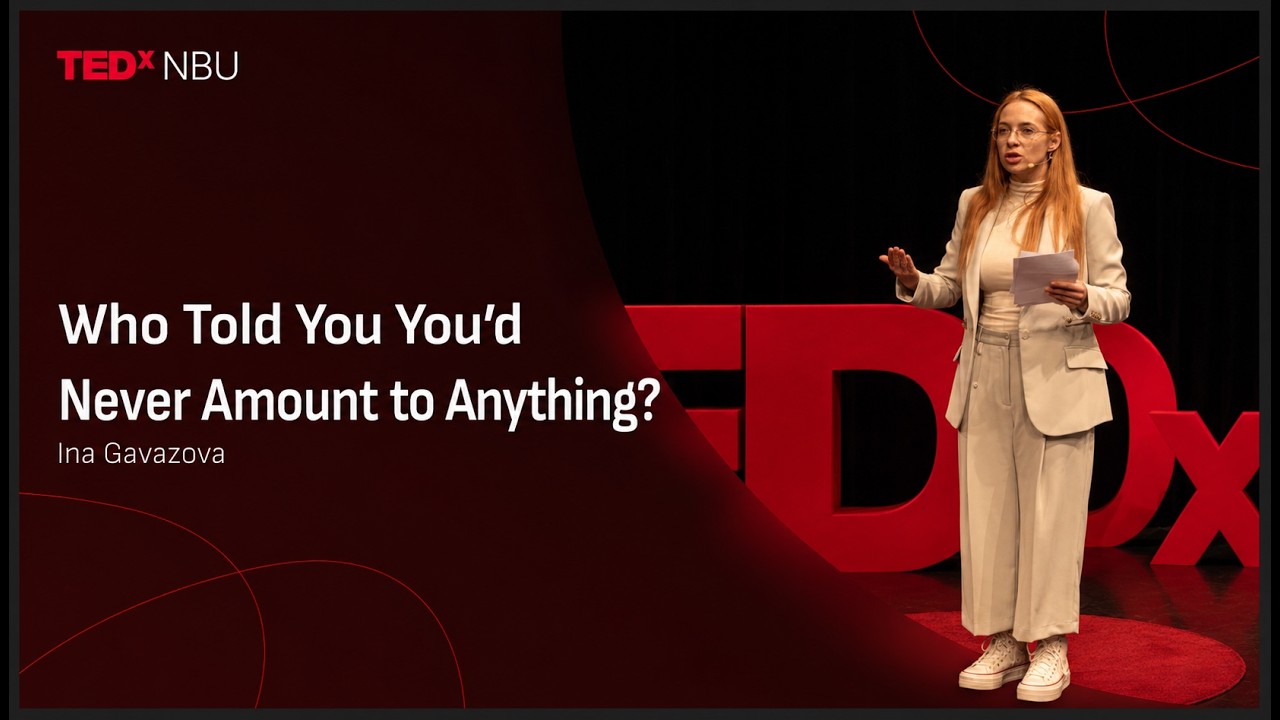
Who Told You You’d Never Amount to Anything? | Ina Gavazova | TEDxNBU
Keywords
Summary
219 words
Critical Evaluation
Value of the Information & Strength of the Argument
The talk offers valuable insights into the psychological challenges faced by creative professionals, particularly the conflation of personal identity with artistic output. Gavazova’s argument that criticism of one’s work is often perceived as a personal attack is well-articulated and resonates with common experiences in creative fields. She also provides a compelling reinterpretation of negative feedback, suggesting that it often reflects the critic’s own insecurities. However, the argumentation is largely anecdotal and lacks empirical support. The speaker’s personal story is powerful but does not constitute a systematic analysis. The claim about the doubling of creative industry exports is presented without a source, weakening its credibility. The talk would benefit from referencing psychological studies on feedback, self-efficacy, or the creative industry’s economic data to strengthen its case.
Scientific Rigor, Source Quality, Title Accuracy
The talk does not cite specific scientific sources or studies. The only external reference is the general TEDx website link in the description, which does not provide direct evidence for the claims made. The speaker’s credibility is based on her entrepreneurial success and Forbes recognition, but this does not substitute for rigorous sourcing. The title accurately reflects the content, which is a motivational and reflective talk rather than a scientific exposition. The absence of citations and the reliance on personal anecdotes limit the scientific rigor of the presentation.
228 words
Title / Content Match
The title accurately reflects the central theme of the talk, which is about overcoming the belief that one is not good enough, especially in creative fields.
Quality & Reliability
5/10
The talk is a personal and professional testimony rather than a scientific study. It relies on anecdotal evidence and a single, unverified statistic about the creative industries. The speaker's credibility is established through her entrepreneurial background and Forbes recognition, but the content lacks rigorous data or citations.
Key Moments
Markers derived by PSI from the transcript: the creator did not define chapters.
- Introduction: The speaker asks who has been told to stop drawing and focus on math, highlighting the discouragement of creative pursuits.
- Discussion of the economic growth of creative industries, citing a doubling of exports from $550 billion in 2010 to over $1 trillion.
- Exploration of how criticism in art schools and agencies often attacks the person, not the work, leading to self-doubt.
- Personal story of leaving home at 16 and working long hours to prove that a creative career is viable.
- Observation that talented interviewees often downplay their work, having internalized negative feedback.
- Reinterpretation of common criticisms as projections of the critics' own failures, concluding that creatives are not the problem.
Cited Sources
- TEDx Program — The talk was given at a TEDx event, and the link provides general information about the TEDx program.
Concurring Sources
- TEDx Program — The talk is part of the TEDx series, which is known for sharing ideas and personal experiences.
Contribution & Novelties
The talk contributes a personal and motivational perspective on the challenges faced by creative professionals, particularly the internalization of negative feedback and the conflation of self-worth with artistic output. It offers a novel reinterpretation of criticism as a reflection of the critic’s own insecurities, which may empower creatives to reframe their experiences. However, the talk does not present new empirical research or data.
Pour aller plus loin :
- Impostor syndrome — Relevant to the self-doubt described in the talk.
- Creative industries — Provides context on the economic significance of creative fields.
- Feedback and self-efficacy — Psychological concept related to how feedback affects confidence.
103 words
Radar Profile
The radar profile shows moderate scores in information quantity and quality, but a low technical level, reflecting the talk's focus on personal experience rather than technical depth. The reliability score is moderate, consistent with the lack of citations and reliance on anecdotal evidence.