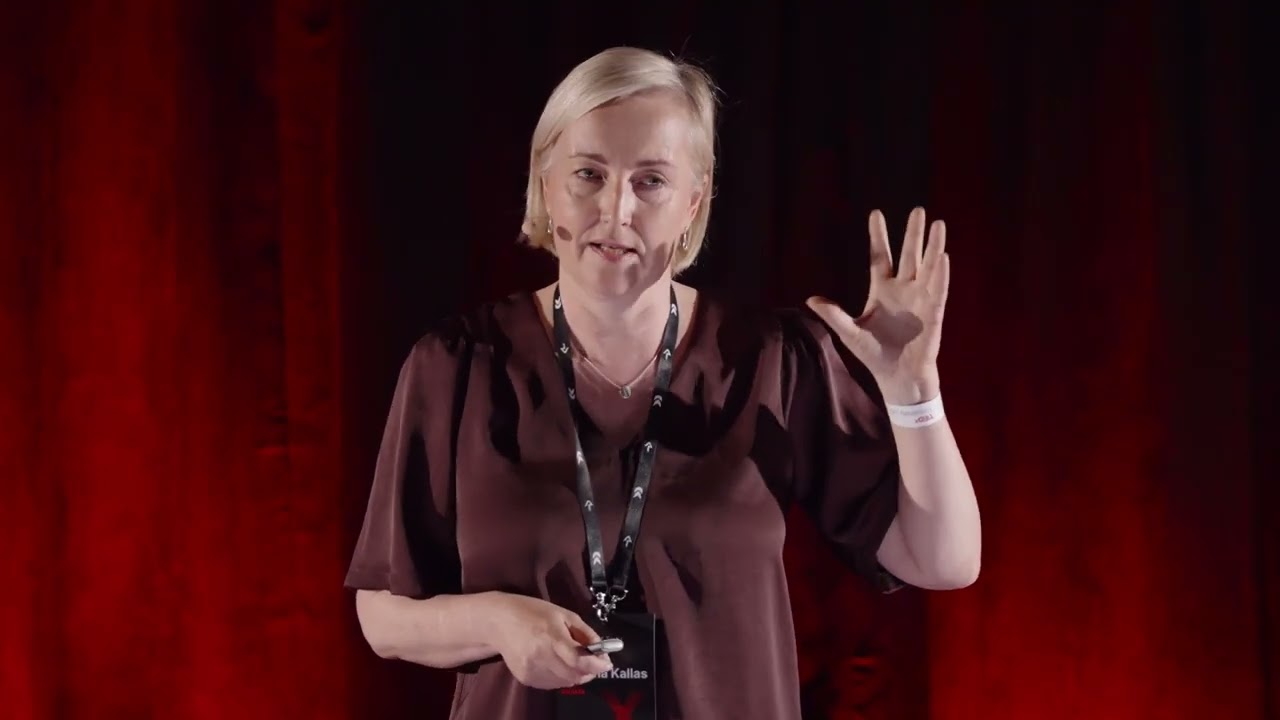
When AI Knows Everything, What Should Humans Learn? | Kristina Kallas | TEDxUniversity of Tartu
Keywords
Summary
152 words
Critical Evaluation
Kristina Kallas delivers a compelling and well-articulated argument for reorienting education toward higher-order cognitive skills in the age of AI. Her position as Minister of Education and Research lends authority, and she demonstrates a thoughtful, evidence-informed approach by citing consultations with neuroscientists and cognitive scientists, as well as referencing OECD data on workforce skills. The talk is strong in its conceptual framework: the distinction between lower-order and higher-order thinking is well-established in educational psychology (e.g., Bloom’s taxonomy), and Kallas applies it effectively to the AI context. She makes a persuasive case that AI can perform lower-order tasks, making it imperative for humans to develop skills that AI cannot easily replicate, such as ethical evaluation and creative synthesis.
However, the talk has limitations. While Kallas mentions OECD findings, she does not provide specific citations or data, which weakens the empirical grounding. The description of Estonia’s AI Leap program is intriguing but lacks detailed evidence of its effectiveness; she acknowledges that it is in a pilot phase and that scientific monitoring is ongoing. The claim that AI is ’not very good’ at evaluation and creation is debatable, as AI systems are increasingly capable in these areas, though perhaps not with the same depth as human cognition. The talk would benefit from a more nuanced discussion of the potential risks and ethical considerations of integrating AI into education, such as data privacy, algorithmic bias, and the digital divide.
The adéquation titre/contenu is excellent: the title poses a question that the talk directly addresses. The speaker’s argument is coherent and logically structured, progressing from the problem (AI’s capabilities) to the solution (educational reform). The talk is more of an expert opinion and policy announcement than a rigorous scientific presentation, but it is valuable for its insights into a real-world policy initiative. The lack of detailed sources and the reliance on anecdotal evidence prevent it from achieving a higher score, but it is a thought-provoking and relevant contribution to the discourse on AI and education.
330 words
Title / Content Match
The title accurately reflects the central question addressed: the talk explores what humans should learn in an AI-driven world, focusing on higher-order cognitive skills.
Quality & Reliability
7/10
The speaker is a PhD holder and Minister of Education and Research in Estonia, providing an expert opinion grounded in policy experience and consultations with neuroscientists and cognitive scientists. The talk references OECD data and describes a concrete national AI education program, but lacks detailed citations and empirical evidence, relying largely on anecdotal and policy-level observations.
Key Moments
Markers derived by PSI from the transcript: the creator did not define chapters.
- Introduction: Minister Kallas explains her journey with AI policy in Estonia.
- Discussion of OECD survey showing workers' skills lower than computers.
- Comparison to printing press as a historical cognitive evolutionary pressure.
- Explanation of lower vs. higher cognitive modes and brain energy consumption.
- Introduction of the cognitive tree: lower-order vs. higher-order thinking skills.
- Announcement of Estonia's AI Leap program and Socratic AI tutor.
- Emphasis on teacher training and scientific monitoring; call for global collaboration.
Cited Sources
- TEDx Talks — The talk was given at a TEDx event, and this link is provided in the description for more information about TEDx.
Concurring Sources
- OECD Skills Outlook — The speaker cites OECD data on workforce skills, which aligns with the argument that humans need to develop higher-order skills.
Dissenting Sources
- AI capabilities in evaluation and creation — The speaker claims AI is not good at evaluation and creation, but some AI systems have shown capabilities in these areas, which could be seen as a point of disagreement.
Contribution & Novelties
The talk provides a unique perspective from a national education minister actively implementing AI integration in schools. It offers a concrete example of a government-led initiative (Estonia’s AI Leap) that combines public-private partnership, teacher training, and a Socratic AI tutor. The emphasis on higher-order cognitive skills as the new educational goal is a timely contribution to the debate on AI and education.
Pour aller plus loin :
- Bloom’s taxonomy — A framework for classifying educational learning objectives, relevant to the distinction between lower-order and higher-order thinking.
- OECD Skills Outlook — The OECD’s reports on skills and workforce, which the speaker references.
- Cognitive offloading — The concept of relying on external tools to reduce cognitive load, relevant to the risks of AI use.
- Socratic method — The pedagogical approach used in the AI tutor mentioned in the talk.
137 words
Radar Profile
The radar profile shows a balanced performance with relatively high scores across all dimensions, indicating a well-rounded talk that provides substantial information, maintains good quality, and demonstrates a solid technical level, though it could benefit from more rigorous scientific backing.
💬 Très positif. Sur les 30 commentaires analysés, les spectateurs expriment une admiration quasi unanime pour la ministre et son approche, saluant sa sagesse, son intelligence et son leadership visionnaire, avec des appels à imiter ce modèle dans d'autres pays.