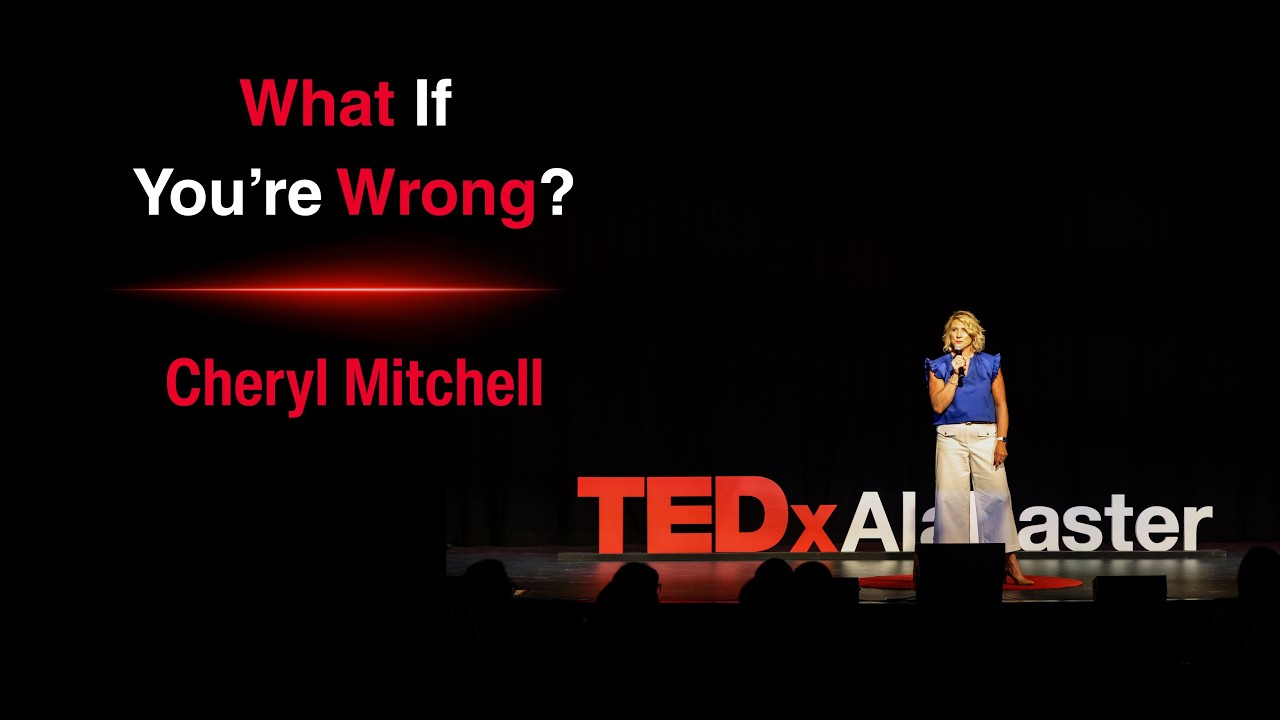
What If You're Wrong? | Cheryl Mitchell | TEDxAlabaster
Keywords
Summary
168 words
Critical Evaluation
Value of the Information & Strength of the Argument
The talk provides valuable insights into how cognitive biases and assumptions affect interpersonal communication. Mitchell’s argument is coherent and well-structured, using personal stories to illustrate abstract concepts. However, the argumentation relies heavily on anecdotal evidence and lacks empirical support or references to psychological research. The speaker’s credibility is built on her professional experience, but the absence of data weakens the scientific rigor. The value lies in its practical, relatable advice for improving communication, but it does not offer novel theoretical contributions.
Scientific Rigor, Source Quality, Title Accuracy
The talk does not cite any scientific sources or studies, which limits its scientific rigor. The only external reference is the TEDx platform itself. The title accurately reflects the content, focusing on the importance of questioning one’s beliefs. While the speaker’s personal authority is evident, the lack of citations to established research on cognitive biases (e.g., confirmation bias, theory of mind) is a notable gap. The content is more inspirational than evidence-based, which is typical for TEDx talks but reduces its reliability as a scientific source.
182 words
Title / Content Match
The title accurately reflects the core message: questioning one's own certainty to improve understanding and relationships.
Quality & Reliability
6/10
The talk offers a personal, experience-based perspective on cognitive biases and communication, but lacks empirical data or citations to scientific literature. The speaker's authority comes from 30 years of professional practice, not from peer-reviewed research.
Key Moments
Markers derived by PSI from the transcript: the creator did not define chapters.
- Introduction: Anecdote about her son's belief about driving age.
- Discussion of how assumptions taint conversations.
- Personal story about dairy farm upbringing and 'school night' rule.
- Metaphor of cataracts and removing cloudy lenses.
- Example of conversation with her son about a sensitive topic.
- Conclusion: Questions for self-reflection and call to curiosity.
Cited Sources
- TEDx Program — Mentioned in the description as the organizing body for the talk.
Concurring Sources
- Confirmation bias — Supports the idea that beliefs are reinforced by selective attention.
- Cognitive dissonance — Explains discomfort when beliefs are challenged.
Dissenting Sources
- The Backfire Effect — Suggests that challenging beliefs can sometimes strengthen them, contrary to the talk's optimistic view.
Contribution & Novelties
The talk offers a personal, narrative-driven perspective on cognitive biases and communication, emphasizing the importance of curiosity over certainty. While not scientifically novel, it provides a relatable framework for self-reflection. The metaphor of ’locked-in beliefs’ and ‘cataracts’ is memorable and accessible.
Pour aller plus loin :
- Confirmation bias — Relevant to the concept of locked-in beliefs.
- Theory of mind — Underlies the ability to understand others’ perspectives.
- Active listening — Practical skill for engaging with curiosity.
76 words
Radar Profile
The radar profile shows moderate scores across all dimensions, with slightly higher quality of information and lower technical level. This reflects a talk that is engaging and well-argued but lacks scientific depth and empirical support.
💬 Sur les 0 commentaires analysés, aucune tendance n'a pu être dégagée.