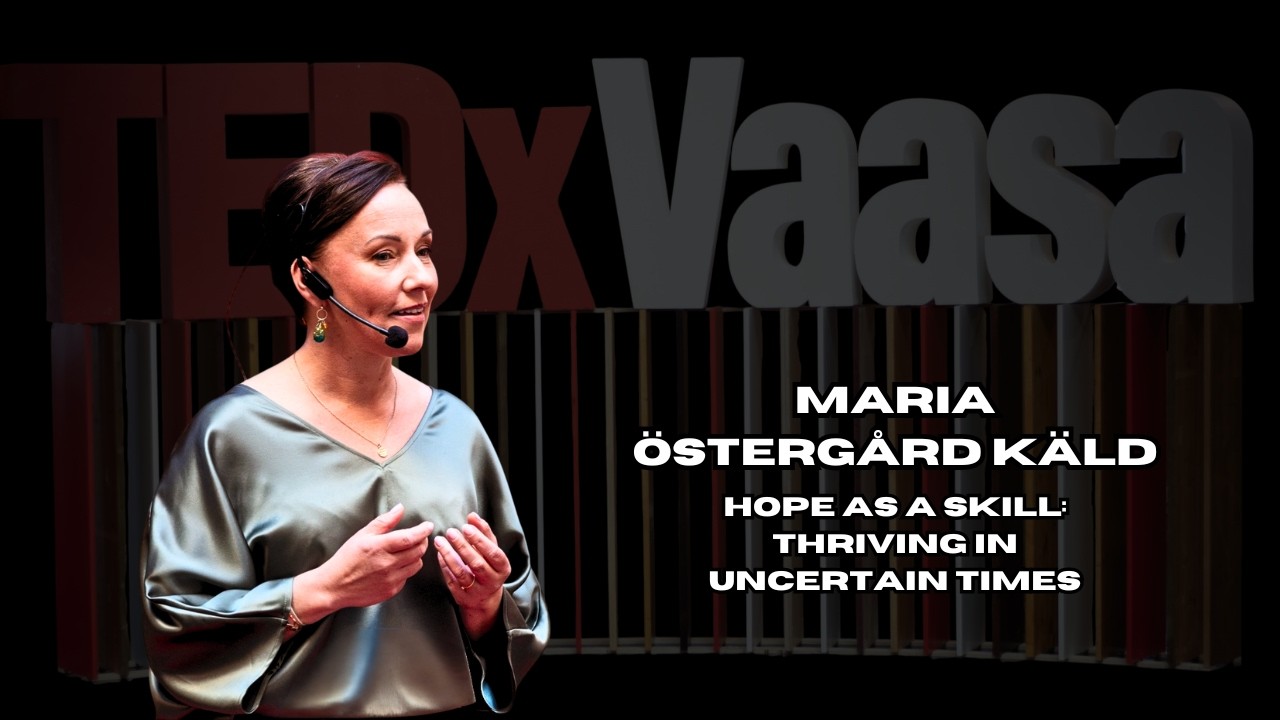
We need to teach young people to hope | Maria Östergård Käld | TEDxVaasa
Keywords
Summary
146 words
Critical Evaluation
The talk presents a compelling and heartfelt argument for the role of adults in nurturing hope in young people. The speaker’s personal anecdotes, particularly about her father, are emotionally resonant and effectively illustrate her points. However, the scientific rigor is limited. While she references ‘cross-cultural youth research’ and ‘behavioral science’, she does not provide specific studies, authors, or data, making it difficult to verify her claims. The statistics she mentions, such as the 60% financial pressure and the Finnish Red Cross Loneliness Barometer, are not cited with sources, though the latter is a known report. The talk is more of an inspirational speech than a scientific presentation, which is typical for TEDx. The argumentation is coherent and aligns with established concepts in positive youth development, such as the importance of adult support and agency. However, it lacks depth in exploring counterarguments or alternative perspectives. The title accurately reflects the content, and the talk stays on message. Overall, it is a valuable contribution to the discourse on youth and hope, but it would benefit from more concrete evidence and citations.
179 words
Title / Content Match
The title accurately reflects the core message: the need to instill hope in young people through adult presence and agency.
Quality & Reliability
6/10
The talk is based on personal experience and general references to research, but lacks specific citations or data sources. The speaker is a finance professional, not a youth development researcher, which limits the depth of scientific grounding. The content is coherent and aligns with established concepts in positive youth development, but the evidence is anecdotal.
Key Moments
Markers derived by PSI from the transcript: the creator did not define chapters.
- Introduction: The speaker asks the audience to think about who shaped their sense of the future.
- Statistics on youth concerns: financial pressure and inequality.
- Thesis: The biggest threat is a generation growing up without hope.
- Personal background: growing up in the Kvarken Archipelago and her father's illness.
- Research reference: hope as a protective factor in youth development.
- Loneliness statistics from the Finnish Red Cross.
- Discussion on AI and its impact on young people's future.
- Call to action: adults should show up, model agency, and tell better stories.
- Message to young people: ask for a chance and practice agency.
- Conclusion: Hope is passed forward through action and presence.
Cited Sources
- TEDx Program — The talk was given at a TEDx event, and this link provides information about the TEDx program.
Concurring Sources
- Positive Youth Development — The talk's emphasis on hope as a protective factor aligns with the principles of positive youth development.
Contribution & Novelties
The talk offers a personal and practical perspective on fostering hope in young people, emphasizing the role of adult presence and agency. It connects financial expertise with youth development, providing a unique angle. The speaker’s call to ‘pass hope forward’ is a memorable takeaway.
Pour aller plus loin :
- Positive Youth Development — This concept is central to the talk’s argument that hope and agency are protective factors.
- Agency (psychology) — The talk emphasizes the importance of agency in overcoming uncertainty.
- Finnish Red Cross Loneliness Barometer — The speaker cites this source for loneliness statistics; the link is to the official page.
102 words
Radar Profile
The radar profile shows moderate scores across all dimensions, with slightly higher quality of information and lower technical level. This reflects a talk that is accessible and emotionally engaging but lacks deep scientific depth.