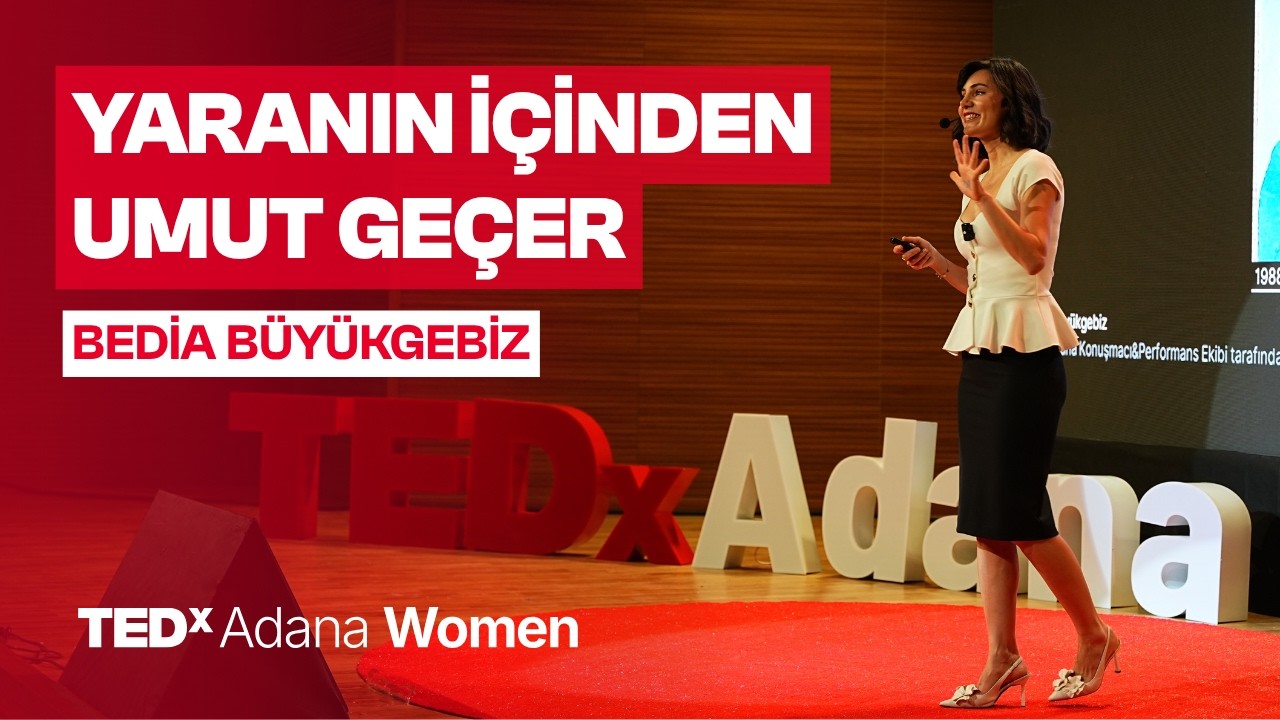
Yaranın İçinden Umut Geçer | Bedia Büyükgebiz | TEDxAdana Women
Keywords
Summary
132 words
Critical Evaluation
Value of the Information & Strength of the Argument
The talk offers a deeply personal and emotionally resonant perspective on resilience and the transformative power of turning one’s wounds into a source of empathy. The argumentation is primarily anecdotal, relying on the speaker’s lived experience rather than empirical evidence. While this makes the talk relatable, it limits its scientific rigor. The references to Nochlin, Weil, and Fromm provide intellectual grounding but are used illustratively rather than analytically. The speaker’s advocacy for attention and solidarity as forms of hope is compelling, but the lack of concrete examples or data weakens the overall argument.
Scientific Rigor, Source Quality, Title Accuracy
The talk is a personal testimony, not a scientific presentation. The sources mentioned (Nochlin, Weil, Fromm) are credible intellectual figures, but they are not cited with specific works or contexts. The only external link provided is the general TEDx page, which does not offer additional references. The title accurately reflects the content, and the talk stays on topic. The absence of citations and empirical support is a significant limitation for a scientific evaluation, but it is typical for a TEDx talk focused on personal experience.
193 words
Title / Content Match
The title accurately reflects the content: the speaker discusses how hope can emerge from personal wounds, illustrated through her life story.
Quality & Reliability
6/10
Personal narrative with references to well-known thinkers (Linda Nochlin, Simone Weil, Erich Fromm) and a medical diagnosis (ADHD), but no empirical data or scientific citations. The talk is subjective and anecdotal, typical of a TEDx talk.
Key Moments
Markers derived by PSI from the transcript: the creator did not define chapters.
- Introduction: the speaker poses the question of whether childhood lack can become adult giving.
- Description of a strict, unloving home and the feeling of being unwanted.
- The impact of the book 'Sevgi Dolu Bir Yürek' (A Loving Heart) on the speaker's worldview.
- Childhood fundraising for Kosovo War victims as a first act of giving.
- Discovery of ADHD diagnosis at age 33 and its effect on understanding her past.
- Reference to Linda Nochlin's question about the lack of great women artists.
- Career as a lawyer and work in human rights, emphasizing the importance of not leaving people alone.
- Reflections on hope as an active construction of meaning, not passive optimism.
- Conclusion: healing through building a lovable world together.
Cited Sources
- TEDx Talks — General TEDx page mentioned in the description.
Concurring Sources
- TEDx Talks — General TEDx page, consistent with the talk's format.
Contribution & Novelties
The talk provides a personal and emotional perspective on how childhood emotional neglect can be transformed into a lifelong commitment to social solidarity and human rights. It highlights the often-overlooked presentation of ADHD in girls, which is a valuable contribution to raising awareness. The speaker’s framing of hope as an active, relational practice rather than a passive expectation is a meaningful conceptual contribution.
Pour aller plus loin :
- Attention as a form of generosity - Simone Weil — Weil’s concept of attention is central to the talk’s message.
- Why Have There Been No Great Women Artists? - Linda Nochlin — Nochlin’s essay is referenced to discuss systemic barriers.
- Erich Fromm’s The Art of Loving — Fromm’s idea of love as an action is cited to support the speaker’s view.
129 words
Radar Profile
The radar profile shows moderate scores across all dimensions, with a slightly higher score in quality of information due to the coherent narrative and intellectual references. The low technical level reflects the personal and non-scientific nature of the talk.