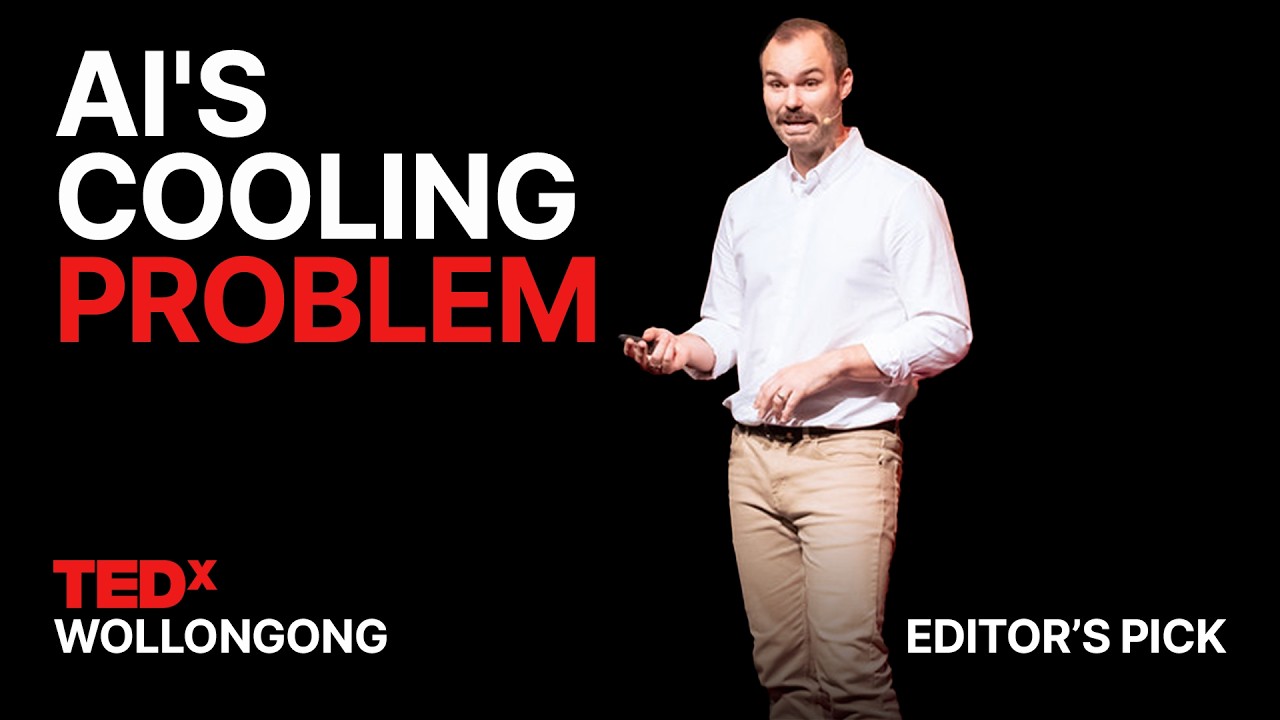
AI data centers are too hot—how can we fix it? | Greg Ryder | TEDxWollongong
Keywords
Summary
117 words
Critical Evaluation
The talk provides a compelling and accessible overview of a critical issue in the AI industry: the energy and cooling demands of data centers. Ryder effectively communicates the scale of the problem, citing the IEA’s estimate that data centers used 1.5% of global electricity in 2024, and projects a doubling by 2030. The explanation of heat transfer and thermal conductivity is clear and uses relatable analogies, making the science accessible without oversimplifying. The speaker’s background in materials science lends credibility, and his description of developing a novel coolant is intriguing, though he provides few specific details about the technology, which limits the scientific depth. The talk is well-structured, moving from problem to solution, and emphasizes the importance of efficiency for both environmental and economic reasons. However, the lack of concrete data or peer-reviewed references for his specific claims (e.g., the 50% reduction) weakens the scientific rigor. The mention of CSIRO’s projection of $1 trillion investment in AI by 2028 is a notable statistic, but its source is not cited. The talk does not address potential drawbacks or challenges of his proposed solution, such as cost or scalability, which would have strengthened the analysis. Overall, the talk is informative and persuasive, but it leans more toward advocacy than a balanced scientific review. The adéquation between title and content is excellent, as the talk directly addresses the question posed. The audience’s comments (not provided) would likely reflect appreciation for the clear explanation and concern about AI’s environmental impact.
246 words
Title / Content Match
The title accurately reflects the content, focusing on the heat problem in AI data centers and potential solutions.
Quality & Reliability
7/10
The talk presents a clear overview of the energy and cooling challenges in AI data centers, citing credible sources like the IEA and CSIRO. The speaker's expertise in materials science adds authority, but the talk is largely anecdotal regarding his own research, with limited peer-reviewed references. Overall, the information is reliable and well-presented, though not deeply technical.
Key Moments
Markers derived by PSI from the transcript: the creator did not define chapters.
- Introduction: AI's physical cost and electricity consumption.
- IEA statistics: 1.5% of global electricity used by data centers in 2024.
- Projection for 2030: 950 TWh, doubling from 2024.
- Heat problem: 30-40% of data center electricity used for cooling.
- Explanation of thermal conductivity and heat transfer.
- Current cooling solutions: air, immersion, direct-to-chip.
- Direct-to-chip liquid cooling and its inefficiencies.
- Research on high thermal conductivity coolants.
- Scaling up and pilot testing.
- Broader applications and conclusion.
Cited Sources
- TEDx Program — Mentioned as the organizing body for the talk.
Concurring Sources
- International Energy Agency - Data Centres and Data Transmission Networks — Supports the claim about global electricity use by data centers.
Contribution & Novelties
The talk presents a novel perspective on AI sustainability by focusing on the often-overlooked cooling challenge. It introduces the concept of designing coolants with metal-like thermal conductivity, which could significantly reduce energy consumption. This approach is innovative and highlights the role of materials science in addressing climate change.
Pour aller plus loin :
- International Energy Agency - Data Centres and Data Transmission Networks — Official IEA report on energy consumption of data centers.
- Thermal conductivity - Wikipedia — Overview of thermal conductivity and its importance in heat transfer.
- Direct-to-chip cooling - Wikipedia — Explanation of direct-to-chip liquid cooling technology.
- CSIRO - Artificial Intelligence — CSIRO’s research on AI and its economic projections.
112 words
Radar Profile
The radar profile shows a balanced performance across all dimensions, with slightly higher scores in information quality and reliability, reflecting the speaker's expertise and credible sources. The lower score in technical depth indicates the talk is accessible to a general audience.