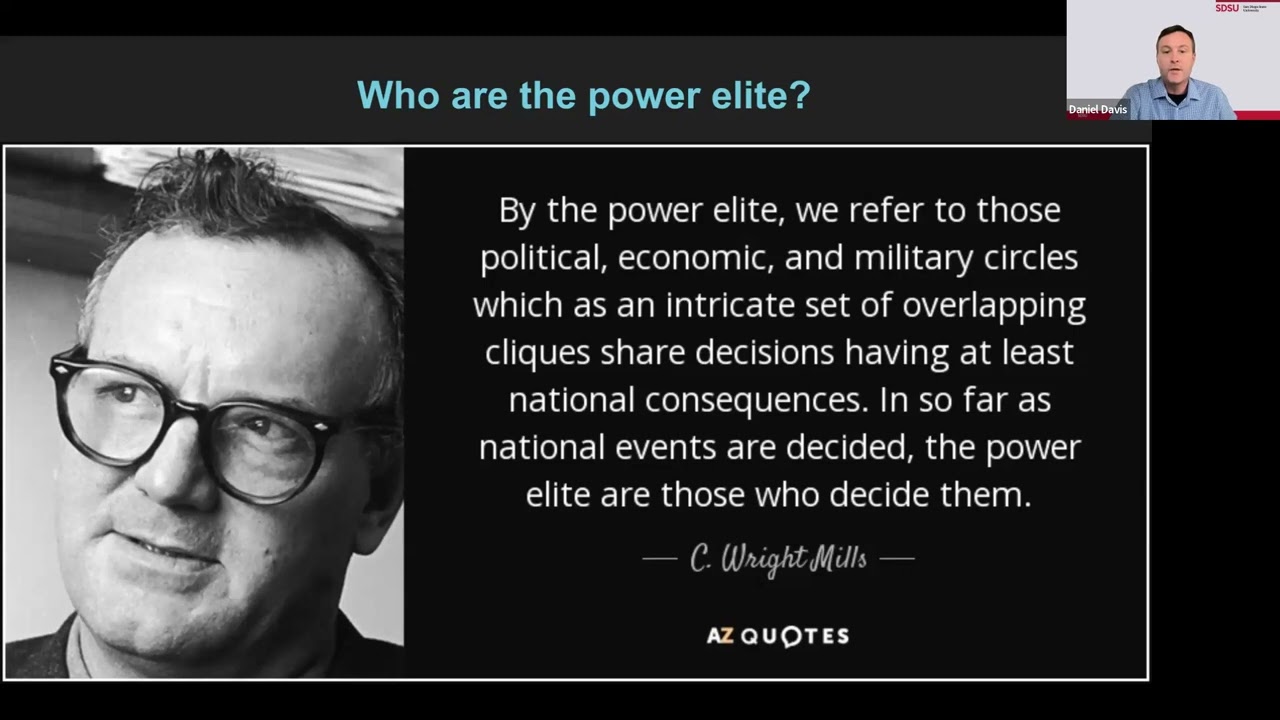
2 The Power Elite
Keywords
Summary
204 words
Critical Evaluation
Value of the Information & Strength of the Argument
The video provides a valuable synthesis of two major sociological theories on power, making complex ideas accessible. It uses concrete examples and data to illustrate points, such as wealth distribution charts and the number of billionaires. The argumentation is clear and logical, presenting the theories in a structured manner and highlighting both similarities and differences. However, it does not critically evaluate the theories or present counterarguments, and some data points lack citations.
Scientific Rigor, Source Quality, Title Accuracy
The video is based on the seminal works of C. Wright Mills (‘The Power Elite’) and G. William Domhoff (‘Who Rules America?’), which are credible academic sources. The presentation is faithful to the original theories, though it simplifies some nuances. The title accurately reflects the content. No external sources are cited in the video or description, so the quality of sources is inferred from the theorists’ reputations.
154 words
Title / Content Match
The title accurately reflects the content, which is an overview of the power elite concept.
Quality & Reliability
8/10
The video provides a clear and accurate overview of the concept of the power elite as developed by C. Wright Mills and G. William Domhoff, based on their major works. The presentation is structured, uses relevant data on wealth inequality, and distinguishes between the two theorists' models. However, it is a lecture summary without original research or critical evaluation, and some claims (e.g., numbers of billionaires) are not sourced in the video.
Key Moments
Markers derived by PSI from the transcript: the creator did not define chapters.
- Introduction to wealth inequality in the US
- Definition of wealth, status, and power
- Methods for studying power
- Estimating the size of the power elite
- C. Wright Mills' model of the power elite
- Mills on conspiracy and drift
- Domhoff's model and four networks
- Comparison of Mills and Domhoff, and concluding question
Cited Sources
- The Power Elite — C. Wright Mills' book, the primary source for the concept.
- Who Rules America? — G. William Domhoff's book, the primary source for his model.
Concurring Sources
- The Power Elite — Mills' original work aligns with the video's presentation.
- Who Rules America? — Domhoff's work aligns with the video's presentation.
Contribution & Novelties
The video offers a clear and concise synthesis of two major theories on power elites, making them accessible to a general audience. It highlights the key differences and similarities between Mills and Domhoff, and emphasizes the organizational nature of power. The lecture also raises a thought-provoking question about resistance.
Pour aller plus loin :
- C. Wright Mills - Wikipedia — Overview of Mills’ life and work.
- G. William Domhoff - Wikipedia — Overview of Domhoff’s contributions.
- Power elite - Wikipedia — General concept and related discussions.
86 words
Radar Profile
The radar profile shows high scores in quantity and quality of information, with a moderate technical level. This indicates a well-structured and informative lecture that is accessible to a broad audience, but not highly technical or research-intensive.