Lecture-240: Update on the Management of Psoriasis. Part -1. 10th edition of Rooks
Keywords
Summary
176 words
Critical Evaluation
Value of the Information & Strength of the Argument
The lecture provides valuable, up-to-date information on psoriasis management, drawing from a authoritative textbook. The speaker’s clinical experience adds practical insights, such as the use of methotrexate injections and combination therapies. The argumentation is generally solid, with explanations of mechanisms of action and evidence-based recommendations, though some claims lack specific citations. The discussion of newer agents like tapinarof and roflumilast is timely, but the lecture’s value is somewhat limited by its incomplete coverage (part 1) and the lack of detailed references.
Scientific Rigor, Source Quality, Title Accuracy
The lecture is based on the 10th edition of Rook’s Textbook of Dermatology, a well-regarded reference, lending credibility. However, the speaker does not provide specific citations or URLs for the claims made, relying on his expertise and the textbook’s authority. The title accurately reflects the content, which is an update on psoriasis management. The lecture’s rigor is moderate: it is an expert opinion rather than a systematic review, and some statements are anecdotal (e.g., personal experience with coal tar). The lack of explicit sources limits verifiability, but the content aligns with established dermatological guidelines.
190 words
Title / Content Match
The title accurately reflects the content, which is an update on psoriasis management based on the latest edition of Rook's textbook.
Quality & Reliability
7/10
The lecture is based on the 10th edition of Rook's Textbook of Dermatology, a reputable source, and delivered by an experienced dermatologist. However, it is an expert opinion with limited peer-reviewed references and some personal anecdotes.
Key Moments
Markers derived by PSI from the transcript: the creator did not define chapters.
- Introduction and overview of lecture based on Rook's 10th edition
- Investigations in psoriasis: clinical diagnosis, biopsy, CRP
- General management principles: patient factors, severity scoring, treatment phases
- Topical corticosteroids: potency, indications, side effects
- Vitamin D analogues: calcipotriol, calcitriol, combination with betamethasone
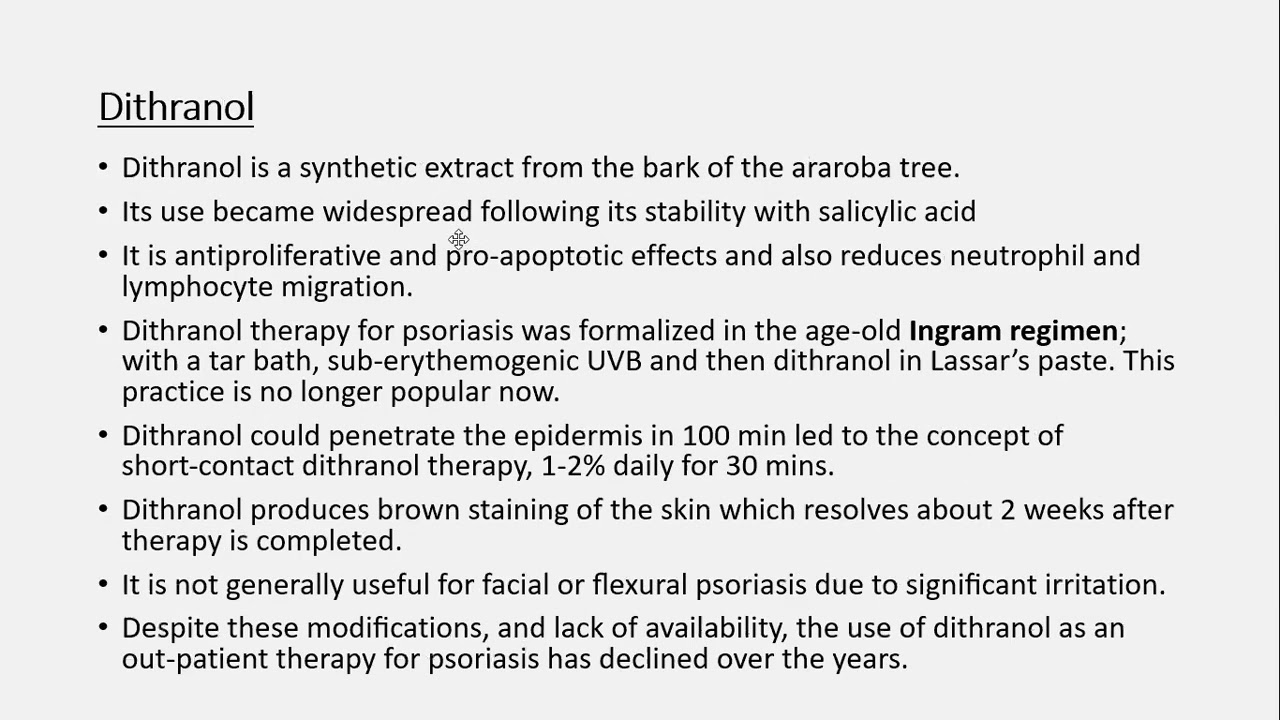
- Dithranol and coal tar: historical use, current status
- Topical retinoids and calcineurin inhibitors
- Novel topical agents: tapinarof, roflumilast
- Phototherapy: narrowband UVB, PUVA, protocols and side effects
- Systemic therapy: methotrexate, cyclosporine, and others
Cited Sources
- Rook's Textbook of Dermatology, 10th Edition — The lecture is based on this textbook, which is the primary source for the content.
Concurring Sources
- Guidelines of care for the management of psoriasis and psoriatic arthritis: Section 3. Guidelines of care for the management and treatment of psoriasis with topical therapies — This guideline supports the use of topical corticosteroids and vitamin D analogues as discussed in the lecture.
- British Association of Dermatologists' guidelines for the safe and effective prescribing of methotrexate for the treatment of skin disease — These guidelines align with the lecture's recommendations on methotrexate dosing and monitoring.
Dissenting Sources
- Systematic review of the efficacy and safety of topical corticosteroids in psoriasis — This review suggests that the efficacy of topical corticosteroids may be lower than claimed in the lecture, particularly for long-term use.
Contribution & Novelties
The lecture provides an update on psoriasis management based on the latest edition of Rook’s textbook, highlighting new topical agents like tapinarof and roflumilast, and emphasizing the shift towards narrowband UVB as first-line phototherapy. It also discusses the evolving role of methotrexate in combination with biologics. The speaker’s clinical experience adds practical tips, such as using subcutaneous methotrexate for better tolerance.
Pour aller plus loin :
- Psoriasis - World Health Organization — Official WHO fact sheet on psoriasis, providing global context and management overview.
- Tapinarof - FDA approval — FDA announcement of tapinarof approval for plaque psoriasis, relevant to the novel topical agent discussed.
- Roflumilast - PubMed article — A study on roflumilast cream for psoriasis, supporting its efficacy and safety.
- Narrowband UVB therapy - DermNet NZ — Comprehensive overview of narrowband UVB, including indications and protocols.
- Methotrexate in psoriasis - British Association of Dermatologists guidelines — Guidelines on methotrexate use, including monitoring and safety.
155 words
Radar Profile
The radar profile shows high scores in quantity of information and technical level, indicating a detailed and specialized lecture. The quality of information and global reliability are slightly lower, reflecting the reliance on expert opinion and lack of explicit citations. The lecture is well-suited for dermatology professionals seeking an update.
💬 Sur les 0 commentaires analysés, aucune tendance n'est disponible.