Lecture-236: Biological Treatments; Useful facts
Keywords
Summary
168 words
Critical Evaluation
Value of the Information & Strength of the Argument
The lecture offers a concise summary of key facts about biologics, which is valuable for clinicians seeking a quick update. The speaker’s argumentation is based on clinical experience and general medical knowledge, but it lacks rigorous scientific evidence and specific data. The discussion of nomenclature is particularly useful, though some examples are mispronounced or misspelled. The lecture does not delve into comparative efficacy or detailed mechanisms, limiting its depth. The advice on pregnancy and lactation is balanced, acknowledging the need to weigh maternal benefits against fetal risks. Overall, the content is informative but not highly original or evidence-rich.
Scientific Rigor, Source Quality, Title Accuracy
The lecture does not cite specific sources or studies, relying instead on the speaker’s expertise. The title accurately reflects the content, which is a general overview of biologics. However, the lack of references and minor inaccuracies in drug names reduce its scientific rigor. The speaker does not mention any conflicting evidence or controversies, presenting a simplified view. The absence of citations makes it difficult to verify claims, though the information aligns with standard dermatological practice. The lecture is suitable for educational purposes but should be supplemented with peer-reviewed literature.
202 words
Title / Content Match
The title accurately reflects the content, which focuses on practical facts about biological treatments in dermatology.
Quality & Reliability
6/10
The lecture provides a general overview of biologics in dermatology, based on the speaker's clinical expertise. It lacks detailed citations and specific data, and contains some inaccuracies in drug nomenclature (e.g., 'Sikunim map' for secukinumab, 'A delimab' for adalimumab). The information is broadly consistent with established medical knowledge but not rigorously sourced.
Key Moments
Markers derived by PSI from the transcript: the creator did not define chapters.
- Introduction and definition of biological treatments
- Mechanism of action and administration routes
- Indications in dermatology: psoriasis, atopic dermatitis, etc.
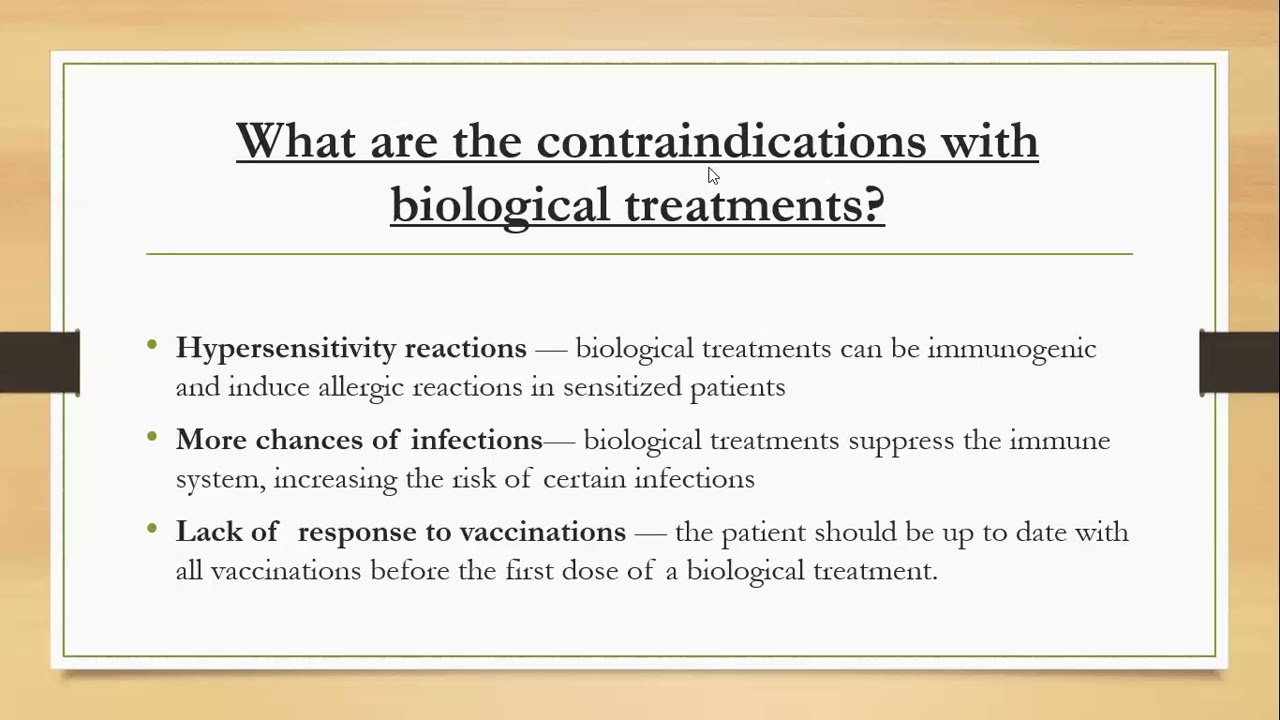
- Contraindications and infection risk
- Nomenclature of biologics: prefix, substems, suffix
- Disadvantages and monitoring requirements
- Side effects and management of allergic reactions
- Use in pregnancy and lactation, infant considerations
Contribution & Novelties
The lecture provides a practical overview of biologics in dermatology, with a focus on nomenclature and clinical considerations. It is useful for clinicians seeking a quick reference, but it does not present novel research or unique insights. The discussion of pregnancy and lactation is particularly relevant, though it lacks specific data.
Pour aller plus loin :
- Biologics in dermatology — Review of biologic therapies for psoriasis.
- Monoclonal antibody nomenclature — WHO guidance on INN for monoclonal antibodies.
- Biologics and pregnancy — Safety of biologics during pregnancy.
86 words
Radar Profile
The radar profile shows moderate scores across all dimensions, indicating a balanced but not exceptional lecture. The highest score is in technical level, reflecting the detailed nomenclature discussion, while reliability is lower due to lack of citations.