Lecture-241: Update on Management of Psoriasis. Part-2. Rook, 10th edition
Keywords
Summary
122 words
Critical Evaluation
Value of the Information & Strength of the Argument
The lecture provides a comprehensive overview of current systemic therapies for psoriasis, with practical insights from the author’s clinical experience. It presents efficacy data from clinical trials (e.g., PASI 75/90 responses) and discusses safety considerations. The argumentation is structured and logical, but it relies heavily on the author’s personal experience and textbook knowledge rather than citing specific studies. The value lies in its clinical relevance and up-to-date information, though the lack of explicit references weakens the scientific rigor.
Scientific Rigor, Source Quality, Title Accuracy
The lecture is based on Rook’s Textbook of Dermatology (10th edition) and the author’s clinical experience. However, specific sources, such as clinical trials or guidelines, are not cited. The title accurately reflects the content. The author’s expertise is evident, but the absence of direct references limits the verifiability of the information. The lecture is suitable for dermatology professionals and trainees.
153 words
Title / Content Match
The title accurately reflects the content: an update on psoriasis management, part 2, based on Rook's 10th edition.
Quality & Reliability
7/10
Lecture based on Rook's textbook (10th edition) and personal clinical experience. Provides detailed drug information, but lacks citations to specific studies or guidelines. Some statements are general and not referenced.
Key Moments
Markers derived by PSI from the transcript: the creator did not define chapters.
- Introduction and overview of the lecture
- Discussion of hydroxycarbamide (hydroxyurea) for psoriasis
- Apremilast: mechanism, dosing, and side effects
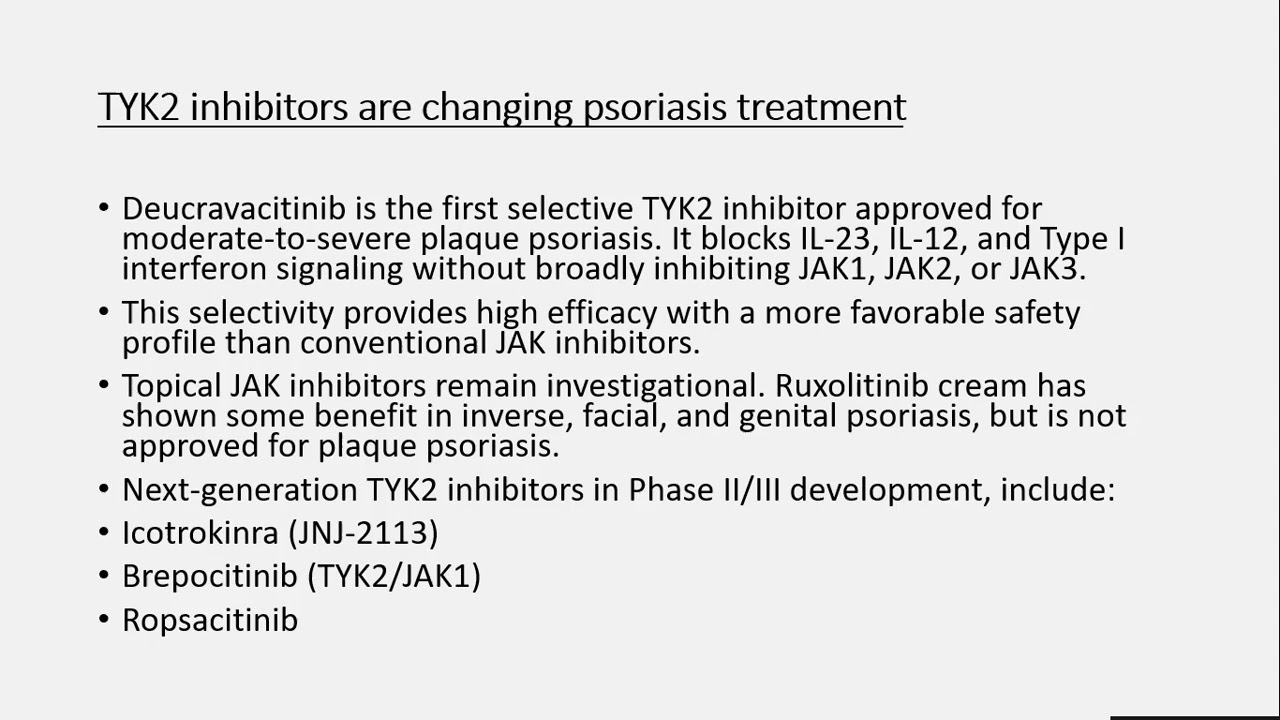
- JAK inhibitors: tofacitinib and deucravacitinib
- Introduction to biologic therapies and TNF-alpha inhibitors
- Infliximab: dosing, efficacy, and safety
- Etanercept and adalimumab: efficacy and use
- IL-17 inhibitors: secukinumab, ixekizumab, brodalumab, bimekizumab
- IL-23 inhibitors and treatment algorithm
Cited Sources
- Rook's Textbook of Dermatology, 10th edition — The lecture is based on this textbook, which is a standard reference in dermatology.
Concurring Sources
- Rook's Textbook of Dermatology — The lecture is based on this authoritative textbook, which is widely used in dermatology.
Contribution & Novelties
The lecture provides an updated overview of psoriasis management, incorporating recent developments in biologic therapies and JAK inhibitors. It offers practical clinical insights from the author’s experience, particularly relevant for regions where access to biologics is limited. The discussion of biosimilars and their cost-reducing potential is valuable.
Pour aller plus loin :
- Psoriasis - World Health Organization — Overview of psoriasis, its impact, and management.
- Deucravacitinib: A Review in Moderate-to-Severe Plaque Psoriasis — Review of deucravacitinib, a TYK2 inhibitor.
- Biosimilars in Dermatology — Discussion on biosimilars and their role in dermatology.
91 words
Radar Profile
The radar profile shows high scores in quantity of information and technical level, indicating a detailed and specialized lecture. The quality and reliability scores are moderate, reflecting the lack of explicit citations. Overall, the lecture is informative for dermatology professionals.