Lecture No. 238: MAKING CLINICAL DIAGNOSIS ON THE BASIS CLINICAL SYNDROMES. Part-2
Keywords
Summary
140 words
Critical Evaluation
Value of the Information & Strength of the Argument
The lecture provides a valuable framework for clinical reasoning in dermatology, emphasizing pattern recognition and systematic classification. The argumentation is based on the author’s clinical experience and is logically structured, moving from broad syndromes to specific diseases. However, the lack of references to scientific literature or clinical guidelines weakens the evidence base. The approach is practical and likely to improve diagnostic accuracy, but it does not delve into the underlying mechanisms or comparative effectiveness of different diagnostic strategies.
Scientific Rigor, Source Quality, Title Accuracy
The lecture is scientifically rigorous in its clinical descriptions and differential diagnoses, but it does not cite specific sources or studies. The title accurately reflects the content, and the lecture is well-organized. The absence of explicit references limits the ability to verify the information independently. The lecture is based on established dermatological knowledge, but without citations, it is difficult to assess the currency and completeness of the information.
161 words
Title / Content Match
The title accurately reflects the content, which is a continuation of a lecture series on clinical diagnosis using syndromes.
Quality & Reliability
7/10
The lecture is based on the author's clinical expertise and provides a systematic approach to dermatological diagnosis. It is educational and well-structured, but lacks explicit references to scientific literature or evidence-based sources, which limits its verifiability.
Key Moments
Markers derived by PSI from the transcript: the creator did not define chapters.
- Introduction to the lecture and recap of previous talk
- Explanation of the purpose: classifying diseases into syndromes for easier diagnosis
- Syndrome 17: Sporotrichoid spread - definition and examples (sporotrichosis, leishmaniasis, atypical mycobacteria)
- Syndrome 18: Neuropathic ulcers - features and causes (diabetes, leprosy)
- Syndrome 19: Linear lesions - various conditions (flagellate dermatitis, phytophotodermatitis, etc.)
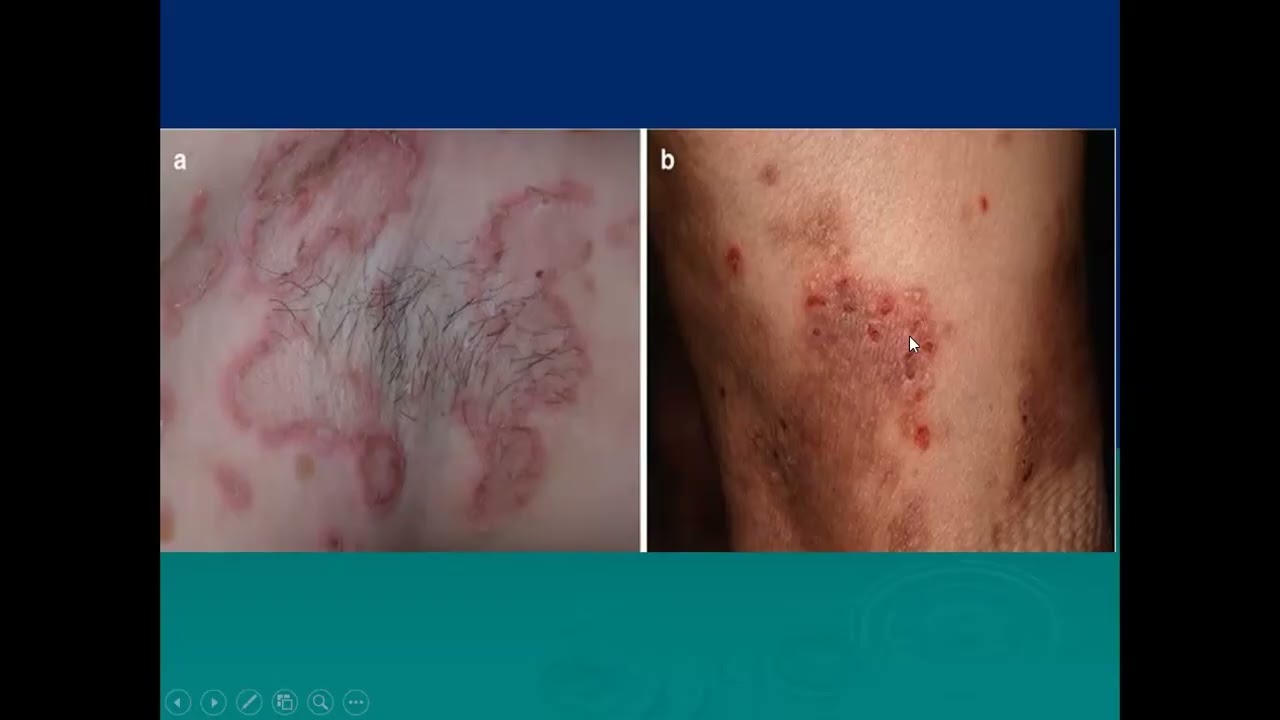
- Syndrome 20: Papulonecrotic lesions - differentials (chickenpox, PLEVA, tuberculids, etc.)
- Syndrome 21: Sinus formation - scrofuloderma, actinomycosis, mycetoma
- Syndrome 22: Vesiculobullous and crusted lesions - acute eczema, herpes, impetigo
- Syndrome 23: Bullous lesions - flaccid vs tense, pemphigus, bullous pemphigoid
- Syndrome 24: Targetoid lesions - erythema multiforme, linear IgA, etc.
- Syndrome 25: Acute rash with epidermal necrosis - SJS/TEN, paraneoplastic pemphigus
- Syndrome 26: Acute pustular rash - pustular psoriasis, AGEP
Contribution & Novelties
The lecture offers a systematic approach to dermatological diagnosis by grouping diseases into clinical syndromes, which is a valuable educational tool. It emphasizes pattern recognition and provides a structured method for differential diagnosis. This approach is particularly useful for medical students and practitioners in resource-limited settings.
Pour aller plus loin :
- Dermatology syndromes — Overview of dermatological conditions and diagnostic approaches.
- Sporotrichosis — Detailed information on the fungal infection that gives the name to the sporotrichoid spread.
- Neuropathic ulcer — Information on diabetic foot ulcers, a common cause of neuropathic ulcers.
- Pemphigus — Overview of the autoimmune blistering diseases mentioned.
- Erythema multiforme — Details on the targetoid lesions.
108 words
Radar Profile
The radar profile shows high scores in quantity and technical level, indicating a comprehensive and detailed lecture. The quality and reliability scores are moderate, reflecting the lack of cited sources. Overall, the lecture is informative but would benefit from references to evidence-based guidelines.