Closing in on Undiagnosable Tumors
Keywords
Summary
162 words
Critical Evaluation
Value of the Information & Strength of the Argument
The value of the information is high, as it provides a clear explanation of how 3D genomics can be applied to cancer research, particularly for detecting structural variants that may be missed by other methods. The argumentation is solid, supported by published studies and internal benchmarking data. The speaker effectively demonstrates the utility of Hi-C in identifying gene fusions and regulatory interactions, using concrete examples. However, the presentation is promotional, and the benchmarking data is not fully detailed, which slightly weakens the scientific rigor.
Scientific Rigor, Source Quality, Title Accuracy
The scientific rigor is good, with references to published studies (e.g., Iafrate and CIRCO labs, Peacock study) and clear methodology. The quality of sources is high, as they are peer-reviewed. The title is somewhat vague but the content aligns with the theme of diagnosing tumors. The presentation is well-structured and technically accurate, though it lacks detailed discussion of limitations. No comments were provided for analysis.
164 words
Title / Content Match
The title is somewhat vague but the content focuses on using 3D genomics to identify structural variants in tumors, which aligns with the idea of 'closing in' on undiagnosable tumors.
Quality & Reliability
8/10
The presentation is based on peer-reviewed studies and internal benchmarking data, with clear methodology and references to published work. The speaker is a senior scientist at Arima Genomics, providing expert insight. However, the content is promotional in nature, and the benchmarking data is not fully detailed in the video.
Key Moments
Markers derived by PSI from the transcript: the creator did not define chapters.
Cited Sources
- Arima Genomics website — Mentioned as a resource for more information and free kit application
Concurring Sources
- Iafrate and CIRCO labs study on T-ALL — Referenced in the video as a published study on 3D genomics in T-ALL.
- Peacock study (2020) — Referenced for the observation that cancer genomes contain driver mutations in coding and non-coding regions.
Contribution & Novelties
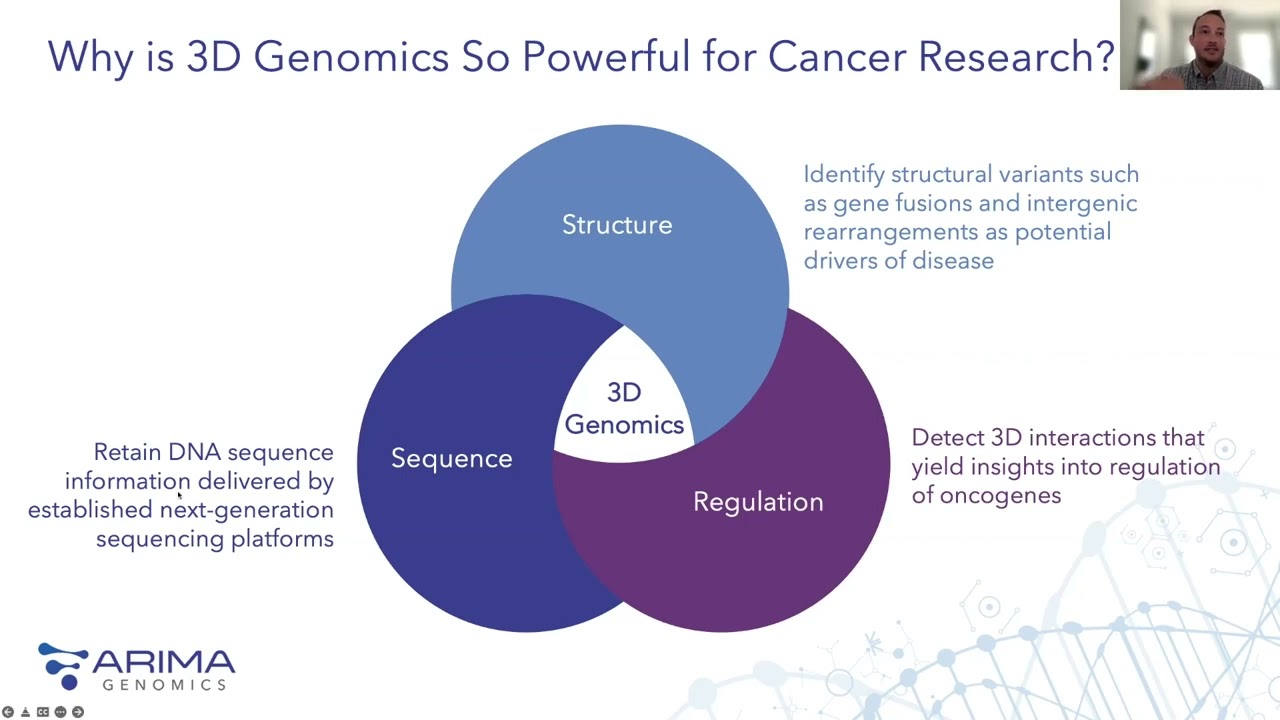
The webinar provides a clear introduction to 3D genomics and its application in cancer research, emphasizing the detection of structural variants. It highlights the advantage of Hi-C in identifying gene fusions and regulatory interactions that may be missed by linear genomics. The presentation includes benchmarking data showing high concordance with orthogonal methods, suggesting clinical utility. However, the content is largely educational and promotional, with limited novel scientific findings.
Pour aller plus loin :
- Hi-C (genomics) — Overview of the Hi-C technique.
- Structural variation — General concept of structural variants.
- Gene fusion — Explanation of gene fusions in cancer.
98 words
Radar Profile
The radar profile shows high scores in quantity and quality of information, with a moderate technical level. The reliability is high, reflecting the expert presentation and use of published data. The overall balance suggests a solid educational resource for researchers interested in 3D genomics.