Got Blood? How 3D Genomics Detects Structural Variants in Pediatric Leukemia Patients
Keywords
Summary
153 words
Critical Evaluation
Value of the Information & Strength of the Argument
The webinar provides valuable insights into the application of Hi-C for structural variant detection in cancer, particularly in pediatric leukemia. The argumentation is solid, supported by peer-reviewed studies and real clinical cases. The speakers effectively demonstrate the advantages of Hi-C over traditional methods, such as FISH, by showing its ability to detect novel fusions and provide breakpoint-level resolution. The presentation is well-structured, starting with basic concepts and progressing to specific applications, making it accessible to a broad audience. However, the commercial nature of the webinar introduces potential bias, as Arima Genomics promotes its own products. Despite this, the scientific content is credible and the case studies are compelling.
Scientific Rigor, Source Quality, Title Accuracy
The webinar maintains a high level of scientific rigor, referencing multiple peer-reviewed publications, including studies in Nature Genetics and Science. The speakers clearly explain the methodology and present data from collaborations with reputable institutions. The title accurately reflects the content, focusing on the use of 3D genomics in pediatric leukemia. The sources cited are relevant and credible, though the presentation is from a company perspective, which may influence the interpretation. The webinar does not include a formal peer-review process, but the scientific evidence presented is robust.
209 words
Title / Content Match
The title accurately reflects the content, focusing on the use of 3D genomics (Hi-C) to detect structural variants in pediatric leukemia patients.
Quality & Reliability
7/10
The webinar presents a commercial perspective but includes peer-reviewed studies and clinical case examples. The methodology is well-explained, and the speakers are experts. However, potential bias due to company promotion and lack of independent verification.
Key Moments
Markers derived by PSI from the transcript: the creator did not define chapters.
- Introduction to the webinar and speakers.
- Pamela Bentley Mills introduces 3D genomics and Arima's technology.
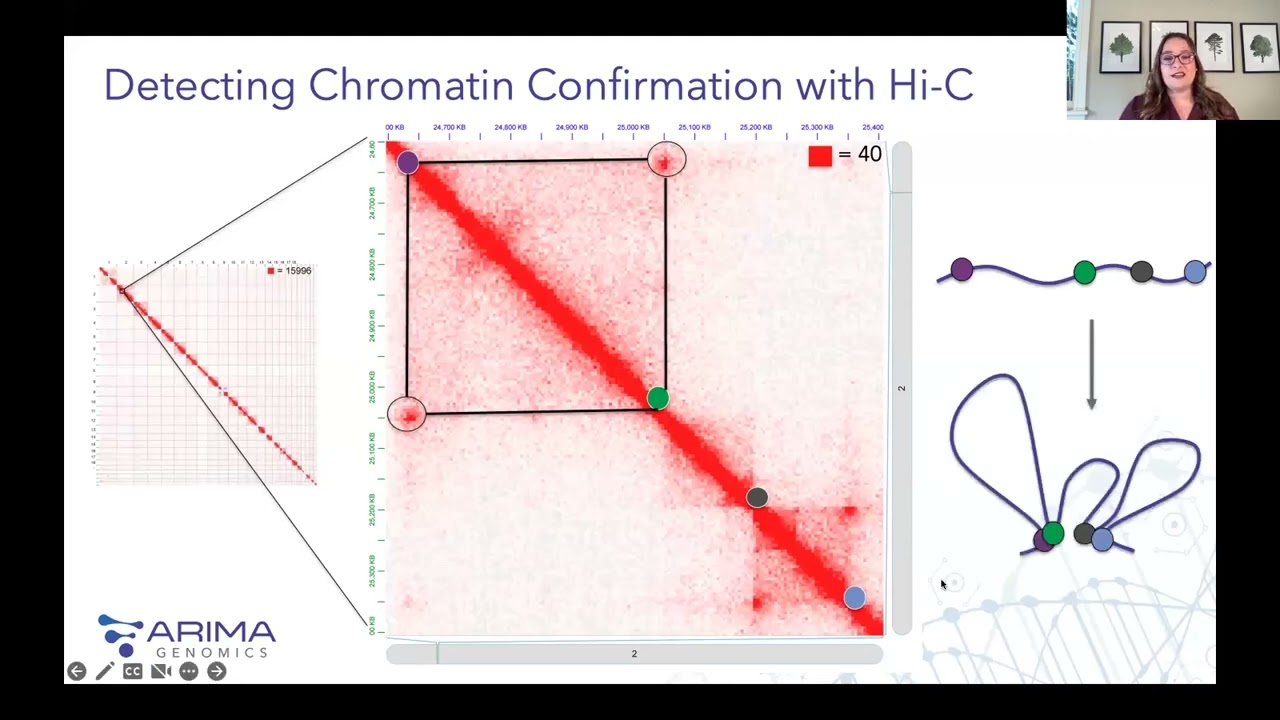
- Explanation of Hi-C data and its application in cancer research.
- Case studies showing detection of gene fusions in various cancers.
- Michael Johnston begins his talk on pediatric leukemia and structural variants.
- Discussion of Hi-C results in B-ALL patients and comparison with FISH.
- Q&A session and concluding remarks.
Cited Sources
- Arima Genomics website — Mentioned as the company providing the technology and resources.
- Nurk et al. (2022) - The complete sequence of a human genome — Referenced as the first complete human genome assembly using Hi-C data.
- Plotkin et al. (2020) - Nature Genetics — Study on MYC regulation in T-ALL using Hi-C.
- Dixon et al. (2018) - Nature Genetics — Paper on integrative approach to understanding structural variants in cancer.
Concurring Sources
- Arima Genomics website — Company website providing product information and resources.
Contribution & Novelties
The webinar highlights the novel application of Hi-C technology for detecting structural variants in pediatric leukemia patients, offering a non-invasive alternative to traditional methods like FISH. It demonstrates the ability to identify both known and novel gene fusions, providing comprehensive breakpoint information. The presentation also showcases the potential of Hi-C to uncover structural variants missed by other sequencing approaches, as illustrated in the pediatric glioblastoma case. This contributes to the growing evidence that 3D genomics can enhance cancer diagnosis and treatment guidance.
Pour aller plus loin :
- Hi-C (genomics) — Overview of the Hi-C technique and its applications.
- Structural variation — Definition and types of structural variants in the genome.
- Acute lymphoblastic leukemia — Background on the disease and its genetic basis.
- Fluorescence in situ hybridization — Traditional method for detecting chromosomal abnormalities.
133 words
Radar Profile
The radar profile shows high scores in quantitative information and technical level, reflecting the detailed scientific content. The quality of information and global reliability are slightly lower due to the commercial context, but still strong. The overall balance indicates a technically robust presentation with minor bias from the company's promotional angle.