Next Generation Epigenomics for Oncology: Dissecting Noncoding Regulatory Elements in Cancer Gen...
Keywords
Summary
174 words
Critical Evaluation
Value of the Information & Strength of the Argument
The webinar provides valuable insights into the application of Hi-C technology in oncology, demonstrating its utility in uncovering disease mechanisms and identifying potential drug targets. The argumentation is solid, supported by specific examples from published studies, including data on MYC regulation in leukemia and enhancer hijacking in ependymoma. The speakers effectively illustrate how 3D genome information can complement linear genomic data to provide a more complete understanding of gene regulation. However, the presentation is promotional, with a focus on Arima’s products, and the scientific depth is limited by the webinar format.
Scientific Rigor, Source Quality, Title Accuracy
The scientific rigor is high, as the speakers reference peer-reviewed publications and present data from their own research. The sources cited include studies from NYU and UCSD, as well as the work from Novartis. The title accurately reflects the content, which focuses on using epigenomics to dissect noncoding regulatory elements in cancer. The webinar is well-structured and the speakers are credible experts in the field.
171 words
Title / Content Match
The title accurately reflects the content, which focuses on using epigenomics (Hi-C) to dissect noncoding regulatory elements in cancer.
Quality & Reliability
8/10
The webinar presents a technical overview of Hi-C technology and its applications in oncology, featuring two expert speakers from Arima Genomics and Novartis. The content is based on published research and includes specific examples with data, but it is promotional in nature and lacks detailed methodological scrutiny.
Key Moments
Markers derived by PSI from the transcript: the creator did not define chapters.
- Introduction to Arima Genomics and the Hi-C technology platform.
- Overview of the Hi-C workflow: sample prep, library prep, sequencing, and bioinformatics.
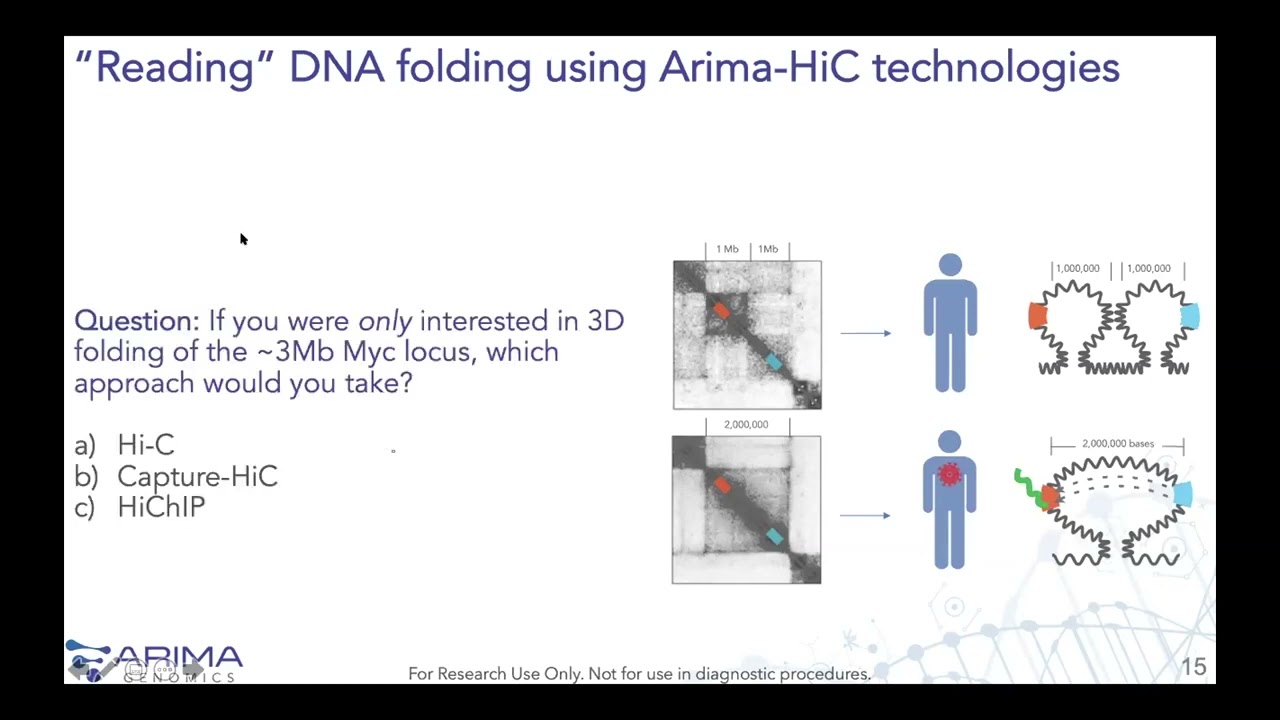
- Case study: MYC locus in leukemia, showing 3D genome changes and enhancer-promoter interactions.
- Case study: Ependymoma and enhancer hijacking, identifying a novel drug target.
- Dr. Gagliardi's talk: CRISPRi screens to identify functional regulatory elements for ER and cyclin D1.
- Q&A session and concluding remarks.
Cited Sources
- Arima Genomics website — Mentioned as the company's platform and products.
- Publication on MYC regulation in leukemia (NYU) — Referenced in the first case study, but no specific URL provided.
- Publication on ependymoma and enhancer hijacking (UCSD) — Referenced in the second case study, but no specific URL provided.
- Novartis research on ER and cyclin D1 regulatory elements — Referenced by Dr. Gagliardi, but no specific URL provided.
Concurring Sources
- Arima Genomics publications — The company's website lists peer-reviewed publications using their technology.
Contribution & Novelties
The webinar provides a clear demonstration of how Hi-C technology can be applied to oncology research, particularly in identifying 3D genome folding changes that contribute to cancer. The case studies illustrate the potential of Hi-C to uncover enhancer-promoter interactions and enhancer hijacking events, which are not easily detected by linear genomic approaches. The presentation also highlights the use of CRISPRi screens combined with Hi-C data to functionally validate regulatory elements, offering a powerful approach for drug target discovery.
Pour aller plus loin :
- Hi-C (genomics) — Overview of the Hi-C technique.
- Enhancer hijacking — Explanation of the mechanism.
- CRISPR interference (CRISPRi) — Description of the gene silencing technique.
108 words
Radar Profile
The radar profile shows high scores in information quality, technical level, and reliability, with a slightly lower score in information quantity due to the webinar's focused scope. This indicates a technically robust presentation with strong scientific content, but limited breadth.