Advances in Nuclear Topology Symposium 2022
Keywords
Summary
170 words
Critical Evaluation
Value of the Information & Strength of the Argument
The presentation provides valuable insights into the application of Hi-C for cancer genomics, particularly for detecting structural variants that are missed by conventional methods. The argumentation is based on a compelling case study and aggregate data from 140 tumors, but lacks detailed statistical analysis and peer-reviewed validation. The speaker effectively explains the technical advantages of Hi-C, such as its ability to work with FFPE tissues and detect proximal fusions. However, the talk is largely promotional for Arima’s products, and the evidence is presented without critical evaluation of limitations or potential biases.
Scientific Rigor, Source Quality, Title Accuracy
The presentation is scientifically grounded but relies heavily on proprietary technology and unpublished data. The speaker mentions collaborations with NYU and other institutions, but no specific sources are cited in the video. The title accurately reflects the content, which is a symposium presentation on nuclear topology. The talk is well-structured and technically detailed, but the lack of references and the commercial context reduce its scientific rigor.
172 words
Title / Content Match
The title accurately reflects the content, which is a presentation at a symposium on nuclear topology and 3D chromatin architecture.
Quality & Reliability
7/10
Presentation by a senior scientist from Arima Genomics, describing their proprietary Hi-C technology and its application to detect structural variants in cancer. The talk includes a case study and aggregate data from 140 tumors, but lacks detailed methodology and peer-reviewed references. The claims are plausible but not independently verified.
Key Moments
Markers derived by PSI from the transcript: the creator did not define chapters.
- Introduction by session chair and speaker introduction
- Anthony Schmitt begins talk, introduces Arima Genomics and their Hi-C technology
- Explains concept of 3D genomics and how Hi-C measures chromosome structure
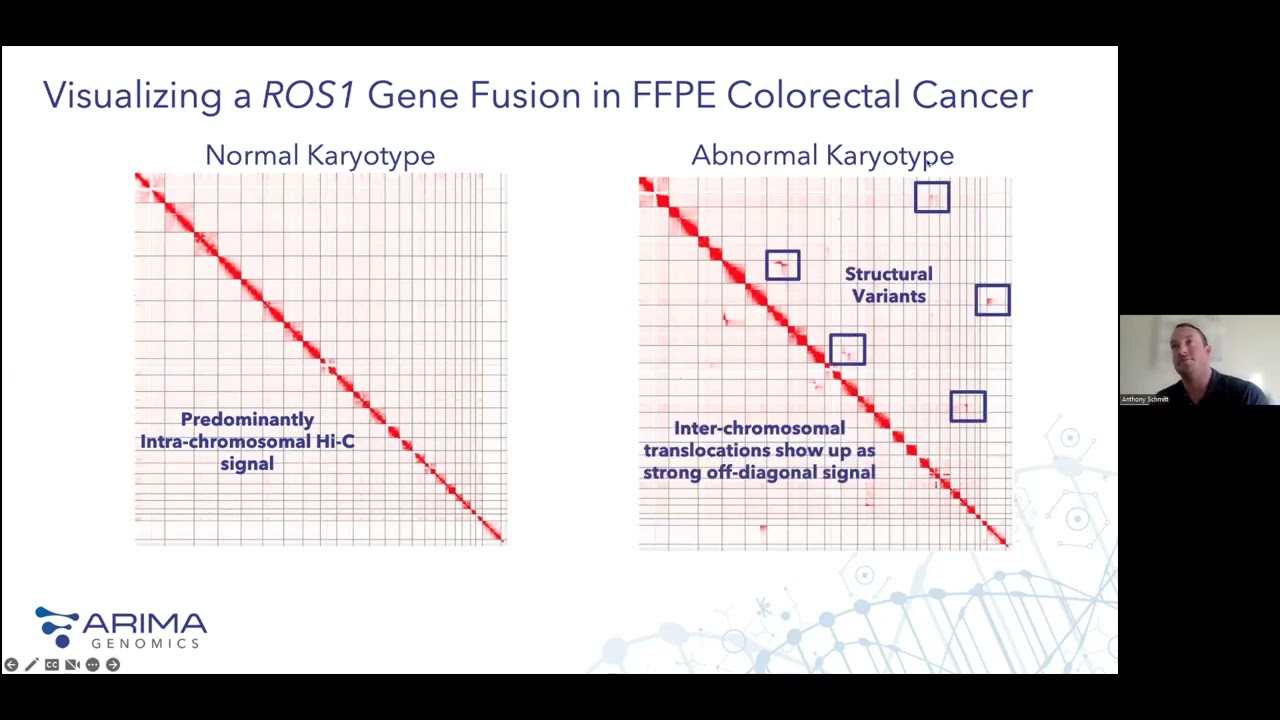
- Shows Hi-C heatmaps comparing normal and tumor samples, highlighting off-diagonal signals indicating structural variants
- Discusses advantages of DNA-based approach: detect known and novel fusions, work with archived FFPE tissues
- Case study: pediatric glioblastoma patient with no actionable driver found by standard methods, Hi-C identified PD-L1 structural variant, patient responded to immunotherapy
- Estimates hundreds of thousands of patients with advanced cancer and no actionable driver, discusses reasons for low diagnostic yield
- Highlights importance of proximal fusions (enhancer hijacking) in lymphoma and solid tumors, with examples
- Presents data from 140 driver-negative tumors, 33% had actionable fusions or proximal fusions
- Concludes with potential impact, mentions collaborators, and answers question about single-cell Hi-C
Contribution & Novelties
The talk presents Arima’s Hi-C technology as a novel approach for detecting structural variants in cancer, particularly in FFPE tissues and for proximal fusions. It provides a case study and aggregate data suggesting improved sensitivity over conventional methods. The presentation is original in its emphasis on the clinical utility of Hi-C for driver-negative tumors.
Pour aller plus loin :
- Hi-C (genomics) — Overview of Hi-C technology.
- Structural variation — General concept of structural variants.
- Enhancer hijacking — Mechanism of proximal fusions.
81 words
Radar Profile
The radar profile shows moderate scores across all dimensions, with slightly higher technical level and information quality, indicating a technically competent but not highly rigorous presentation.