Where Will Genomes Take Us Next: How Chromosome-Scale Assemblies Are Unlocking New Biology
Keywords
Summary
114 words
Critical Evaluation
Value of the Information & Strength of the Argument
The webinar provides substantial value by showcasing real-world applications of chromosome-scale assemblies across diverse species, from conservation to human health. The argumentation is solid, grounded in published research and case studies. The speakers present technical details clearly, demonstrating the utility of Hi-C and long-read sequencing in resolving complex genomes. The panel discussion adds depth, addressing challenges like repetitive regions and the need for computational tools. Overall, the content is informative and persuasive, highlighting the transformative potential of genomics.
Scientific Rigor, Source Quality, Title Accuracy
The scientific rigor is high, with speakers referencing their own published work and large-scale initiatives like the Vertebrate Genomes Project and the Darwin Tree of Life. The sources cited are credible, including peer-reviewed papers and public databases. The title accurately reflects the content, which focuses on the future of genomics through chromosome-scale assemblies. The webinar includes a brief promotional segment for Arima Genomics’ grant, but it is clearly separated and does not affect the scientific content.
169 words
Title / Content Match
The title accurately reflects the content, which focuses on the applications and methods of chromosome-scale genome assemblies in various biological fields.
Quality & Reliability
8/10
The webinar features experts from the Vertebrate Genomes Project and the University of Copenhagen, presenting peer-reviewed research and established methods. The content is technical and accurate, with references to published studies and public resources. Minor promotional content for Arima Genomics is present but does not undermine the scientific value.
Key Moments
Markers derived by PSI from the transcript: the creator did not define chapters.
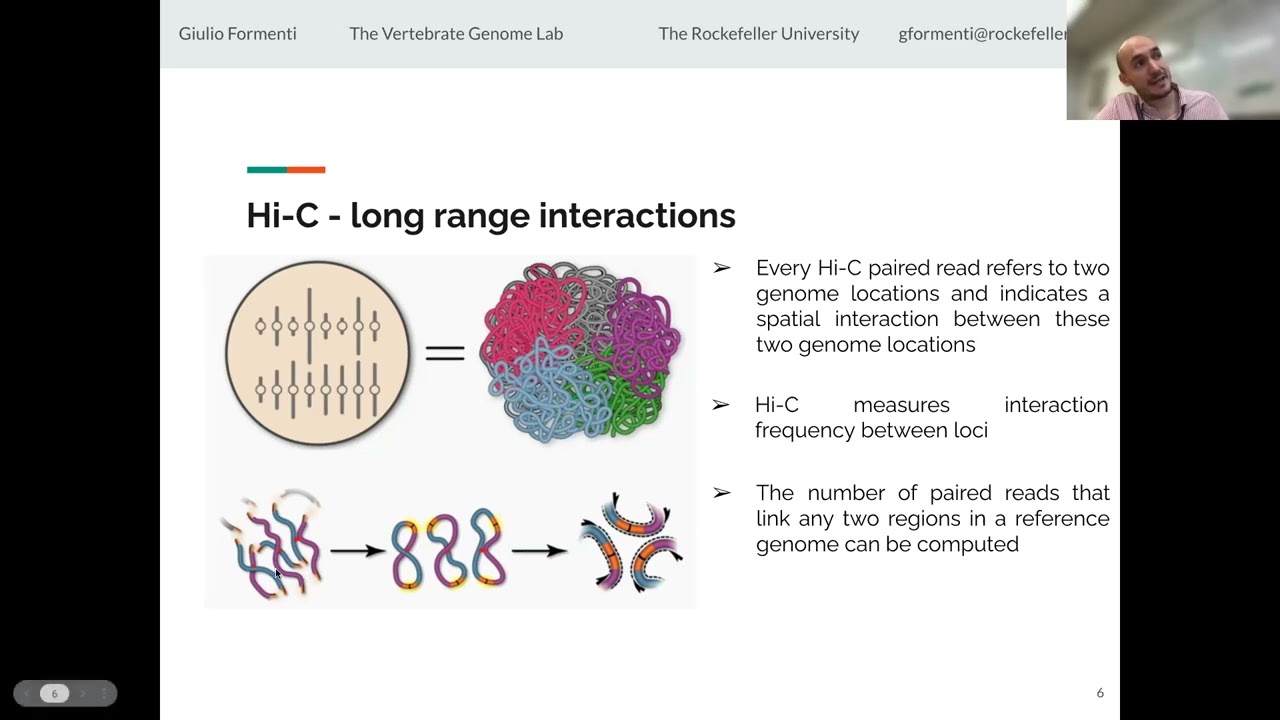
- Introduction to Hi-C technology and its role in genome assembly
- Julio Fernàndez presents the Vertebrate Genomes Project and its goals
- Discussion on using Hi-C for scaffolding and phasing in genome assembly
- Shilpa Garg introduces computational methods for haplotype-resolved assemblies
- Application of methods to cancer genomics and structural variant calling
- Panel discussion on challenges and future directions in genome assembly
Cited Sources
- Vertebrate Genomes Project — Mentioned by Julio Fernàndez as the initiative he works on.
- Galaxy platform — Mentioned as a public infrastructure for running assembly pipelines.
- Arima Genomics — Host of the webinar and provider of Hi-C kits.
Concurring Sources
- Vertebrate Genomes Project — Aligned with the webinar's emphasis on high-quality reference genomes.
- Arima Genomics — The host company, providing Hi-C technology discussed in the webinar.
Contribution & Novelties
The webinar provides a comprehensive overview of the latest advancements in chromosome-scale genome assembly, emphasizing the integration of Hi-C and long-read sequencing. It highlights novel applications in conservation genomics, cancer research, and biodiversity, showcasing how these technologies enable the reconstruction of complex genomes. The speakers present new computational methods that improve haplotype phasing and structural variant detection, offering practical insights for researchers.
Pour aller plus loin :
- Hi-C (genomics) — Overview of Hi-C technology and its applications.
- Vertebrate Genomes Project — Official site with details on the project’s goals and progress.
- Hifiasm — A tool for haplotype-resolved assembly using long reads, mentioned in the webinar.
105 words
Radar Profile
The radar chart shows high scores in quantity and quality of information, with a slightly lower technical level, indicating that the content is rich and reliable but may require some background knowledge. The overall profile suggests a well-balanced, informative webinar suitable for an audience with some genomics familiarity.
💬 Sur les 0 commentaires analysés, aucune tendance n'est disponible.