3D Genomics for Structural Variant Detection: Technology Update
Keywords
Summary
167 words
Critical Evaluation
Value of the Information & Strength of the Argument
The presentation provides valuable insights into the application of 3D genomics for structural variant detection, with a strong emphasis on the advantages of Hi-C technology. The argumentation is well-structured, starting with foundational concepts and building up to specific examples. The speaker effectively explains complex topics such as the hierarchical organization of the genome and the challenges of detecting structural variants with traditional methods. He supports his claims with references to published studies and demonstrates the utility of the technology through case studies. However, the presentation is inherently promotional, as it focuses on Arima’s products, which may introduce bias. The technical depth is high, making it suitable for an audience with some background in genomics.
Scientific Rigor, Source Quality, Title Accuracy
The presentation demonstrates scientific rigor by referencing key publications in the field, such as the pioneering work by Feng et al. on Hi-C-based structural variant detection. The speaker also acknowledges limitations of the technology, such as the inability to detect variants fully contained within repeat regions. The quality of sources is generally good, with citations to peer-reviewed literature. The title accurately reflects the content, as the talk is indeed a technology update on 3D genomics for structural variant detection. The presentation is well-organized and the claims are supported by data, though the promotional nature of the webinar should be considered when evaluating objectivity.
232 words
Title / Content Match
The title accurately reflects the content: a technology update on using 3D genomics for structural variant detection.
Quality & Reliability
7/10
The video is a technical presentation by an R&D lead from Arima Genomics, providing a detailed overview of 3D genomics and their new products. It includes specific technical details and references to published studies, but it is primarily a promotional webinar for their technology, with limited independent verification.
Key Moments
Markers derived by PSI from the transcript: the creator did not define chapters.
- Introduction and overview of the presentation
- Explanation of 3D genome organization and its hierarchical layers
- Discussion on the biological relevance of 3D genome features and their pathological implications
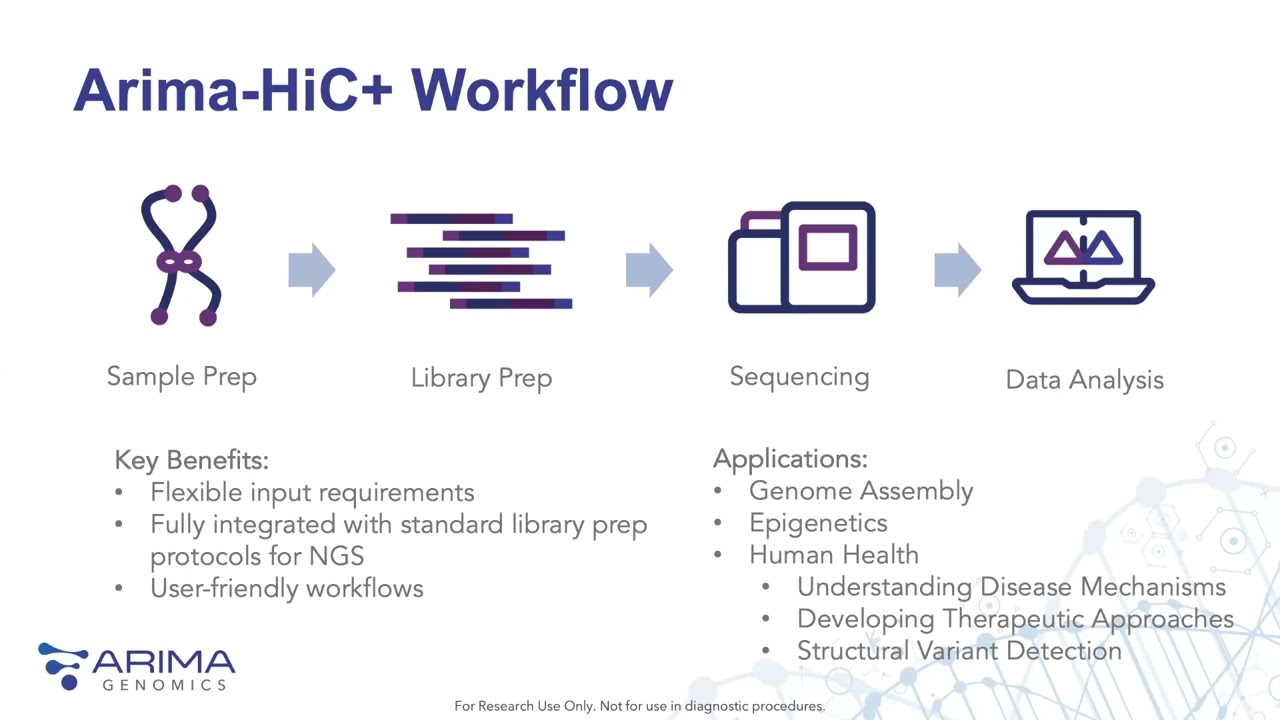
- Introduction to Arima Hi-C technology and its applications
- Overview of structural variants in disease and the role of Hi-C in detecting them
- Advantages of Hi-C over traditional sequencing for structural variant detection
- Challenges with FFPE samples and new product announcements
- Introduction of the Arima SV bioinformatics pipeline and its features
- Examples of Hi-C data in normal and cancer samples
- Case study: detecting a ROS1 fusion in colorectal cancer
Cited Sources
- Hi-C detects structural variants in cancer genomes — Referenced as a pioneering paper for Hi-C-based structural variant detection
- Duan lab review on 3D genome organization — Cited as a review on the biological relevance of 3D genome features
Concurring Sources
- Hi-C detects structural variants in cancer genomes — The paper referenced in the video supports the use of Hi-C for SV detection.
Contribution & Novelties
The presentation offers an update on Arima Genomics’ technology for structural variant detection using 3D genomics, highlighting new capabilities for FFPE samples and a bioinformatics pipeline. The main novelty is the integration of Hi-C with an SV detection pipeline, enabling the detection of gene fusions and non-coding structural variants, and linking them to gene regulation. This approach provides a more comprehensive view of structural variants compared to traditional methods.
Pour aller plus loin :
- Hi-C: A comprehensive guide — Provides background on the Hi-C technique.
- Structural variation in the human genome — Overview of structural variants from the National Human Genome Research Institute.
- Juicebox: A visualization tool for Hi-C data — Tool mentioned in the presentation for visualizing Hi-C data.
120 words
Radar Profile
The radar profile shows high scores in quantity of information and technical level, reflecting the detailed and specialized content. Quality of information is also high, but the promotional nature of the presentation slightly reduces the overall reliability score. The fiabilite_globale is moderate, indicating that while the information is credible, it is presented from a company perspective.
💬 No comments were provided for analysis.