Unveiling the Power of 3D Genomics: Decoding Extreme Structural Heterogeneity in Glioblastoma (E...
Keywords
Summary
120 words
Critical Evaluation
Value of the Information & Strength of the Argument
The webinar provides valuable insights into the application of 3D genomics in cancer research. Dr. Sicking’s presentation effectively demonstrates the utility of Hi-C in identifying clinically actionable structural variants, supported by a compelling case study. Dr. Papantonis’s research is groundbreaking, revealing the extent of structural heterogeneity in GBM and proposing a mechanism by which SVs create neoloops that drive tumor-specific gene expression. The argumentation is solid, based on high-resolution Hi-C data and validated with simulations and functional experiments. However, the promotional nature of the webinar and the lack of peer-reviewed details for some claims slightly reduce the overall value.
Scientific Rigor, Source Quality, Title Accuracy
The scientific rigor is high, with both speakers referencing published studies and providing detailed methodology. Dr. Sicking cites the T2T Consortium and a study by Plotkin et al., while Dr. Papantonis references his preprint on bioRxiv. The sources are credible and relevant. The title accurately reflects the content, focusing on 3D genomics and structural heterogeneity in glioblastoma. The webinar is well-structured, with clear explanations of complex concepts, making it accessible to a scientific audience.
188 words
Title / Content Match
The title accurately reflects the content, focusing on 3D genomics and structural heterogeneity in glioblastoma.
Quality & Reliability
8/10
The webinar features two expert speakers (Dr. Kristen Sicking and Dr. Argyris Papantonis) presenting peer-reviewed research and clinical case studies. The content is well-structured, with clear methodology and data interpretation. However, as a webinar, it includes promotional elements for Arima's products, and the scientific claims are not independently verified in this context.
Key Moments
Markers derived by PSI from the transcript: the creator did not define chapters.
- Introduction to the webinar and speakers.
- Dr. Sicking introduces 3D genomics and Arima's technology.
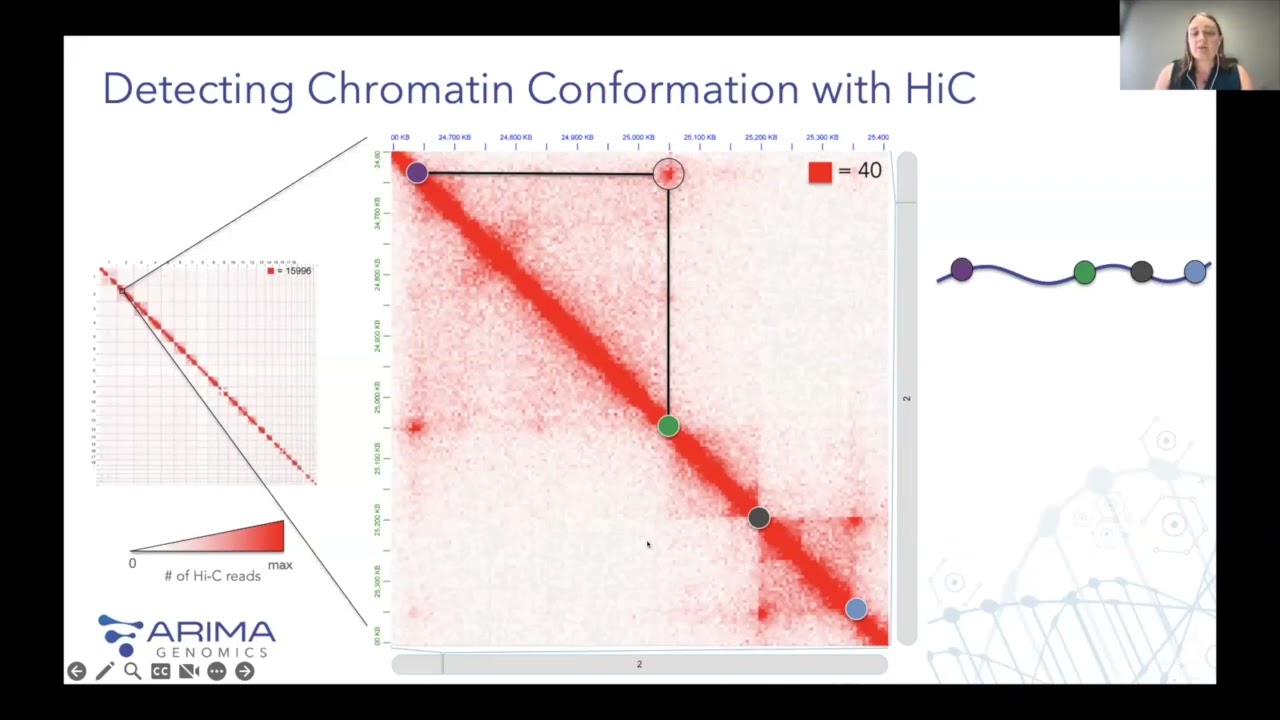
- Explanation of Hi-C workflow and data visualization.
- Case study: PDL1 fusion identified by Hi-C in a pediatric glioma patient.
- Discussion on using Hi-C to detect structural variants and gene fusions.
- Dr. Papantonis begins his talk on glioblastoma heterogeneity.
- Presentation of Hi-C data from 28 GBM stem cell lines.
- Identification of thousands of structural variants and neoloops.
- Analysis of neoloops and their impact on gene regulation.
- Discussion of patient-specific vulnerabilities and biomarkers.
- Q&A session begins.
Cited Sources
- Preprint on bioRxiv — Dr. Papantonis mentions his preprint on the spatial organization of glioblastoma genomes.
- T2T Consortium — Dr. Sicking references the T2T Consortium's use of Hi-C to scaffold the complete human genome.
- Plotkin et al. study — Dr. Sicking cites a study on T-ALL using Hi-C to investigate MYC regulation.
Concurring Sources
- Arima Genomics website — The company's official site provides information on their Hi-C products and services.
Contribution & Novelties
This webinar provides a comprehensive overview of 3D genomics applications in cancer research, with a focus on glioblastoma. The key novelty is the discovery of extreme structural heterogeneity in GBM, with over 3,100 structural variants and 6,300 neoloops, which are new enhancer-promoter contacts that sustain tumor-specific transcriptional programs. This work highlights the potential of Hi-C to uncover patient-specific vulnerabilities and biomarkers, offering new avenues for targeted therapies.
Pour aller plus loin :
- Hi-C (genomic technique) — Overview of the Hi-C method.
- Structural variation — General concept of structural variants in genomics.
- Enhancer-promoter interactions — Role of enhancers in gene regulation.
100 words
Radar Profile
The radar profile shows high scores in quantity, quality, and reliability, with a slightly lower technical level, reflecting the webinar's balance between detailed scientific content and accessibility. The overall high scores indicate a valuable resource for researchers interested in 3D genomics and cancer biology.
💬 No comments were provided for analysis.