Leveraging the 3D Genome in Translational Research
Keywords
Summary
122 words
Critical Evaluation
Value of the Information & Strength of the Argument
The talk provides valuable insights into the utility of 3D genome profiling for identifying disease mechanisms and biomarkers. The case studies are well-chosen and illustrate the power of Hi-C in linking non-coding variants to gene expression changes. The argumentation is coherent, but the presentation is promotional, and the speaker does not critically discuss limitations or alternative approaches. The scientific value is moderate, as the content is based on published research but presented at a high level.
Scientific Rigor, Source Quality, Title Accuracy
The talk references two peer-reviewed papers (Monti et al., Cancer Discovery; Achinger-Kawecka et al., Nature Communications) and a preprint, but does not provide full citations. The title accurately reflects the content. The speaker is a product manager, not an independent researcher, which may introduce bias. The scientific rigor is acceptable, but the lack of detailed methodology and potential conflicts of interest lower the reliability score.
156 words
Title / Content Match
The title accurately reflects the content, which focuses on applying 3D genome profiling to translational research and biomarker discovery.
Quality & Reliability
7/10
The speaker is a product manager at Arima Genomics, a company specializing in Hi-C technology. The talk presents two case studies from peer-reviewed publications (Cancer Discovery and Nature Communications) and a preprint, but the presentation is promotional and lacks detailed methodological scrutiny. The scientific content is accurate but simplified.
Key Moments
Markers derived by PSI from the transcript: the creator did not define chapters.
- Introduction to 3D genome profiling and its importance.
- Explanation of genome organization: territories, compartments, TADs, loops.
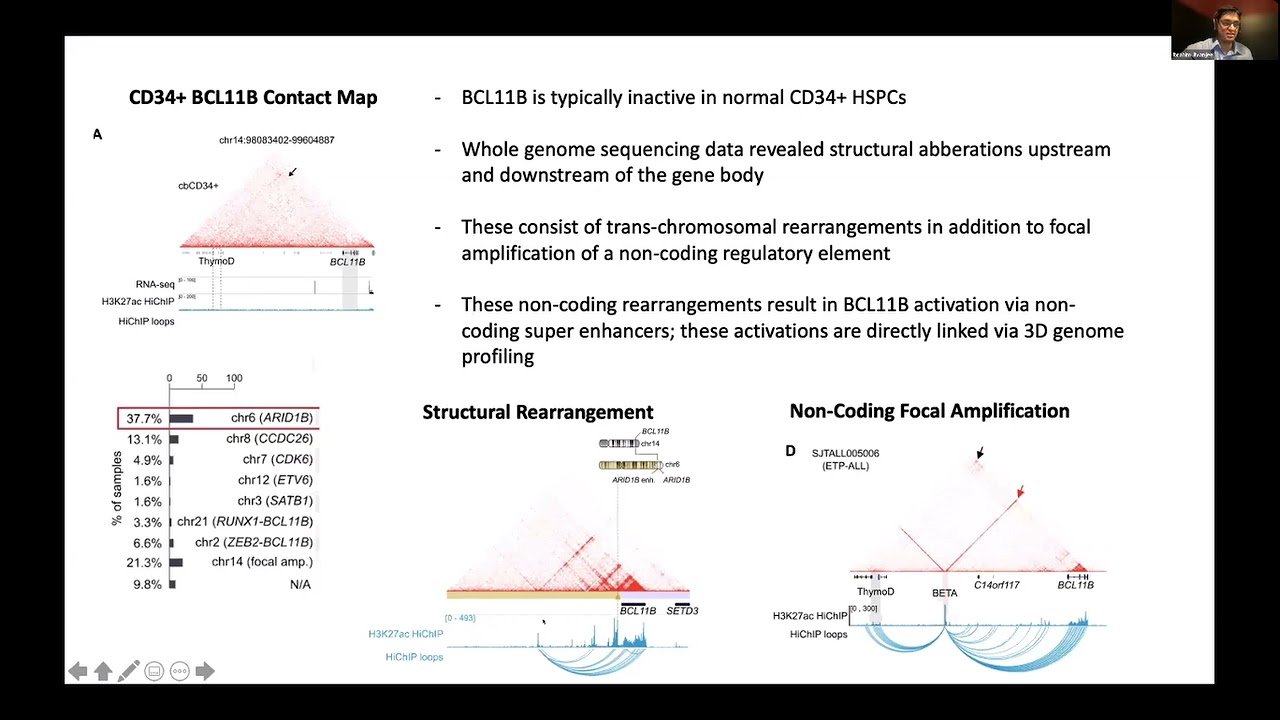
- Case study 1: Enhancer hijacking in leukemia (BCL11B).
- Case study 2: Endocrine-resistant breast cancer and decitabine.
- Overview of Arima's technology platform and applications.
Cited Sources
- Enhancer hijacking drives oncogenic BCL11B expression in lineage-ambiguous stem cell leukemia — Referenced as the first case study on enhancer hijacking.
- Epigenetic reprogramming of estrogen receptor binding sites — Referenced as the second case study on endocrine-resistant breast cancer.
Concurring Sources
- Hi-C: A comprehensive technique to capture the conformation of genomes — General reference for Hi-C technology.
Contribution & Novelties
The talk highlights the added value of 3D genome profiling over linear genomics, particularly in detecting non-coding structural variants and linking them to gene regulation. It demonstrates practical applications in cancer subtyping and therapeutic response prediction. The presentation is informative for researchers new to the field.
Pour aller plus loin :
- Hi-C (genomics) — Overview of the Hi-C technique.
- Topologically associating domain — Explanation of TADs and their role in gene regulation.
- Enhancer hijacking — Concept of enhancer hijacking in cancer.
81 words
Radar Profile
The radar profile shows balanced scores, with slightly higher values for information quantity and reliability, reflecting the solid scientific basis but moderate technical depth and promotional tone.