Illuminating the Human Retina with 3D Genomics: Leveraging Chromatin Architecture to Understand ...
Keywords
Summary
165 words
Critical Evaluation
Value of the Information & Strength of the Argument
The webinar provides valuable information on the application of 3D genomics to retinal research. The argumentation is solid, with clear explanations of the methodology and results. The presenters effectively demonstrate how integrating Hi-C data with other epigenomic datasets can identify functional regulatory elements and link them to disease-associated variants. The examples from cancer research illustrate the potential of 3D genomics to uncover disease mechanisms. The argumentation is supported by published studies and the presenters’ own research, which adds credibility.
Scientific Rigor, Source Quality, Title Accuracy
The scientific rigor is high, with references to published studies and detailed methodology. The sources cited include the Telomere-to-Telomere Consortium paper in Science, the study on T-ALL in Nature Genetics, and the Ewing sarcoma research. The title accurately reflects the content, focusing on the use of 3D genomics to understand the retina and blinding diseases. The presentation is well-structured and the claims are supported by data.
160 words
Title / Content Match
The title accurately reflects the content, which focuses on using 3D genomics to study the human retina and understand blinding diseases.
Quality & Reliability
8/10
The webinar is presented by experts from Arima Genomics and the National Eye Institute, with a clear methodology and references to published studies. The content is technical and specific, with a focus on research findings. However, it is a promotional webinar, and some claims may be biased towards the company's technology.
Key Moments
Markers derived by PSI from the transcript: the creator did not define chapters.
- Introduction to 3D genomics and its importance in understanding genome function.
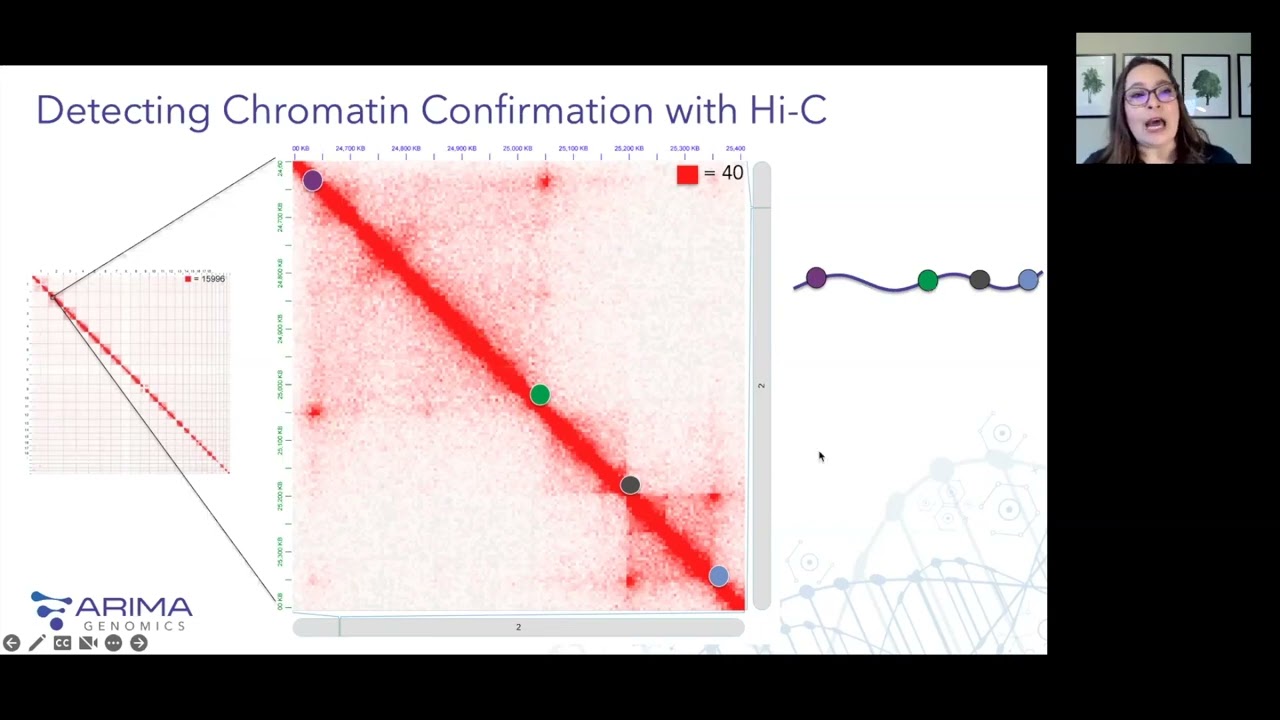
- Explanation of Hi-C technology and how it captures 3D chromatin interactions.
- Example of 3D genomics in T-ALL, showing how enhancer-promoter interactions are altered.
- Example of Ewing sarcoma and how the EWS-FLI1 fusion protein reconfigures chromatin architecture.
- Introduction to Dr. Ximena Corso Diaz and her research on retinal gene regulation.
- Presentation of Hi-C maps of the human retina and identification of cis-regulatory elements.
- Discussion of super-enhancers and their role in retinal gene regulation.
Cited Sources
- Telomere-to-Telomere Consortium — Reference for the complete human genome assembly and Hi-C data.
- Plotin et al., Nature Genetics 2020 — Study on T-ALL showing 3D genome alterations in oncogene regulation.
- Ewing sarcoma research — Study on EWS-FLI1 and chromatin reprogramming in Ewing sarcoma.
Concurring Sources
- Telomere-to-Telomere Consortium — Provides reference Hi-C data for the human genome.
- Plotin et al., Nature Genetics 2020 — Supports the use of 3D genomics to understand disease mechanisms.
Contribution & Novelties
This webinar provides a comprehensive overview of 3D genomics and its application to retinal research. The main novelty is the use of Hi-C to generate chromatin contact maps of the human retina, which were integrated with epigenomic data to identify cis-regulatory elements and super-enhancers. This approach allows for the linking of non-coding genetic variants to target genes, which is crucial for understanding the genetic basis of retinal diseases. The presentation also highlights the conservation of chromatin architecture between mouse and human retinas, providing a foundation for future studies.
Pour aller plus loin :
- Hi-C: A comprehensive technique to capture the conformation of genomes — This paper describes the Hi-C method in detail.
- Super-enhancers in the control of cell identity and disease — This article discusses the role of super-enhancers in gene regulation.
- CRX and NRL transcription factors in retinal development — This review covers the role of these factors in photoreceptor development.
152 words
Radar Profile
The radar profile shows high scores in all dimensions, indicating a well-rounded and reliable presentation. The high scores in information quantity and quality reflect the detailed and accurate content, while the technical level is appropriate for a scientific audience. The overall reliability is high, with no major discrepancies noted.
💬 No comments were provided for analysis.