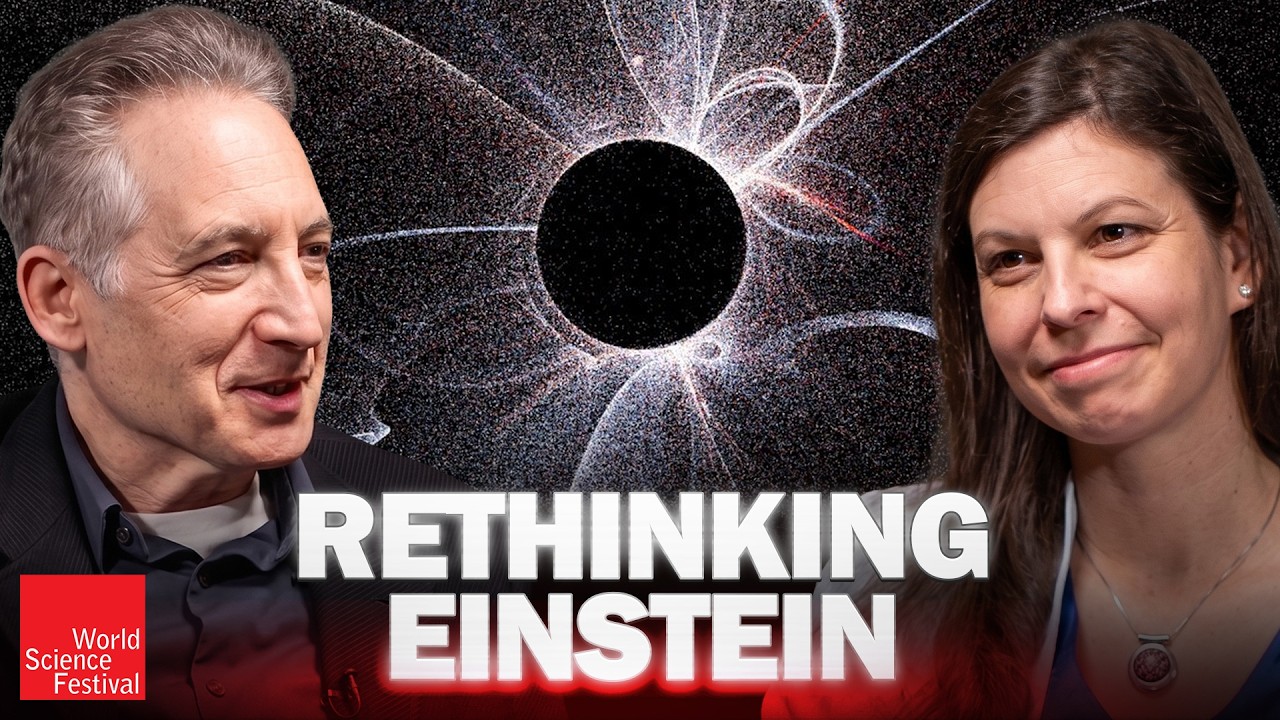
Does Einstein Need an Upgrade? | World Science Festival
Keywords
Summary
173 words
Critical Evaluation
The video presents a high-level, expert discussion on a cutting-edge topic in theoretical physics: massive gravity. Claudia de Rham is a leading researcher in this field, and her explanations are both authoritative and accessible. The conversation is well-structured, starting with the basics of gravity and gradually building up to the complexities of massive gravity and its implications for cosmology. The scientific rigor is high: they carefully distinguish between established facts, theoretical possibilities, and open questions. They also address potential criticisms and the historical context of the theory, including the no-go theorems and the Boulware-Deser ghost problem. The sources cited are primarily the researchers’ own work and the broader literature, which is appropriate for a discussion of this nature. The title is apt, as the central question is whether Einstein’s theory needs modification, and the content directly addresses this. The production quality is excellent, with clear visuals and editing that enhances understanding. The only minor weakness is that the discussion is quite technical and may be challenging for a general audience, but this is not a flaw in the content itself. Overall, this is an outstanding example of science communication, providing deep insights into the frontiers of gravitational physics.
198 words
Title / Content Match
The title is engaging and accurately reflects the central question about the necessity of Einstein's theory and potential modifications.
Quality & Reliability
9/10
Discussion between two eminent physicists (Brian Greene and Claudia de Rham) on a well-defined theoretical topic. The content is rigorous, up-to-date, and presented with appropriate nuance. The World Science Festival is a reputable science communication platform.
Chapters
- Did Einstein Have Any Choice in Creating His Theory?
- Why Gravity Captivates Us From the Start
- How Einstein Reimagined Gravity as the Geometry of Spacetime
- Thinking of Gravity Like Electromagnetism
- Is Gravity Quantum Mechanical?
- What Is the Speed of Light, Really?
- How Hard Is It to Give the Photon a Mass?
- The Graviton: What We Know and What We've Bounded
- The First Attempt at Massive Gravity
- Extra Dimensions and Copies of Gravity With Mass
- Why a Massive Graviton Seemed Impossible
- A Way Out of the Discontinuity
- Why the the Boulware-Deser Ghost Theory Seemed to Break Down
- The Cosmological Constant Problem
- Massive Gravity as a Solution to Accelerated Expansion
- How the Theory Finally Became Mathematically Consistent
- Numerical Solutions: Black Holes in Massive Gravity
- How Well Does It Solve the Original Cosmological Problem?
- What to Look For in Gravitational Waves
- What Would Einstein Think of Massive Gravity?
- Is There Beauty in a More Complex Theory of Gravity?
Cited Sources
- World Science Festival — Official website of the World Science Festival, the organization producing this program.
- World Science Festival on LinkedIn — LinkedIn page of the World Science Festival, providing additional context about the organization.
- World Science Festival YouTube Channel — YouTube channel where the video is hosted, with subscription link.
- Video URL — Direct link to the video on YouTube.
Concurring Sources
- Massive Gravity - Wikipedia — Provides a general overview of massive gravity, consistent with the video's content.
- Cosmological constant - Wikipedia — Explains the cosmological constant problem, which the video discusses as a motivation.
Dissenting Sources
- No-go theorems for massive gravity — The video mentions historical no-go theorems that seemed to rule out massive gravity, but these were later circumvented. This is a point of contention in the literature.
Contribution & Novelties
This video provides a unique opportunity to hear directly from a leading researcher in massive gravity, Claudia de Rham, as she explains the motivations, challenges, and potential of this theory. It offers an accessible yet rigorous overview of a topic that is often confined to specialized literature. The discussion clarifies common misconceptions and highlights the current state of research, making it a valuable resource for both students and enthusiasts.
Pour aller plus loin :
- Massive gravity - Wikipedia — A comprehensive overview of the theory, its history, and its variants.
- Cosmological constant - Wikipedia — Background on the cosmological constant problem, which is central to the motivation for massive gravity.
- Graviton - Wikipedia — Information on the hypothetical graviton particle and its properties.
- Claudia de Rham - Imperial College London — Her academic profile and list of publications.
138 words
Radar Profile
The radar profile shows high scores across all dimensions, indicating a well-rounded and reliable video. The strongest aspects are the quantity and quality of information, while the technical level is also high, making it suitable for an audience with some physics background.
💬 Très positif. Sur les 30 commentaires analysés, le public exprime une admiration marquée pour Claudia de Rham et Brian Greene, saluant la clarté des explications et la profondeur de la discussion. Plusieurs commentaires humoristiques sur les tics de langage de Claudia de Rham, mais dans un esprit bienveillant.