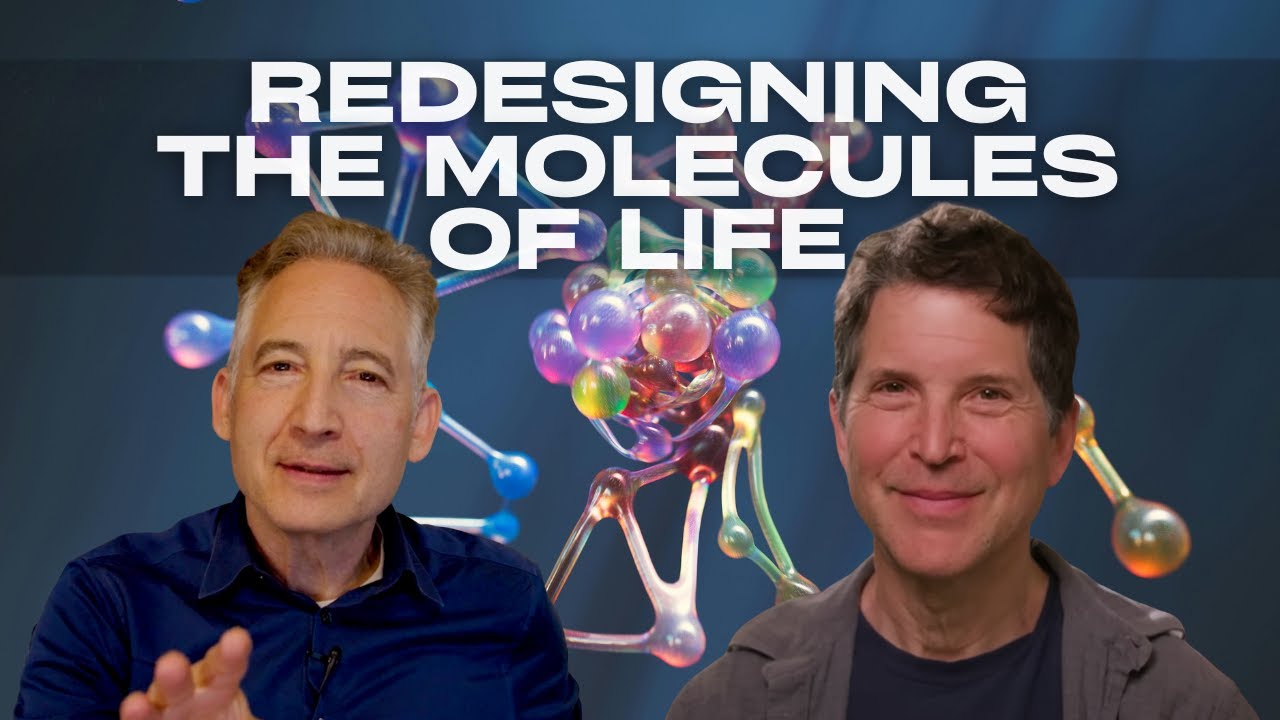
Redesigning The Molecules of Life | Brian Greene & David Baker | World Science Festival
Keywords
Summary
156 words
Critical Evaluation
The conversation provides an excellent overview of the field of protein design, featuring a Nobel laureate who is a leading figure in the field. David Baker’s explanations are clear and accessible, making complex topics understandable without oversimplifying. The discussion is grounded in established scientific principles, and Baker’s authority ensures a high level of accuracy. The argumentation is solid, with Baker logically explaining the progression from understanding protein folding to designing new proteins. The sources cited are primarily Baker’s own work and the general scientific literature, which are appropriate for the topic. The title accurately reflects the content, which focuses on redesigning proteins for novel functions. The conversation is well-structured, covering both fundamental concepts and cutting-edge applications. One minor limitation is that the discussion is relatively high-level and does not delve into technical details, but this is appropriate for a general audience. Overall, this is a high-quality, informative, and inspiring discussion that effectively communicates the excitement and potential of protein design.
160 words
Title / Content Match
The title accurately reflects the content, which focuses on redesigning proteins for novel functions.
Quality & Reliability
9/10
Discussion with Nobel laureate David Baker, a leading expert in protein design, providing authoritative insights into computational protein design and its applications. The conversation is grounded in established scientific principles and recent breakthroughs, with no apparent misinformation.
Key Moments
Markers derived by PSI from the transcript: the creator did not define chapters.
- Introduction of David Baker and his background.
- Discussion on the role of proteins in biology.
- Explanation of protein folding and its importance.
- Baker describes the shift from studying natural proteins to designing new ones.
- Discussion on computational methods and deep learning in protein design.
- Applications of designed proteins in medicine and materials.
- Baker reflects on the future of protein design and its implications.
Cited Sources
- World Science Festival — Official website of the World Science Festival, the organization producing this video.
- World Science Festival LinkedIn — LinkedIn page of the World Science Festival, providing additional context about the organization.
- World Science Festival YouTube Channel — YouTube channel of the World Science Festival, where this video is hosted.
Concurring Sources
- AlphaFold — AlphaFold is a deep learning system developed by DeepMind for predicting protein structures, which aligns with the discussion on AI in protein science.
- Rosetta@home — Rosetta@home is a distributed computing project for protein structure prediction and design, which is relevant to the computational methods discussed.
Contribution & Novelties
This video provides a unique opportunity to hear directly from a Nobel laureate about the cutting-edge field of protein design, offering insights into the transition from discovery to design in biology. It highlights the role of AI and deep learning in accelerating scientific progress, and the potential for engineered proteins to address global challenges.
Pour aller plus loin :
- AlphaFold — AI system for protein structure prediction, a key tool in the field.
- Rosetta@home — Distributed computing project for protein structure prediction and design.
- De novo protein design — Overview of the field of designing new proteins from scratch.
99 words
Radar Profile
The radar profile shows high scores across all dimensions, indicating a well-rounded and authoritative discussion. The video excels in information quantity and quality, with a strong technical level and high reliability.
💬 Très positif. Sur les 30 commentaires analysés, les spectateurs expriment une admiration unanime pour la clarté des explications et la profondeur des connaissances des intervenants, saluant la qualité de la discussion et son caractère inspirant.