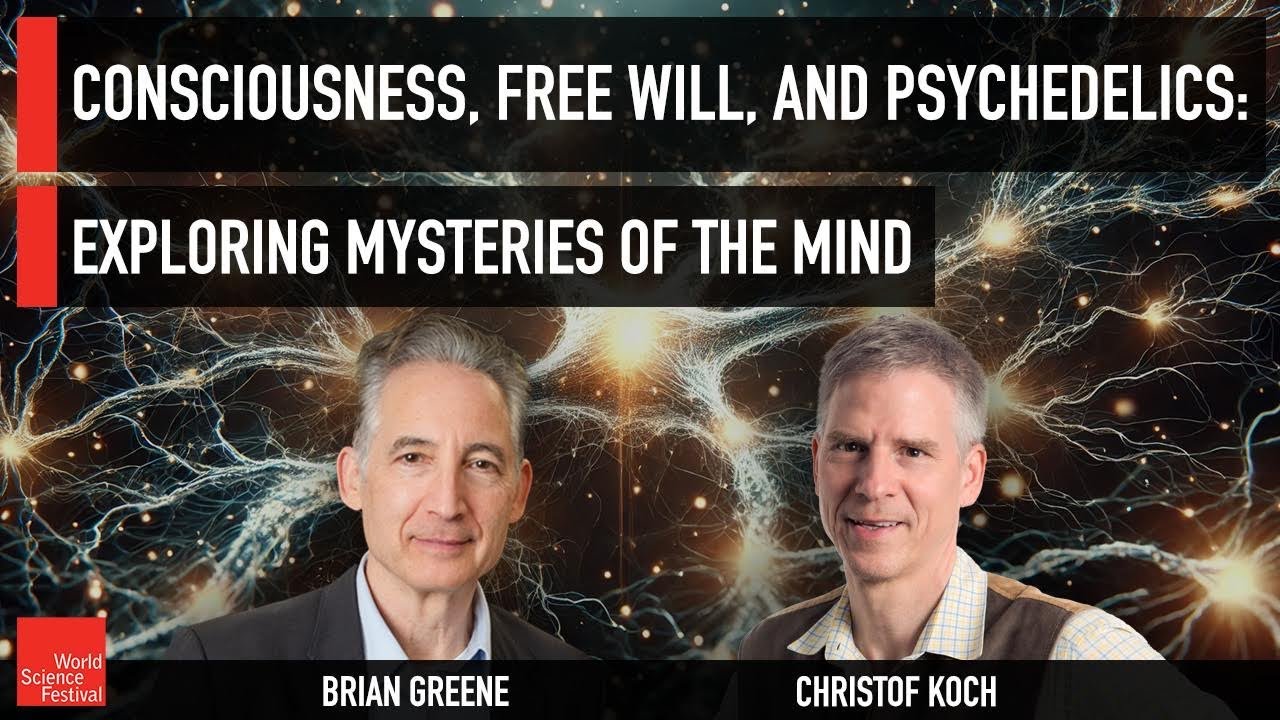
Consciousness, Free Will, and Psychedelics: Exploring Mysteries of the Mind | World Science Festival
Keywords
Summary
170 words
Critical Evaluation
The conversation between Brian Greene and Christof Koch offers a rich and insightful exploration of consciousness, free will, and psychedelics, drawing on Koch’s extensive scientific background and personal experiences. Koch’s expertise is evident as he navigates complex topics with clarity and depth, providing a nuanced perspective that bridges neuroscience, physics, and philosophy. The discussion is intellectually stimulating, with Koch articulating the hard problem of consciousness and the limitations of current scientific approaches. He candidly admits that despite decades of research, a comprehensive theory of consciousness remains elusive, and he advocates for a pluralistic approach that includes both empirical investigation and theoretical frameworks like integrated information theory (IIT).
The strength of the conversation lies in its ability to make profound scientific and philosophical questions accessible without oversimplifying them. Koch’s personal anecdotes, such as his experiences with psychedelics and his reflections on death, add a human dimension that enhances the discussion. However, some of his claims, particularly regarding panpsychism and the causal power of consciousness, are speculative and not universally accepted within the scientific community. While Koch presents these ideas as personal perspectives, they may be misinterpreted by viewers as established scientific facts.
The moderation by Brian Greene is excellent, as he asks probing questions that guide the conversation without imposing his own views. The pacing is appropriate, allowing for deep dives into each topic. The production quality is high, with clear audio and visuals.
In terms of scientific rigor, the conversation is grounded in Koch’s research and the broader literature on consciousness. However, it is important to note that this is an expert opinion discussion rather than a peer-reviewed presentation. Some claims, such as the specific neural correlates of consciousness, are well-supported, while others, like the role of psychedelics in revealing the nature of consciousness, are more anecdotal.
The title accurately reflects the content, and the conversation delivers on its promise to explore the mysteries of the mind. Overall, this is an excellent resource for anyone interested in consciousness, offering both scientific depth and personal insight.
335 words
Title / Content Match
The title accurately reflects the content: a conversation about consciousness, free will, and psychedelics, with a focus on Christof Koch's scientific and personal insights.
Quality & Reliability
8/10
Discussion between two renowned scientists (Christof Koch and Brian Greene) with high expertise in neuroscience and physics. The content is based on decades of research and personal experience, but it is an opinion/expert discussion rather than a peer-reviewed study. The claims are generally well-supported by scientific consensus, though some speculative elements (e.g., panpsychism, psychedelics) are presented as personal perspectives.
Chapters
Cited Sources
- World Science Festival — Official website of the World Science Festival, the organization producing this video.
- World Science Festival LinkedIn — LinkedIn page of the World Science Festival, providing additional context about the organization.
- World Science Festival YouTube Channel — YouTube channel of the World Science Festival, where the video is hosted.
Concurring Sources
- Integrated Information Theory (IIT) — Koch's support for IIT aligns with the theory's claims about consciousness being integrated information.
- Global Workspace Theory — Another prominent theory of consciousness that is often compared with IIT, providing a contrasting perspective.
Dissenting Sources
- Daniel Dennett's Eliminativism — Dennett argues that consciousness as commonly understood does not exist, which contradicts Koch's assertion that consciousness is a fundamental phenomenon.
Contribution & Novelties
This conversation provides a unique blend of scientific expertise and personal reflection, offering insights into Christof Koch’s evolving views on consciousness, including his endorsement of integrated information theory and his openness to panpsychism. It also highlights the potential of psychedelics as tools for exploring the mind, a topic that is gaining increasing scientific attention.
Pour aller plus loin :
- Integrated Information Theory (IIT) — A theoretical framework for consciousness proposed by Giulio Tononi, which Koch discusses and supports.
- Panpsychism — The view that consciousness is a fundamental feature of the universe, which Koch mentions as a possibility.
- Neural correlates of consciousness — The minimal neural mechanisms that are jointly sufficient for any one specific conscious experience, a key concept in Koch’s research.
122 words
Radar Profile
The radar profile shows high scores in quality of information and fiabilite, reflecting the expertise of the speakers and the depth of the discussion. The quantity of information is also high, but the technical level is moderate, making it accessible to a general audience. The overall fiabilite is strong, though some speculative elements temper the score.
💬 Très positif : Sur les 30 commentaires analysés, la grande majorité exprime une admiration pour la conversation et les intervenants, avec des demandes pour inviter d'autres penseurs comme Bernardo Kastrup et des réflexions sur la profondeur du sujet.