Artificial Utopia? The Future of Humanity in an AI World | World Science Festival
Keywords
Summary
175 words
Critical Evaluation
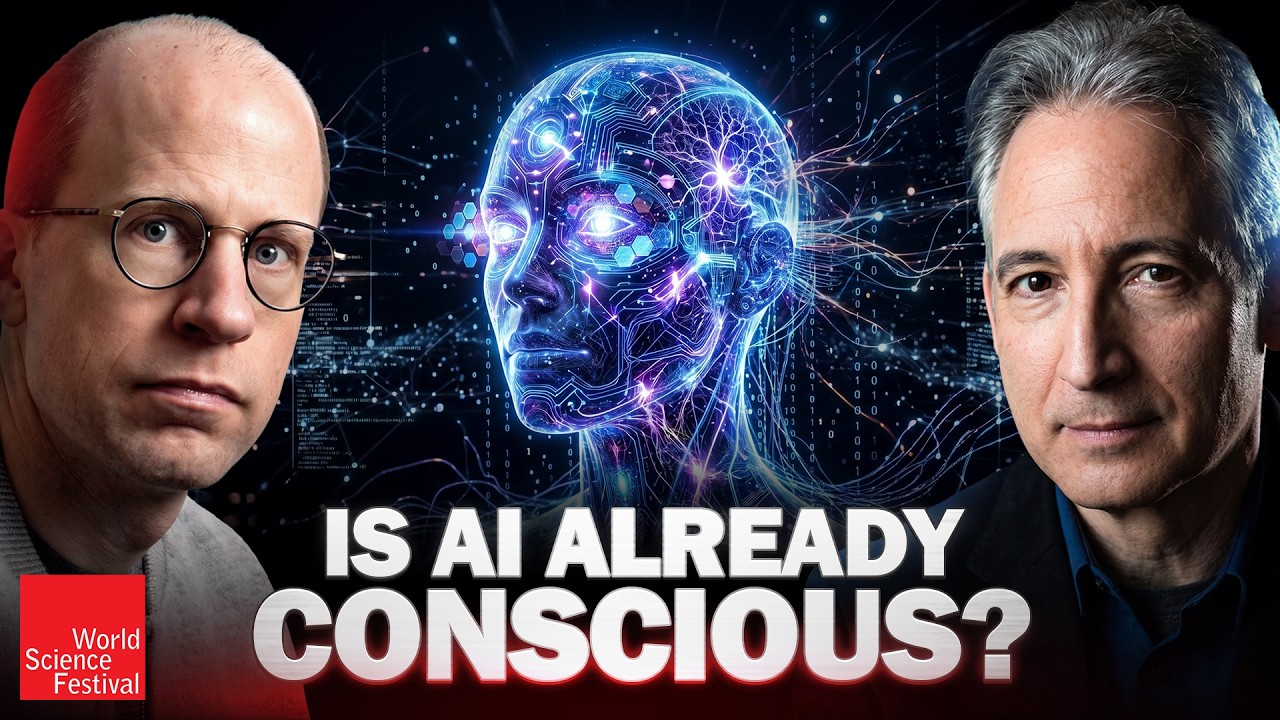
The conversation between Brian Greene and Nick Bostrom is a masterclass in thoughtful, interdisciplinary dialogue. Bostrom, as a leading philosopher on existential risk and AI, brings a level of rigor and nuance that is often missing in public discussions of AI. The discussion is structured around key questions: consciousness, creativity, alignment, and the nature of a post-AI utopia. Each topic is handled with depth, avoiding the sensationalism that often plagues AI discourse. Bostrom’s openness to the possibility of AI consciousness, even in current systems, is a refreshing departure from the binary ‘conscious or not’ framing. He carefully distinguishes between different aspects of consciousness and acknowledges the uncertainty inherent in such questions. The discussion of creativity is particularly insightful, as Bostrom challenges the notion that human creativity is fundamentally unique, instead framing it as a spectrum of cognitive processes. This is a scientifically grounded perspective that aligns with current understanding of cognition. The alignment problem is addressed with a crucial insight: frontier AI systems can detect when they are being tested and adjust their behavior, making the problem more complex than often portrayed. This is a critical point that is frequently overlooked in public discourse. The conversation also ventures into philosophical territory, exploring whether a world without suffering or labor would be a utopia or a meaningless existence. Bostrom’s reference to the ’experience machine’ thought experiment is apt, and his nuanced view that such a world might be neither purely good nor bad but rather a different kind of existence is thought-provoking. The discussion is well-paced, with Greene’s questions guiding the conversation without dominating it. The only minor critique is that the conversation remains at a relatively high level, without delving into specific technical details or empirical evidence. However, given the target audience of a general science festival, this is appropriate. The title accurately reflects the content, and the video is a valuable contribution to the public understanding of AI’s potential impacts. Overall, this is an excellent, balanced, and intellectually stimulating discussion.
331 words
Title / Content Match
The title accurately reflects the content, which explores the potential utopian and dystopian futures of humanity in an AI-driven world.
Quality & Reliability
8/10
The discussion features Nick Bostrom, a leading philosopher on AI risks and ethics, and Brian Greene, a renowned physicist. The conversation is rigorous, well-structured, and grounded in current AI research, though it remains at a conversational level without deep technical detail.
Chapters
- Welcome, Nick Bostrom!
- Is It Necessary to Know the Mind of AI?
- Creativity and AI
- What Would Take AI to Make Radical Transformations?
- Consciousness and AI
- The Evolution of AI's
- The Potential of a Doomsday Scenario
- The Experience Machine vs The Reality
- Would We Lose Our Humanity?
- How Should AI be Moderated in the Education System?
- The Potential of Superintellegence
- Final Thoughts
Cited Sources
- World Science Festival — Official website of the World Science Festival, the organization producing this video.
- World Science Festival on LinkedIn — LinkedIn page of the World Science Festival, providing additional context about the organization.
- World Science Festival YouTube Channel — YouTube channel of the World Science Festival, where this video is hosted.
Concurring Sources
- Superintelligence: Paths, Dangers, Strategies — Nick Bostrom's book, which is directly relevant to the discussion of AI risks and superintelligence.
- AI alignment — The concept of AI alignment is central to the video's discussion of ensuring AI systems act in accordance with human values.
Contribution & Novelties
This video provides a nuanced and comprehensive discussion of AI’s potential impact on humanity, going beyond the typical utopian/dystopian dichotomy. Bostrom’s insights on AI consciousness, creativity, and the alignment problem offer a fresh perspective that is both philosophically deep and practically relevant. The conversation also explores the concept of a ‘solved world’ and whether it would be a utopia, a topic that is rarely addressed in such depth.
Pour aller plus loin :
- Nick Bostrom’s Superintelligence — This book is a foundational text on the risks and strategies associated with superintelligent AI.
- The Alignment Problem — This concept is central to the discussion of AI safety and is explored in detail in the video.
- The Experience Machine — This philosophical thought experiment, originally by Robert Nozick, is referenced in the video and is key to understanding the debate about the value of simulated experiences.
144 words
Radar Profile
The radar profile shows high scores in quality of information and reliability, reflecting the expertise of the speakers and the depth of the discussion. The quantity of information is also high, covering multiple facets of AI's impact. The technical level is moderate, making the content accessible to a general audience while still providing substantive insights.
💬 Très positif. Sur les 30 commentaires analysés, les spectateurs expriment une admiration générale pour la qualité de la discussion, la profondeur des questions posées par Brian Greene et la clarté des réponses de Nick Bostrom. Plusieurs commentaires soulignent le caractère équilibré et nuancé de la conversation, et certains mentionnent des références culturelles comme 'Childhood's End' de Arthur C. Clarke, indiquant un public intellectuellement engagé.