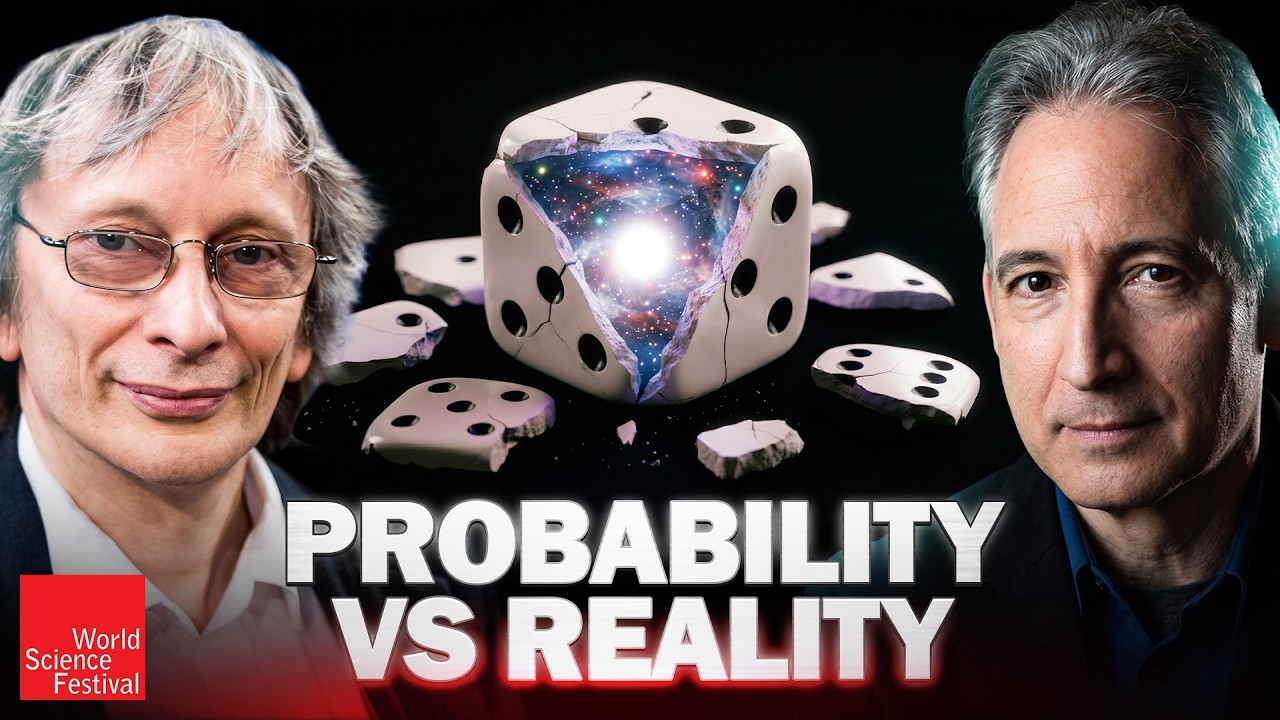
What Is Quantum Mechanics Really Telling Us? | World Science Festival
Keywords
Summary
189 words
Critical Evaluation
The conversation between Brian Greene and David Deutsch is a masterclass in the philosophy of quantum mechanics, offering a rigorous and thought-provoking exploration of the many-worlds interpretation (MWI). The value of the information is exceptionally high: the discussion is not a superficial overview but a deep dive into the conceptual foundations of quantum theory, addressing subtle issues such as the nature of probability, the role of the wave function, and the compatibility of free will with determinism. The argumentation is solid and well-structured, with Deutsch presenting a coherent and compelling case for the MWI, grounded in the logic of the theory itself. He effectively critiques alternative interpretations, such as Bohr’s complementarity, by pointing out their logical inconsistencies and their failure to provide a complete description of reality. The scientific rigor is evident in the careful distinction between the Schrödinger and Heisenberg pictures, and in the use of decision theory to address the problem of probability in a deterministic multiverse. The sources cited are appropriate, including references to the work of David Albert and David Wallace, who are prominent defenders of the MWI. The adéquation between the title and content is excellent: the title poses a profound question, and the conversation directly addresses it by examining what quantum mechanics truly implies about reality. The only minor weakness is that the discussion is heavily weighted toward Deutsch’s perspective, with Greene serving more as a facilitator than a critical interlocutor. However, this is not a flaw but a reflection of the format, which allows for a deep exposition of a particular viewpoint. Overall, this is an outstanding contribution to public understanding of quantum foundations, and it is likely to stimulate further interest and debate.
281 words
Title / Content Match
The title accurately reflects the content: a deep dive into what quantum mechanics implies about reality, focusing on the many-worlds interpretation and its implications for probability and free will.
Quality & Reliability
9/10
Discussion between two renowned physicists (Brian Greene and David Deutsch) on the foundations of quantum mechanics, particularly the many-worlds interpretation. The content is rigorous, well-argued, and grounded in established physics, though it reflects the personal views of the speakers. The video is produced by a reputable organization (World Science Festival) and includes references to academic work (e.g., by David Albert and David Wallace).
Chapters
- Rethinking Reality: What’s Actually Real?
- From Classical to Quantum: When Things Stop Making Sense
- What’s Wrong with Probability in Physics?
- Determinism vs Randomness (What’s Really True?)
- The Multiverse Explained (Many Worlds Theory)
- Do Multiple Versions of You Really Exist?
- Probability Without Chance
- When Decision Theory Meets Quantum Physics
- How Do You Make Choices in a Quantum World?
- Betting on Reality (How Decisions Actually Work)
- Is Probability Even Real?
- Thought Experiments That Break Your Intuition
- Common Misunderstandings About the Multiverse
- The “Quantum Suicide” Idea (And Why It’s Dangerous)
- Probability as a Tool, Not Something Real
- Responding to Critics (Albert & Wallace)
- What Does It Mean to Be Rational?
- The Mistake People Make About “Versions” of Themselves
- Free Will vs Physics: Do We Really Choose?
- Why It Feels Like We Have Control
- Different Levels of Reality (And Why They Matter)
- Constructor Theory Explained
- Final Thoughts: Adapting to a Stranger Universe
Cited Sources
- World Science Festival — Official website of the World Science Festival, the organization producing this video.
- World Science Festival on LinkedIn — LinkedIn page of the World Science Festival, providing additional information about the organization.
Concurring Sources
- Many-worlds interpretation - Wikipedia — Provides a general overview of the many-worlds interpretation, which aligns with the views expressed in the video.
Dissenting Sources
- Copenhagen interpretation - Wikipedia — The Copenhagen interpretation, which is the traditional alternative to the many-worlds interpretation, is criticized in the video for its reliance on wave function collapse and its instrumentalist approach.
Contribution & Novelties
This video offers a unique and in-depth discussion of the many-worlds interpretation of quantum mechanics, featuring two leading physicists. It provides a clear articulation of why the MWI is a natural consequence of taking quantum mechanics seriously, and it addresses the often-misunderstood issue of probability in a deterministic multiverse. Deutsch’s introduction of constructor theory as a potential new foundation for physics is a novel contribution that goes beyond standard discussions.
Pour aller plus loin :
- Many-worlds interpretation - Wikipedia — Provides a comprehensive overview of the MWI, its history, and its philosophical implications.
- David Deutsch - Wikipedia — Background on David Deutsch, including his contributions to quantum computing and constructor theory.
- Constructor theory - Wikipedia — Explains the framework of constructor theory, which Deutsch discusses as a potential new approach to physics.
- Quantum decision theory - Wikipedia — Relevant to the discussion of decision theory in the context of quantum mechanics.
151 words
Radar Profile
The radar profile shows high scores across all dimensions, indicating a video that is rich in information, technically deep, and highly reliable. The balance between quantity and quality of information is excellent, and the technical level is appropriate for an audience with some background in physics.
💬 Très positif. Sur les 30 commentaires analysés, les spectateurs expriment une admiration unanime pour la discussion, saluant la profondeur des échanges et la clarté des explications, avec un enthousiasme particulier pour la présence de David Deutsch.