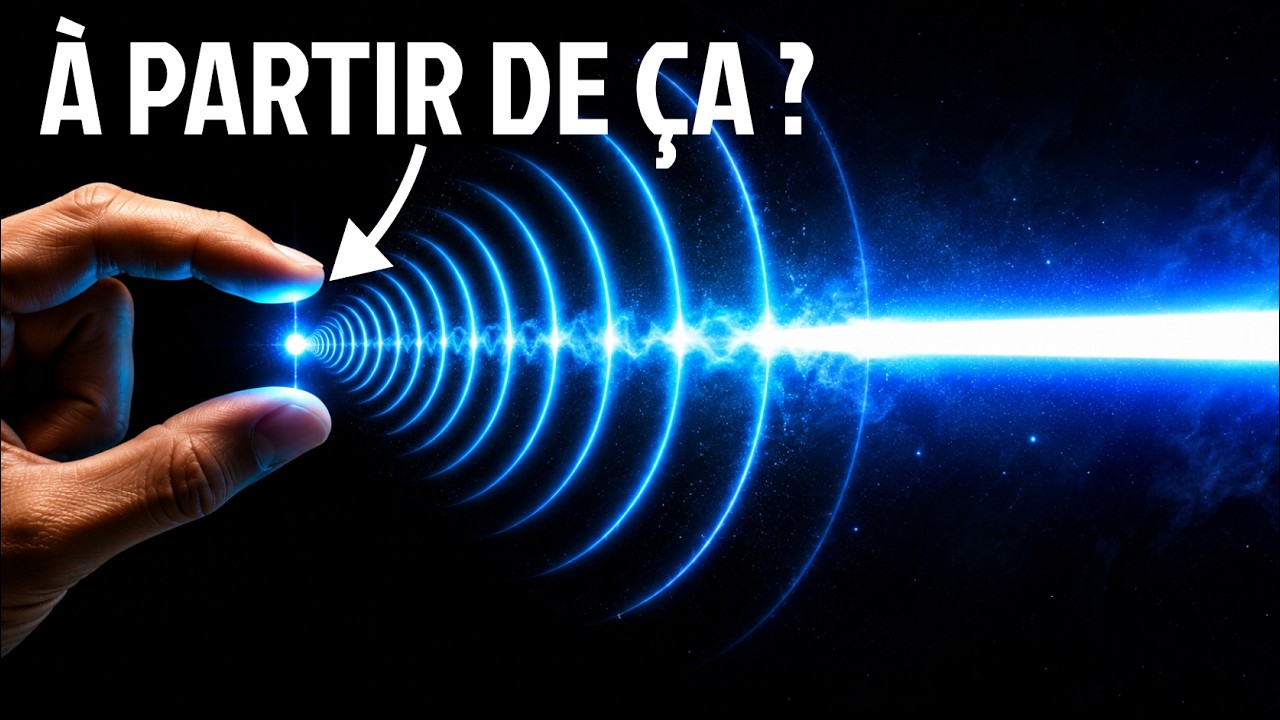
D'où Vient VRAIMENT la Lumière ?
Keywords
Summary
183 words
Critical Evaluation
Value of the Information & Strength of the Argument
The video’s primary value lies in its clear, step-by-step geometric derivation of radiation from accelerated charges, a topic often treated only mathematically in textbooks. It successfully builds intuition by using field line diagrams and similar triangles to derive the transverse electric field’s dependence on acceleration and distance. The argumentation is solid, logically progressing from static fields to accelerated motion, and it correctly identifies the key physical concepts: the retarded time and the distinction between near-field (Coulomb) and far-field (radiation) components. The historical narrative, from Faraday to Maxwell, is accurate and enriches the explanation. The video does not oversimplify; it acknowledges the subtlety of the kink construction and provides a rigorous, albeit accessible, derivation.
Scientific Rigor, Source Quality, Title Accuracy
The video demonstrates high scientific rigor by grounding its explanation in well-established physics. It explicitly cites primary sources: J.J. Thomson’s ‘Electricity and Matter’ (1904), a modern derivation by H. Padmanabhan (2009), and standard textbooks like Purcell & Morin and Jackson. The historical account of Maxwell’s work and Hertz’s confirmation is accurate. The title ‘D’où Vient VRAIMENT la Lumière ?’ is well-matched to the content, as the video indeed explains the true origin of light as electromagnetic radiation from accelerated charges. The video’s approach is faithful to the historical development, which adds to its credibility.
222 words
Title / Content Match
The title accurately reflects the content: the video explains the origin of light as electromagnetic radiation from accelerated charges, delving into the mechanism behind it.
Quality & Reliability
9/10
The video provides a rigorous, historically grounded derivation of radiation from accelerated charges, using the geometric construction of J.J. Thomson and Feynman, and correctly cites primary sources (Thomson 1904, Padmanabhan 2009, Purcell & Morin 2013, Jackson 1999). The explanation is physically accurate and avoids oversimplification, making it highly reliable for educational purposes.
Key Moments
Markers derived by PSI from the transcript: the creator did not define chapters.
- Introduction to electric field representation using test charges and field lines.
- Demonstration of the 'kink' in field lines when a charge accelerates, introducing the concept of a propagating perturbation.
- Geometric derivation of the transverse electric field component using similar triangles, showing its 1/r dependence.
- Discussion of the retarded time and its implications for the field at a distance.
- Explanation of oscillating charges producing electromagnetic waves with perpendicular E and B fields.
- Historical context: the atomic stability problem and Bohr's quantum postulates as a response to radiation from orbiting electrons.
- Maxwell's equations and the prediction that light is an electromagnetic wave, confirmed by Hertz.
Cited Sources
- Electricity and Matter — J.J. Thomson's 1904 book presenting the geometric construction of the kink in field lines.
- A Simple Derivation of the Electromagnetic Field of an Arbitrarily Moving Charge — Modern derivation of the fields of a moving charge, cited as a reference for the geometric approach.
- Electricity and Magnetism, 3rd edition — Purcell and Morin's textbook, specifically Appendix H on radiation by an accelerated charge.
- Theoretical Astrophysics: Astrophysical Processes, volume 1 — Padmanabhan's textbook, chapter 4, covering radiation processes.
- Classical Electrodynamics, 3rd edition — Jackson's standard graduate textbook, chapter 14, on radiation from accelerated charges.
Concurring Sources
- The Feynman Lectures on Physics, Vol. I, Ch. 28 — Feynman's presentation of the same geometric argument for radiation from accelerated charges.
- Purcell, E.M., Morin, D.J. (2013). Electricity and Magnetism, 3rd ed., Appendix H — Textbook treatment of radiation by an accelerated charge, consistent with the video's derivation.
- Jackson, J.D. (1999). Classical Electrodynamics, 3rd ed., Ch. 14 — Standard graduate-level treatment of radiation from accelerated charges, confirming the physics.
Dissenting Sources
- Quantum mechanics interpretation of atomic stability — The video presents Bohr's model as a 'patch' to explain atomic stability, but modern quantum mechanics provides a more fundamental explanation based on wavefunctions and quantized energy levels. This is not a contradiction but a deeper layer of understanding.
Contribution & Novelties
The video’s original contribution is its pedagogical approach: it revives and clearly explains the geometric derivation of radiation from accelerated charges, a method often omitted in favor of purely mathematical treatments. This provides deep physical intuition for why accelerated charges radiate and how the radiation field emerges from the geometry of field lines. It bridges the gap between qualitative explanations and the full Maxwell equations.
Pour aller plus loin :
- Liénard-Wiechert potentials — These potentials describe the exact electromagnetic field of a moving point charge, providing the rigorous foundation for the geometric derivation.
- Jefimenko’s equations — These equations give the electric and magnetic fields directly in terms of the charge and current distributions, incorporating retardation effects.
- Maxwell’s equations — The fundamental equations governing electromagnetism, whose solution predicts electromagnetic waves.
- Dipole antenna — A practical application of the principle that accelerated charges radiate, as used in radio transmission.
147 words
Radar Profile
The radar profile shows very high scores in information quality and reliability, with slightly lower but still strong scores in information quantity and technical level. This indicates a video that is both accurate and rich in content, though it may require some prior physics knowledge to fully appreciate the technical depth.
💬 Sur les 0 commentaires analysés, aucune tendance n'est disponible.