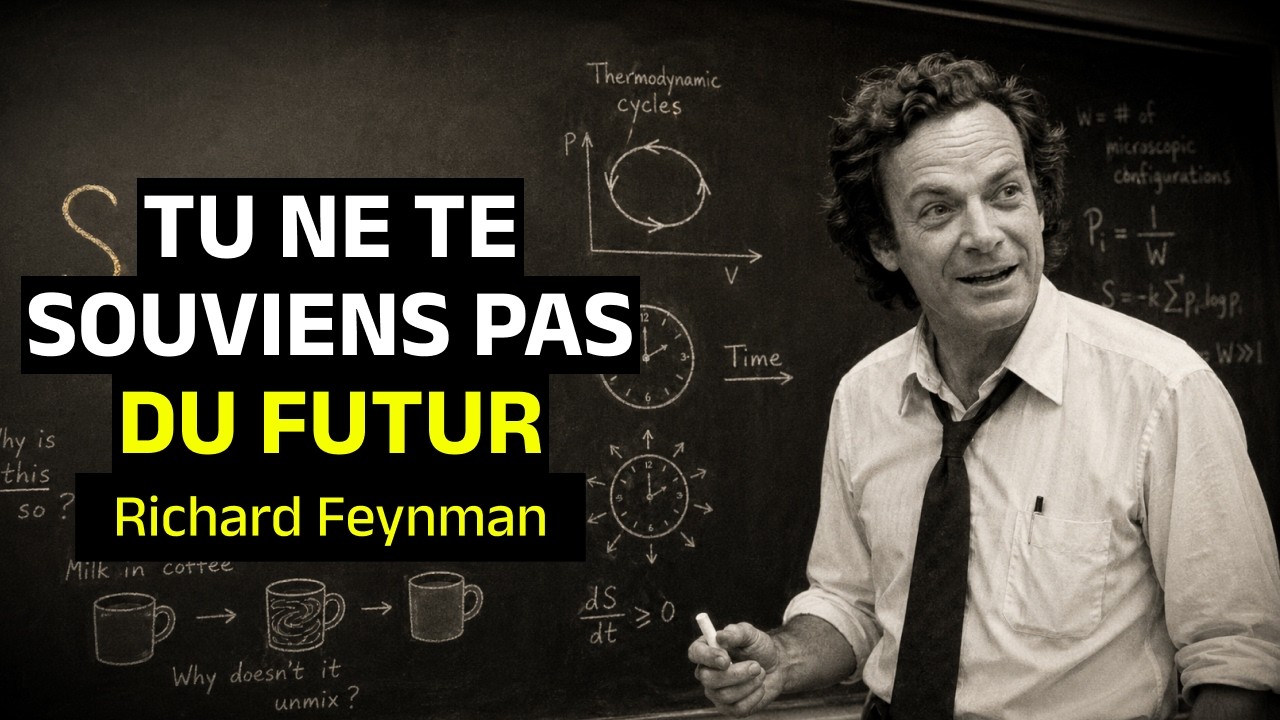
Pourquoi TU NE TE SOUVIENS PAS du futur ? — La découverte qui a tué un physicien
Keywords
Summary
155 words
Critical Evaluation
Value of the Information & Strength of the Argument
The video provides a compelling and accessible explanation of a complex topic, using analogies like the house becoming a ruin to illustrate entropy. It effectively argues that the arrow of time is not a fundamental law but a consequence of the universe’s initial low-entropy state. The narrative is well-structured, building from the paradox of time-reversible laws to the statistical explanation and the cosmological hypothesis. However, the argumentation sometimes relies on rhetorical flourishes and dramatization, which may oversimplify the scientific nuances. The inclusion of Boltzmann’s personal story adds emotional weight but also risks conflating scientific history with tragedy.
Scientific Rigor, Source Quality, Title Accuracy
The video cites several authoritative sources, including Feynman’s lectures and Penrose’s work, and provides a link to the Feynman Lectures website. However, it does not provide direct citations for all claims, and the disclaimer that 85% of the content is faithful to Feynman’s ideas suggests some creative liberty. The title is somewhat sensational but accurately reflects the content’s focus on memory and the arrow of time. The video’s scientific rigor is generally good, but the dramatization of Boltzmann’s life and the lack of precise references for some statements slightly undermine its scholarly value.
205 words
Title / Content Match
The title is engaging and accurately reflects the video's focus on the arrow of time and memory, though it sensationalizes the connection to Boltzmann's death.
Quality & Reliability
7/10
The video presents a generally accurate account of the arrow of time problem, entropy, and the contributions of Boltzmann and Feynman, but includes dramatized elements and a disclaimer that 85% is faithful to Feynman's ideas. The scientific content is sound, but the narrative style and lack of precise citations for all claims reduce the score.
Key Moments
Markers derived by PSI from the transcript: the creator did not define chapters.
- Introduction to the paradox: laws of physics are time-symmetric, but our experience is not.
- Explanation of entropy with the house analogy: order vs. disorder.
- Discussion of Feynman's 1964 Messenger Lecture and the 'Past Hypothesis'.
- Introduction of Boltzmann's equation S = k log W and his tragic story.
- Connection between memory and the universe's initial low entropy.
- Cosmic perspective: the universe's evolution from order to disorder.
- Reflection on memory as an act of resistance against entropy.
- Conclusion: the arrow of time is a result of cosmic initial conditions.
Cited Sources
- The Feynman Lectures on Physics, Vol. I — Reference for Feynman's lectures, particularly the chapter on ratchet and pawl, and the general discussion of entropy.
Concurring Sources
- The Character of Physical Law — Feynman's book based on the Messenger Lectures, which the video references for the discussion on the distinction of past and future.
- The Road to Reality — Penrose's book, which includes the calculation of the improbability of the universe's initial low entropy.
Contribution & Novelties
The video offers a fresh, narrative-driven approach to explaining the arrow of time, making complex physics accessible through storytelling. It effectively connects the abstract concept of entropy to personal experiences like memory and loss, providing a unique emotional perspective. The inclusion of Boltzmann’s tragic history adds a human dimension often missing in scientific discussions.
Pour aller plus loin :
- Arrow of time — Overview of the concept and its various aspects.
- Entropy — Detailed explanation of entropy in thermodynamics and statistical mechanics.
- Ludwig Boltzmann — Biography and contributions to statistical mechanics.
- Past Hypothesis — Discussion of the hypothesis that the universe began in a low-entropy state.
106 words
Radar Profile
The radar profile shows high scores in information quantity and quality, reflecting the video's rich content and accurate scientific basis. The technical level is moderate, indicating accessibility to a general audience. The overall reliability is good, but the dramatization and lack of precise citations for all claims slightly reduce the score.
💬 Sur les 0 commentaires analysés, aucune tendance n'a pu être dégagée.