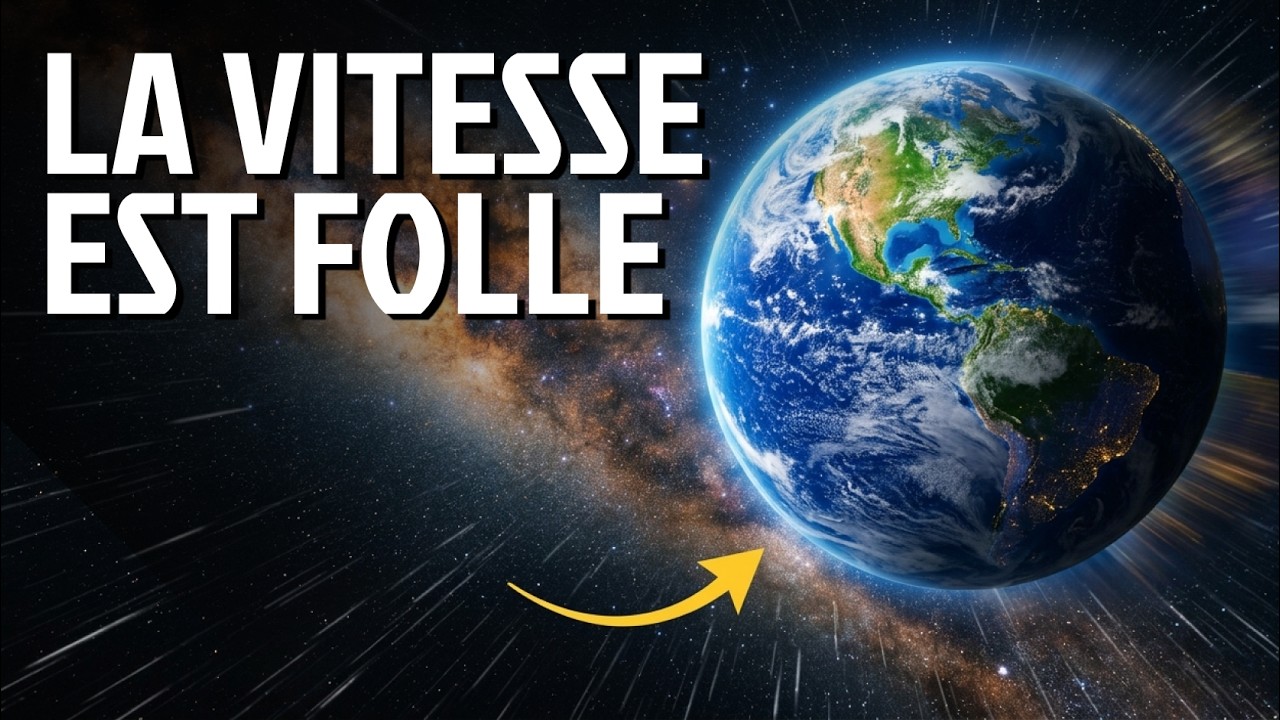
À Quelle Vitesse Voyageons-nous Réellement à Travers l’Univers ?
Keywords
Summary
172 words
Critical Evaluation
Value of the Information & Strength of the Argument
The video provides a comprehensive and accessible overview of the different scales of motion, effectively using analogies (e.g., comparing the Milky Way to France) to convey vast distances. The argumentation is logically structured, building from Earth’s rotation to the universe’s expansion. It successfully conveys the relativity of motion and the historical development of our understanding. However, it sometimes oversimplifies complex concepts and lacks in-depth discussion of the underlying physics, such as the mechanisms of dark energy.
Scientific Rigor, Source Quality, Title Accuracy
The video does not cite specific sources within the narration, but the description mentions general topics. The historical accounts (Copernicus, Galileo) are accurate, and the scientific facts (speeds, distances) are generally correct, though some figures are rounded. The title accurately reflects the content, and the video stays on topic throughout. The lack of explicit citations reduces its scientific rigor, but the information is presented in a way that aligns with established astronomical knowledge.
164 words
Title / Content Match
The title accurately reflects the content, which systematically explores the various motions of Earth through the universe.
Quality & Reliability
7/10
The video presents established astronomical facts and historical context with reasonable accuracy, but lacks citations to primary sources and contains minor imprecisions (e.g., speed of sound at sea level). The narrative is engaging but not peer-reviewed.
Key Moments
Markers derived by PSI from the transcript: the creator did not define chapters.
- Introduction: the illusion of stillness and the concept of Earth's motion.
- Historical shift: Copernicus, Kepler, and Galileo's contributions to heliocentrism.
- Earth's rotation speed: 1670 km/h at the equator, 1100 km/h in Paris.
- Earth's orbital speed around the Sun: 107,000 km/h, compared to Voyager 1.
- The Solar System's orbit around the Milky Way: 828,000 km/h, and the concept of a galactic year.
- The motion of the Milky Way within the Local Group and towards the Great Attractor.
- The cosmic microwave background as a reference frame and the discovery by Penzias and Wilson.
- The expansion of the universe and dark energy, concluding that all motion is relative.
Concurring Sources
- Earth's rotation speed — Confirms the equatorial rotation speed of approximately 1670 km/h.
- Earth's orbital speed — Confirms the average orbital speed of about 107,000 km/h.
- Solar System's galactic orbit — Mentions the orbital speed of the Solar System around the galactic center.
Contribution & Novelties
The video synthesizes known astronomical facts into a coherent narrative about cosmic motion, making it accessible to a general audience. It effectively illustrates the relativity of motion and the vast scales involved. For those interested in going further, the following resources are relevant:
Pour aller plus loin :
- Cosmic microwave background — Provides detailed information on the CMB, its discovery, and its significance.
- Galactic year — Explains the concept of the Solar System’s orbit around the galactic center.
- Great Attractor — Discusses the gravitational anomaly and its role in galaxy motion.
- Expansion of the universe — Covers the discovery and implications of cosmic expansion.
- Dark energy — Provides an overview of dark energy and its role in accelerating expansion.
119 words
Radar Profile
The radar profile shows high scores in information quantity and quality, with moderate technical depth and reliability. This indicates a well-structured documentary that is informative and generally accurate, but not highly technical or heavily sourced.
💬 No comments were provided for analysis.