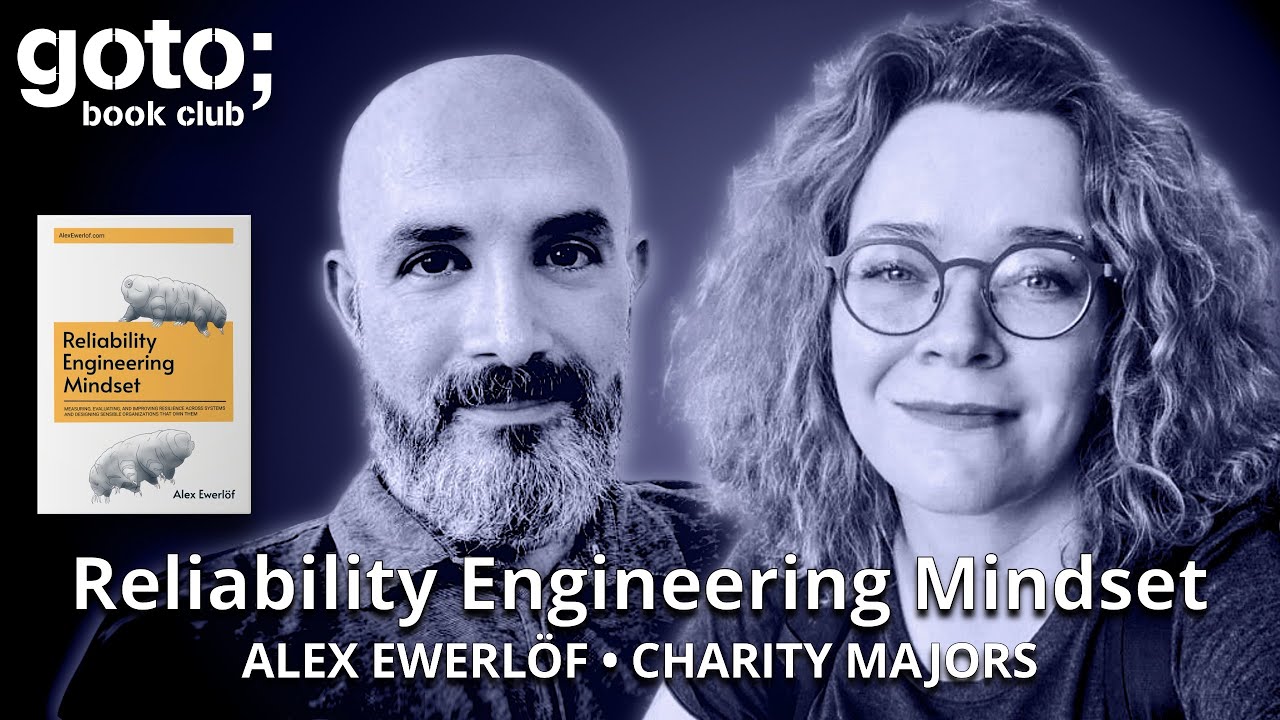
Reliability Engineering Mindset • Alex Ewerlöf & Charity Majors • GOTO 2025
Keywords
Summary
128 words
Critical Evaluation
The interview provides valuable insights into the practical application of reliability engineering, particularly the challenges of scaling SRE practices in large organizations. Alex Ewerlöf’s experience at Volvo Cars, where he implemented SLIs and SLOs across hundreds of teams, lends credibility to his advice. He effectively critiques the ‘best practice’ mentality, advocating for context-specific ‘fit practices’. The discussion on the gap between Google’s SRE model and the reality of most companies is particularly insightful, highlighting the need for platform engineering as a foundation. Charity Majors adds depth with her perspective on observability and the importance of connecting feedback loops. The conversation is well-structured and avoids oversimplification, acknowledging the nuances of reliability engineering. However, the content is primarily opinion-based, lacking empirical data or case studies to support claims. The sources cited are relevant but mostly self-referential (the authors’ own books and blogs). The title accurately reflects the content, focusing on the mindset rather than technical details. Overall, the interview offers a thoughtful and practical perspective, but its reliance on anecdotal evidence limits its scientific rigor.
173 words
Title / Content Match
The title accurately reflects the content, which focuses on the mindset and practical aspects of reliability engineering.
Quality & Reliability
8/10
The interview features two experienced practitioners in reliability engineering, providing practical insights grounded in real-world experience. The discussion is balanced and critical of idealized practices, with references to their own works and industry resources. However, it is primarily opinion-based and lacks empirical data or formal studies.
Chapters
Cited Sources
- GOTO Book Club — The interview was recorded for the GOTO Book Club.
- Reliability Engineering Mindset (book) — Alex Ewerlöf's book discussed in the interview.
- Alex Ewerlöf's website — Author's personal website.
- Charity Majors' blog — Charity Majors' blog on observability and engineering.
- Honeycomb blog: SLOs are the API for your engineering team — Article by Charity Majors on SLOs.
- Full transcription of the interview — Transcription of this interview.
Concurring Sources
- Google SRE Book — The interview discusses Google's SRE practices, which are documented in this book.
- Honeycomb blog: SLOs are the API for your engineering team — Charity Majors' article aligns with the discussion on SLOs.
External References
Contribution & Novelties
The interview offers a practical perspective on implementing SRE practices in non-Google environments, emphasizing the importance of context and ‘fit practice’. Alex Ewerlöf’s framework for identifying meaningful SLIs through dependency analysis is a novel contribution. The discussion also highlights the role of platform engineering as a prerequisite for effective SRE.
Pour aller plus loin :
- Site Reliability Engineering (book) — The foundational Google SRE book, referenced in the interview.
- Observability Engineering (book) — Charity Majors’ book on observability.
- The Four Golden Signals — Concept discussed in the interview, from the Google SRE book.
- Platform Engineering — Community and resources on platform engineering, relevant to the discussion.
106 words
Radar Profile
The radar profile shows high scores in quality of information and reliability, reflecting the expertise of the speakers. The quantity of information is moderate, as the interview is relatively short and focused on high-level concepts. The technical level is high, but accessible to a professional audience.