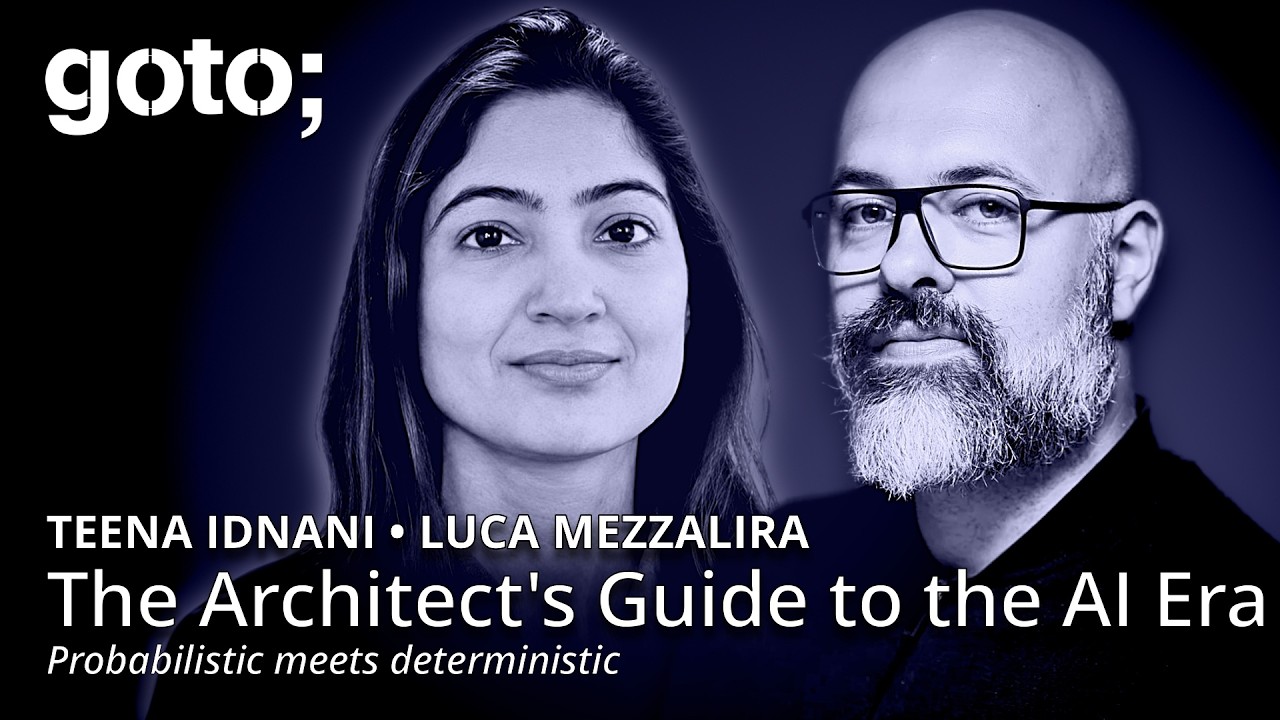
The Architect's Guide to the AI Era
Keywords
Summary
183 words
Critical Evaluation
The interview provides a thoughtful and balanced perspective on the evolving role of software architects in the AI era. Both speakers bring substantial practical experience, and their insights are grounded in real-world scenarios, such as Luca’s anecdote about an over-engineered Lambda function. The discussion is well-structured, covering key aspects like the acceleration of research, the risks of AI-generated code, and the importance of combining deterministic and probabilistic approaches. However, the content is largely anecdotal and lacks empirical evidence or references to specific studies or frameworks. The speakers make valid points about the need for architects to understand business context and maintain engineering judgment, but these are presented as opinions rather than supported by data. The concept of the ‘M-shaped’ architect is interesting but not deeply explored, and the discussion on harness engineering is brief. The interview would benefit from more concrete examples and references to existing literature or industry practices. The adéquation between title and content is strong, as the conversation directly addresses the challenges and opportunities for architects with AI. Overall, the interview offers valuable insights for practitioners but could be enhanced with more rigorous evidence and deeper exploration of the concepts introduced.
194 words
Title / Content Match
The title accurately reflects the content, which focuses on how software architects can adapt to AI.
Quality & Reliability
7/10
The speakers are experienced solutions architects with practical insights, but the discussion is largely anecdotal and lacks empirical evidence or citations. The content is coherent and aligns with industry trends, but the reliability is moderate due to the absence of formal references.
Chapters
Cited Sources
- GOTO Unscripted article — Related article on GOTO Unscripted
- Luca Mezzalira's website — Speaker's personal website
- Building Micro-Frontends — Luca Mezzalira's book website
- Luca Mezzalira on LinkedIn — Speaker's LinkedIn profile
- Teena Idnani on LinkedIn — Speaker's LinkedIn profile
Concurring Sources
- GOTO Unscripted article — Related article on GOTO Unscripted
External References
Contribution & Novelties
The interview offers a practical perspective on how AI is reshaping the role of software architects, introducing the ‘M-shaped’ architect concept and emphasizing the need to blend deterministic and probabilistic systems. It provides actionable advice on using AI as a research accelerator while maintaining engineering judgment.
Pour aller plus loin :
- Harness engineering — A concept mentioned in the discussion for guiding AI with specifications and feedback.
- T-shaped skills — The traditional model of skills that the speakers contrast with the ‘M-shaped’ approach.
- Pareto principle — Referenced in the discussion about the 80/20 rule in software development.
97 words
Radar Profile
The radar profile shows a balanced distribution across the scores, with slightly higher scores in quantity and quality of information, and lower scores in technical depth and reliability. This reflects a discussion that is informative and practical but lacks deep technical detail and formal evidence.