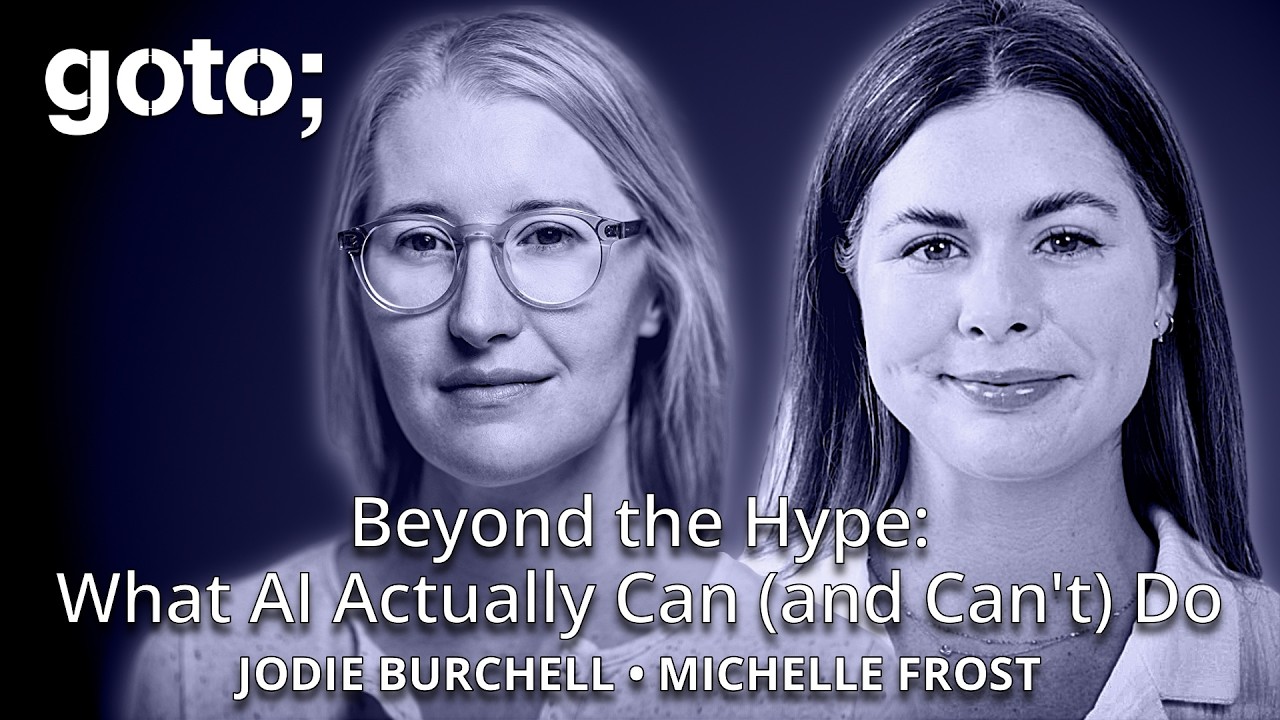
Beyond the Hype: What AI Actually Can (and Can't) Do • Jodie Burchell & Michelle Frost • GOTO 2026
Keywords
Summary
180 words
Critical Evaluation
The interview provides a valuable, measured perspective on AI, grounded in the speakers’ extensive experience. Jodie Burchell’s background in clinical psychology and biostatistics lends credibility to her emphasis on scientific rigor and measurement. Michelle Frost’s expertise in AI ethics and fairness adds depth to the discussion of bias and governance. The conversation successfully demystifies AI by distinguishing between generative AI and classical machine learning, a crucial clarification often missing in public discourse. The argument for retaining foundational ML knowledge is well-articulated, using a concrete RAG example to demonstrate that data quality and domain expertise are indispensable. The discussion on AI ethics is nuanced, acknowledging the mathematical complexity of fairness and the socio-technical nature of the problem. The historical parallels to AI bubbles are insightful, providing context for current hype. However, the interview is largely opinion-based, with few direct citations to specific studies or papers. While the speakers reference research on developer productivity, they do not provide specific data or sources, limiting the ability to verify claims. The conversation is engaging and accessible, but it may lack the depth required for a purely scientific audience. The adéquation between title and content is strong, as the discussion indeed explores AI’s capabilities and limitations. Overall, the interview offers a thoughtful, expert perspective, but its reliance on anecdotal evidence and lack of systematic citations slightly diminish its scientific rigor.
225 words
Title / Content Match
The title accurately reflects the content: a measured discussion on AI's capabilities and limitations.
Quality & Reliability
8/10
The speakers are experienced data scientists and AI advocates with backgrounds in psychology, biostatistics, and AI ethics. They reference research and provide nuanced perspectives, but the discussion is largely opinion-based and lacks systematic citations.
Chapters
Cited Sources
- AI with Michelle — Michelle Frost's website, likely containing her talks and articles on AI ethics.
- arXiv paper 1911.01547 — A paper referenced in the description, possibly related to AI or NLP.
- Stanford Software Engineering Productivity — Research on developer productivity, likely referenced in the discussion.
- GOTO Unscripted article — Associated article for this interview.
Concurring Sources
- AI with Michelle — Michelle Frost's work on AI ethics aligns with the discussion.
- Stanford Software Engineering Productivity — Research on developer productivity, supporting the discussion on AI's impact.
External References
Contribution & Novelties
The interview offers a refreshingly balanced perspective on AI, emphasizing the importance of distinguishing between generative AI and classical machine learning. It highlights the enduring relevance of foundational ML knowledge and the socio-technical complexities of AI ethics. The historical context of AI bubbles provides a useful framework for understanding current hype.
Pour aller plus loin :
- AI winter — Historical periods of reduced funding and interest in AI, relevant to the discussion of AI bubbles.
- Transformer architecture — The foundational architecture behind most generative AI models, central to the conversation.
- Fairness in machine learning — Overview of fairness definitions and challenges, directly related to Michelle’s expertise.
- Retrieval-augmented generation (RAG) — The technique discussed as an example of a seemingly simple AI application that still requires careful data handling.
128 words
Radar Profile
The radar profile shows strong scores in quality of information and reliability, reflecting the speakers' expertise and measured tone. The quantity of information is moderate, and the technical level is accessible, making it suitable for a broad audience. The overall balance suggests a trustworthy but not deeply technical discussion.